
Humanoid Robotics: From Home Hype to Industrial Reality
The hype around humanoid robotics has long been confined to the realm of sci-fi and speculative futurism. But in 2025, the narrative is shifting. Industrial adoption-once a distant promise-is now the tangible inflection point driving investment in this sector. With market valuations surging, major automakers piloting humanoids on factory floors, and venture capital flooding the space, the transition from "home hype" to "industrial reality" is accelerating. For investors, this marks a pivotal moment: the industrial applications of humanoid robotics are no longer theoretical. They are here, and they are reshaping the future of automation.
The Industrial Market: A $66 Billion Inflection Point by 2032
The global humanoid robotics market is on a meteoric trajectory. According to a report by MarketsandMarkets, the market was valued at $2.43 billion in 2023 and is projected to grow to $3.28 billion in 2024, with a compound annual growth rate (CAGR) of 45.5% through 2032, reaching $66.0 billion by then. BCC Research forecasts an even steeper ascent, predicting a CAGR of 42.8% through 2030, with the market expanding from $1.9 billion in 2025 to $11 billion by 2030. These figures are not just numbers-they signal a seismic shift in how industries approach automation.
The hardware segment, in particular, is dominating growth. Sensors, actuators, and control systems are enabling humanoids to perform tasks requiring advanced mobility and interaction. For example, Tesla's Optimus Gen 2 and Agility Robotics' Digit are already demonstrating capabilities in logistics and assembly lines, with Digit recently moving 100,000 totes at GXO Logistics' distribution center without requiring major infrastructure changes. Such real-world deployments validate the scalability of humanoid robotics in industrial settings.
Capital Flows: A $7.3 Billion Surge in H1 2025
Investor confidence is translating into action. In H1 2025 alone, deal value surged to $7.3 billion. Startups like Figure AI, which raised $675 million in 2024, have since surpassed $1 billion in committed capital and achieved a $39 billion valuation. Tether Investments' recent backing of Generative Bionics further underscores the sector's appeal, with the firm aiming to develop "intelligent humanoid robots for industrial-scale performance".
Government funding is also accelerating adoption. China's industrial robotics market recorded sales exceeding 80,000 units in Q3 2025, while Beijing's $1.4 billion robotics fund and Canada's $30 billion investment in Sanctuary Cognitive Systems highlight the strategic importance of this technology. These capital injections are not speculative-they are bets on a future where humanoids replace or augment labor in high-risk, repetitive, and precision-driven tasks.
Case Studies: BMW, Mercedes-Benz, and the Auto Industry's Robot Revolution
The automotive sector is leading the charge in industrial humanoid adoption. BMW, in collaboration with Figure AI, has deployed its Figure 02 and 03 models at its Spartanburg plant to perform tasks like inserting sheet metal parts with millimeter accuracy. These robots are trained via voice commands and imitation learning, reducing reliance on complex programming. Similarly, Mercedes-Benz is testing Apptronik's Apollo humanoid at its Berlin Digital Factory Campus to handle internal logistics, such as transporting components.
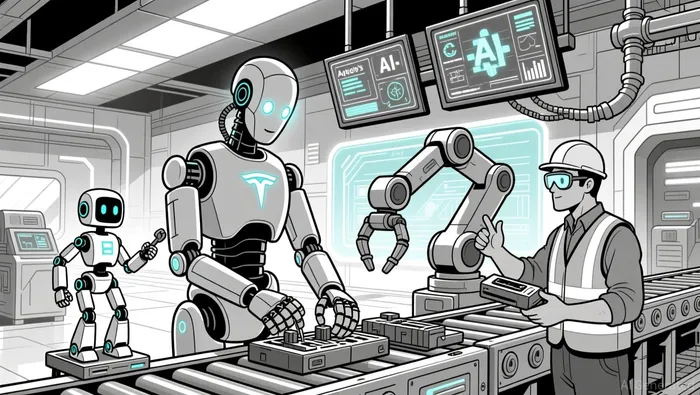
Tesla's ambitions are even more audacious. The company plans to produce 10 million Optimus units annually by 2027, with a dedicated facility at Gigafactory Texas. Optimus's five-fingered hands and neural network-based autonomy position it to disrupt tasks requiring fine motor control, from quality inspection to inventory management. FordF--, meanwhile, is leveraging collaborative robots (cobots) for precision tasks like engine block filling, using AI to retrain robots rapidly for changing product demands.
These case studies illustrate a broader trend: humanoids are not just augmenting labor-they are redefining it. By handling dangerous, dirty, or dull tasks, they free human workers to focus on creative and supervisory roles, aligning with Industry 5.0's vision of human-robot collaboration according to research.
Challenges and Mitigations: Costs, Ethics, and Regulation
Despite the momentum, challenges persist. High initial costs and ethical concerns over job displacement remain barriers. However, IDTechEx forecasts a steady decline in component and overall costs as production scales. For instance, logistics adoption could accelerate if humanoid prices drop to $20,000-a threshold that would make them cost-competitive with traditional automation. Regulatory frameworks are also evolving, with safety standards in healthcare and manufacturing sectors adapting to the rise of humanoids according to industry analysis.
The Investment Thesis: Why Industrial Adoption Is the Inflection Point
The convergence of AI, hardware innovation, and industrial demand creates a compelling investment thesis. Unlike consumer-facing humanoids, which face skepticism and limited use cases, industrial robots are solving real-world problems with measurable ROI. BMW's iFactory initiative, for example, has already demonstrated a 47% reduction in repetitive motion injuries through humanoid deployment. Similarly, Tesla's Optimus is projected to achieve a payback period of under two years in certain applications.
For investors, the key is to focus on companies with scalable industrial applications. Figure AI, Agility Robotics, and TeslaTSLA-- are not just building robots-they are building platforms for automation. As the market matures, firms that integrate AI-driven learning, modular hardware, and cross-industry adaptability will dominate.
Conclusion: The Future of Automation Is Humanoid
Humanoid robotics is no longer a speculative play. It is a $66 billion market by 2032, driven by industrial adoption and backed by $7.3 billion in H1 2025 investments. From BMW's precision assembly to Tesla's mass production ambitions, the sector is proving its value in real-time. For investors, the inflection point is clear: industrial humanoids are the next frontier of automation. The question is no longer if they will succeed-but how fast.







Comentarios
Aún no hay comentarios