
HubSpot's AI-Powered Resurgence: A Buying Opportunity in a Slowing Economy?
HubSpot (HUBS) has long been a poster child for the SaaS revolution, but its recent stumble in the stock market has created a rare opening for investors. Let's dig into why this AI-driven CRMCRM-- giant could be primed for a comeback—and why the dip might be a buying opportunity.
The AI Revolution: HubSpot's Secret Weapon
HubSpot's latest AI tools—like the Customer Agent (part of Service Hub) and Copilot (embedded in Content Hub)—are not just incremental upgrades. They're game-changers. Take this: Customer Agent resolved over 50% of support tickets autonomously, cutting resolution time by 39%. That's real operational efficiency, and it's exactly what businesses need in a cost-conscious economy.
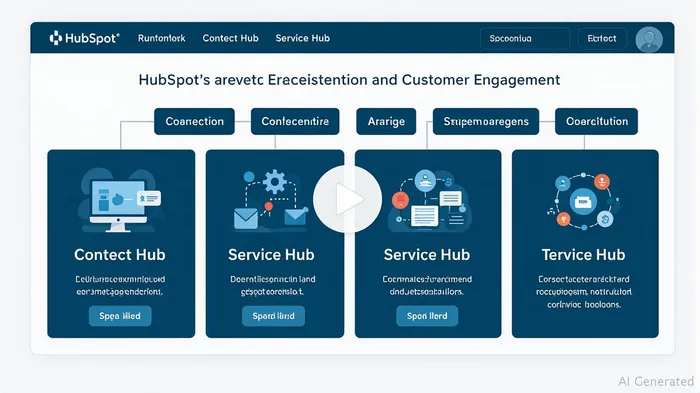
These innovations aren't just about saving time. They're about increasing platform stickiness. Over 250,000 businesses now use HubSpot's AI integrations, and with Copilot adoption doubling quarter-over-quarter, this is a flywheel effect in motion. The question is: Can these tools justify HubSpot's 11.27x price-to-sales ratio? Let's look at the numbers.
The Margin Makeover: 15% and Counting
HubSpot's Q2 results show it's finally hitting its stride. After a Q1 stumble where margins dipped to 14.0% (due to AI investments), management has turned the corner. Q2's non-GAAP operating margin is expected to hit 17%, with full-year guidance pointing to 18%. That's a 400-basis-point improvement from 2023, and it's no accident.
The secret? Operational leverage. By automating workflows and reducing customer service costs, HubSpotHUBS-- is proving that AI isn't just a cost center—it's a profit engine. Meanwhile, the $500M share buyback announced in May 2025 isn't just a shareholder-friendly move; it's a signal that management believes in the stock's long-term value.
The Near-Term Hurdles: Pricing Pressures and Skepticism
No free ride here. The 4% year-over-year decline in Average Subscription Revenue Per Customer (ARRPC) is a red flag. It suggests some SMBs are scaling back or opting for cheaper plans—a reality in an economy where small businesses are cost-sensitive.
Add to that the market's skepticism: HubSpot's stock has dropped 11.4% in the past three months, even as revenue guidance rose. Why? Investors are waiting to see if margin gains can outpace these pricing headwinds.
Why This Pullback is a Buying Opportunity
Here's why I'm bullish:
1. AI is working: The tools are real, the adoption is real, and the efficiency gains are real. The 39% ticket-resolution improvement isn't a one-off—it's a scalable model.
2. Margin momentum: Q2's 17% margin is a 200-basis-point beat over Q1, and full-year guidance suggests it's no fluke. This isn't a flash in the pan.
3. Valuation reset: At $582, HubSpot trades at a 25% discount to its $753 analyst price target. If margins hit 18%, the stock could surge—especially if ARRPC stabilizes.
The Bottom Line: A Long Game Worth Playing
HubSpot isn't just a SaaS company—it's a platform play. With 258,258 customers (up 19% year-over-year), it's building a network effect that rivals can't match. The AI tools aren't just a gimmick; they're the future of how businesses engage customers.
Yes, the near-term pricing issues are real, but they're manageable. The 15%+ margin target is achievable, and once achieved, the stock's valuation multiples could snap back. For investors with a 2–3-year horizon, this is a no-brainer.
Action Plan: Buy the dip. Set a target of $700+ by end of 2025 if margins hit 18%, and hold for the long-term platform thesis. This is a company that's nailing the AI transition—don't let short-term noise drown out the long game here.
Disclosure: This article is for informational purposes only and not financial advice. Always consult a financial advisor before making investments.





Comentarios
Aún no hay comentarios