
Huawei's "Supernode + Cluster" Strategy and Its Implications for 6G Infrastructure
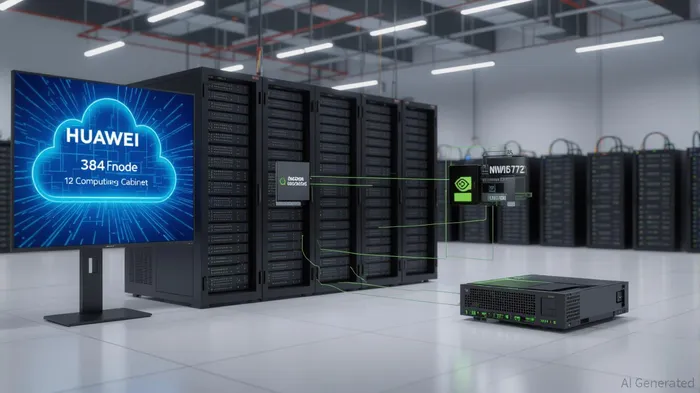
Huawei's “Supernode + Cluster” strategy represents a bold reimagining of 6G infrastructure, blending high-performance computing with AI-native network design. At the heart of this strategy is the CloudMatrix 384 Supernode, a system that leverages 384 Ascend 910C chips to deliver 300 petaflops of BF16 compute performance—surpassing Nvidia's NVL72 by 166%[2]. This system, developed in collaboration with China Telecom, is not merely a technical milestone but a strategic cornerstone for Huawei's vision of AI-driven 6G networks. By 2030, Huawei aims to commercialize 6G, with full implementation by 2035, positioning itself as a leader in an infrastructure landscape where AI will optimize connectivity for up to 100 billion devices[4].
Strategic Positioning in Next-Gen Telecom Ecosystems
Huawei's approach to 6G diverges sharply from incremental 5G improvements. As stated by Huawei's Wireless CTO, Dr. Wen Tong, 6G must embrace a “quantum leap” in AI integration, moving from service-based architectures to Application-Driven Networks (ADN)[1]. This shift implies a re-architecture of 6G cores, where AI is not just an optimization tool but a foundational element. For instance, Huawei's CloudMatrix 384 is already being used to train advanced AI models like Meta's LLaMA 3 and Alibaba's Qwen, achieving benchmarks of 750 tokens per second per card[3]. Such capabilities align with the telecom industry's 2025 trends, where AI-driven automation, predictive maintenance, and cloud-native infrastructure are reshaping operations[6].
The company's strategic partnerships further underscore its telecom ambitions. Collaborations with SMIC and TSMCTSM-- have enabled Huawei to circumvent U.S. export controls, producing 7nm chips for the Mate 60 Pro and 5.5G-enabled devices[4]. This vertical integration—bolstered by government-backed “national teams”—has strengthened China's semiconductor self-sufficiency, reducing reliance on foreign suppliers like Shin-Etsu Chemical and Dupont[5].
Semiconductor Ecosystem Dynamics and Competitive Responses
Huawei's semiconductor advancements have triggered a global response. NvidiaNVDA--, a key player in AI-RAN (Radio Access Network) technologies, now views Huawei as a “serious challenge,” particularly due to the latter's 3GPP submissions and AI-RAN 6G proposals, which promise double spectral efficiency[1]. Meanwhile, Huawei's development of CANN—a CUDA alternative—threatens to disrupt the AI software ecosystem by attracting global developers[1].
The U.S. has responded with heightened scrutiny. The Mate 60 Pro's 7nm Kirin 9000S chip, manufactured by SMIC, has prompted investigations into potential sanctions violations[4]. Yet, Huawei's resilience highlights a broader shift: China's state-backed 6G strategy mirrors its 5G playbook, prioritizing infrastructure dominance and standard-setting. The U.S., recognizing 6G's strategic value for economic and national security, is accelerating its own R&D efforts to counter China's lead[6].
Investment Implications and Geopolitical Risks
For investors, Huawei's strategy presents both opportunities and risks. On the upside, its CloudMatrix 384 and AI-native 6G vision could redefine telecom infrastructure, enabling applications from smart cities to autonomous systems. The system's 48 terabytes of high-bandwidth memory and dense compute capabilities position Huawei to capture market share in AI-driven edge computing[2]. However, the 559 kW power consumption of the CloudMatrix 384 raises efficiency concerns, a potential bottleneck in energy-conscious markets[3].
Geopolitical tensions add complexity. While Huawei's domestic partnerships and vertical integration mitigate supply chain risks, U.S. sanctions and export controls remain a wildcard. The company's ability to navigate these pressures—evidenced by its SMIC collaboration and domestic chemical partnerships—suggests resilience[5]. Yet, global semiconductor supply chains remain fragile, with Western firms like IntelINTC-- and Samsung facing stiff competition from China's state-backed ecosystem[2].
Conclusion
Huawei's “Supernode + Cluster” strategy is a masterstroke in positioning itself at the intersection of 6G and AI. By embedding AI into network architecture and leveraging domestic semiconductor advancements, the company is reshaping telecom and semiconductor ecosystems. While challenges—ranging from energy efficiency to geopolitical friction—persist, Huawei's vision aligns with global trends toward AI-driven infrastructure and cloud-native systems. For investors, the key lies in balancing the transformative potential of Huawei's innovations with the uncertainties of a rapidly evolving geopolitical and technological landscape.





Comentarios
Aún no hay comentarios