
Huawei debuts top AI supercomputer overseas in challenge to Nvidia
Huawei debuts top AI supercomputer overseas in challenge to Nvidia
Huawei Unveils Advanced AI Supercomputer Overseas, Faces Challenges from U.S. Rival Nvidia
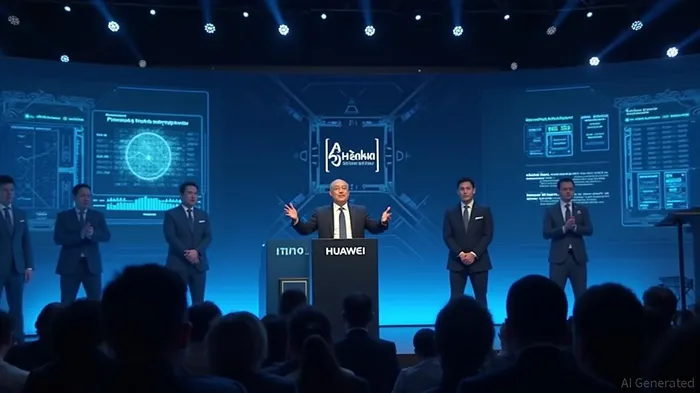
Huawei Technologies has announced its first overseas deployment of a high-performance AI supercomputer, positioning it as a direct competitor to Nvidia's leading systems in the global artificial intelligence (AI) hardware market. The move underscores Huawei's strategy to expand its influence in AI computing, leveraging its in-house Ascend chip series and large-scale cluster architectures. The company claims its new Atlas 950 SuperCluster, set for launch in 2026, will deliver 6.7 times the computing power of Nvidia's upcoming NVL144 system.
However, independent analyses suggest Huawei's AI capabilities remain constrained by manufacturing and performance gaps relative to Nvidia. A Council on Foreign Relations report highlights that Huawei's flagship Ascend 910C chip delivers approximately 60% of the inference performance of Nvidia's H100 under comparable conditions. This gap widens with newer Nvidia products, such as the H200 and Blackwell generations, which incorporate advanced packaging and high-bandwidth memory technologies. Huawei's reliance on SMIC for fabrication—limited to 7nm-class processes without EUV lithography— further restricts its ability to match Nvidia's cutting-edge designs.
To compensate, Huawei has adopted a cluster-based approach, aggregating thousands of Ascend chips into systems like the CloudMatrix 384 and Atlas 950 SuperPod. These configurations, while requiring significantly more chips, enable Huawei to compete on total compute capacity. China's access to cheap energy and government subsidies for AI infrastructure also supports this strategy. Despite these efforts, the CFR estimates Huawei's total AI compute capacity will remain at just 2% of Nvidia's through the mid-2020s, with production volumes capped at 200,000–300,000 high-end chips annually.
Nvidia, meanwhile, maintains a dominant 98% revenue share in the AI chip market, supported by a mature supply chain and ecosystem. The company has acknowledged Huawei as a "formidable" competitor but emphasized that customers will prioritize "the best technology stack" for AI workloads.
As Huawei advances its roadmap—planning the Ascend 950, 960, and 970 series through 2028—the race for AI supremacy will hinge on Huawei's ability to scale production and close performance gaps, while Nvidia continues to leverage its manufacturing and ecosystem advantages.




Comentarios
Aún no hay comentarios