
Huawei's AI Breakthrough and Its Strategic Implications for Global Tech Supply Chains
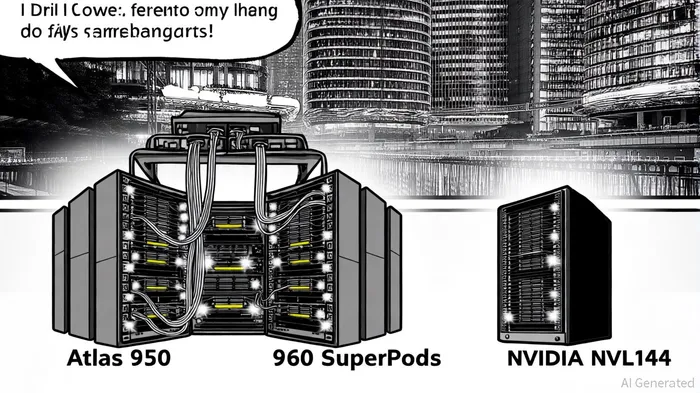
Huawei's recent advancements in AI semiconductors have positioned it as a formidable challenger to global leaders like NvidiaNVDA--, even as U.S. export restrictions constrain its access to cutting-edge manufacturing processes. The company's Atlas 950 and 960 SuperPods, set for launch in late 2026 and 2027, respectively, exemplify its strategic pivot to system-level innovation. According to a report by Reuters, the Atlas 950 SuperPod will integrate 8,192 Ascend 950DT chips, delivering 6.7 times the computing power of Nvidia's NVL144 system[1]. By 2027, the Atlas 960 SuperPod, with up to 15,488 Ascend 960 chips, is expected to further cement Huawei's dominance in AI-driven workloads[2]. These systems leverage clustering and high-bandwidth memory (HBM) solutions like HiBL 1.0 and HiZQ2.0 to overcome process-node limitations, showcasing Huawei's ability to innovate within geopolitical constraints[3].
Emerging Investment Opportunities in AI Semiconductors
Huawei's progress is not just a technical triumph but a catalyst for reshaping the AI semiconductor investment landscape. The company's Ascend 910C AI chip, manufactured by SMIC using 7nm processes, has already begun mass shipments and is marketed as a direct competitor to Nvidia's H20[4]. This chip, coupled with the National Integrated Circuit Industry Investment Fund's third-phase allocation of ¥344 billion ($47 billion), underscores China's commitment to semiconductor self-reliance[5]. For investors, Huawei's ecosystem—spanning cloud infrastructure (e.g., CloudMatrix 384) and partnerships with domestic firms—represents a high-growth corridor. As stated by Bloomberg, the global AI chip market is projected to surge from $150 billion in 2025 to $500 billion by 2028, driven by demand for generative AI and edge computing[6].
National Tech Independence: A Geopolitical and Economic Arms Race
Huawei's trajectory reflects broader national strategies to secure semiconductor supply chains. The U.S. CHIPS Act and EU Chips Act aim to reduce reliance on Asian manufacturing, with the former allocating $52.7 billion for domestic production and R&D[7]. Meanwhile, Japan's Rapidus project, backed by ¥10 trillion in subsidies, seeks to reclaim leadership in advanced chip fabrication by 2030[8]. China's “Big Fund” strategy, now in its third phase with $47.5 billion in capital, prioritizes AI and 5G technologies to counter U.S. export controls[9]. These initiatives highlight a global shift toward localized production and strategic stockpiling, with Huawei serving as China's flagship in this contest.
Strategic Implications for Investors
For investors, the interplay between technological innovation and geopolitical dynamics presents both risks and opportunities. Huawei's ability to cluster mature-node chips into supercomputing systems demonstrates that process-node limitations can be mitigated through architectural ingenuity. This approach aligns with the semiconductor industry's growing emphasis on 3D packaging and heterogeneous integration, which are expected to drive efficiency gains[10]. However, the sector remains vulnerable to supply chain disruptions and talent shortages, as noted by Deloitte in its 2025 industry outlook[11].
The global semiconductor market's projected CAGR of 5.08% through 2035[12] suggests long-term growth, but investors must navigate regional volatility. For instance, the EU's fragmented financing and regulatory hurdles under the Chips Act 2.0 could delay its ambitions[13], while India's emerging semiconductor clusters offer untapped potential. Huawei's success in leveraging state-backed resources and domestic partnerships provides a blueprint for companies navigating similar constraints.
Conclusion
Huawei's AI breakthroughs are more than a technical milestone—they are a microcosm of the global race for semiconductor dominance. By combining system-level innovation with strategic investments, the company has turned U.S. export restrictions into an opportunity to redefine AI computing. For investors, the key lies in aligning with firms and regions that can adapt to both technological and geopolitical shifts. As the semiconductor landscape evolves, Huawei's story underscores the importance of resilience, collaboration, and a long-term vision in an increasingly fragmented world.







Comentarios
Aún no hay comentarios