
HSBC's Strategic Debt Refinancing and Its Implications for Credit Quality and Shareholder Value
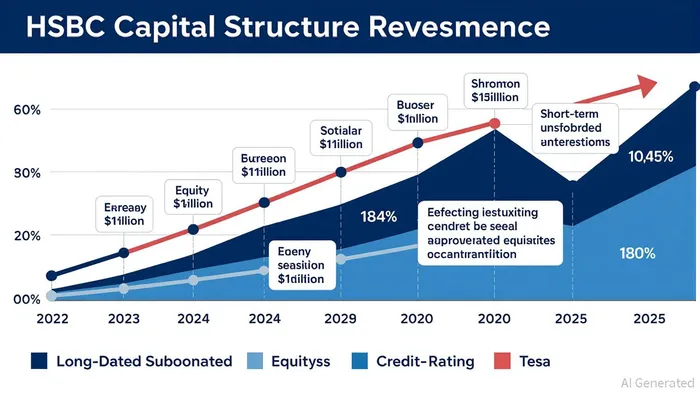
HSBC Holdings PLC’s 2025 refinancing of long-dated subordinated debt underscores its strategic focus on optimizing capital efficiency and mitigating systemic risks in a volatile global economy. By tendering $2.78 billion in subordinated notes with a settlement date of September 11, 2025, the bank aims to restructure its capital base while navigating macroeconomic headwinds, including trade policy uncertainties and shifting interest rate environments [1]. This move aligns with broader industry trends, where financial institutionsFISI-- increasingly leverage amend-and-extend provisions and payment-in-kind (PIK) features to preserve liquidity [2].
Capital Efficiency and Debt Terms
HSBC’s refinancing strategy is anchored in the issuance of long-dated subordinated debt with staggered maturities and competitive coupon rates. For instance, the bank previously exchanged $222 million in 7.35% subordinated notes due 2032 and $2 billion in 6.5% notes due 2036, offering a participation cash incentive of $3.50 per $1,000 principal to encourage investor participation [1]. These terms reflect a deliberate effort to extend debt maturities, reduce refinancing frequency, and lower near-term cash flow pressures. By prioritizing longer-term instruments, HSBCHSBC-- can better align its liability structure with the duration of its assets, a critical factor in maintaining capital adequacy ratios under Basel III frameworks [2].
The inclusion of cash incentives further enhances capital efficiency by reducing the cost of capital. Such incentives act as a bridge between the bank’s need for stable funding and investors’ demand for risk-adjusted returns. This approach is particularly relevant in a high-rate environment, where refinancing costs for long-term debt have surged, necessitating creative structuring to balance cost and flexibility [2].
Risk Mitigation and Credit Quality
While HSBC’s refinancing efforts bolster capital efficiency, they also raise questions about credit quality. MorningstarMORN-- DBRS has assigned the bank a long-term issuer rating of AA (low) with a stable outlook, signaling confidence in its ability to manage liquidity and solvency risks [2]. However, the subordinated nature of these instruments—ranked below senior debt in repayment priority—introduces potential vulnerabilities. Rating agencies typically scrutinize the maturity profiles of subordinated debt, as shorter-term obligations can amplify refinancing risks during periods of market stress [1].
The bank’s exposure to U.S. trade policy shifts further complicates its risk profile. As noted by Reuters, HSBC has flagged concerns that escalating tariffs under a potential Trump administration could dampen loan demand and credit quality, indirectly affecting its capital efficiency [1]. In this context, HSBC’s focus on long-dated subordinated debt serves as a hedge against near-term macroeconomic shocks, ensuring a buffer for absorbing potential losses.
Shareholder Value and Strategic Implications
For shareholders, HSBC’s refinancing strategy presents a nuanced trade-off. On one hand, the extension of debt maturities and reduced refinancing costs could free up capital for shareholder returns or organic growth. On the other, the higher cost of long-term subordinated debt—evidenced by coupon rates exceeding 6.5%—may compress net interest margins, particularly if short-term rates decline in the medium term [1].
The bank’s stable credit rating from Morningstar DBRS suggests that its capital structure remains resilient, but investors must monitor its leverage ratios and regulatory capital ratios closely. A deterioration in credit quality could trigger higher funding costs or regulatory interventions, eroding shareholder value. Conversely, successful execution of its refinancing strategy could reinforce investor confidence, particularly in a low-growth global environment where capital preservation is paramount [2].
Conclusion
HSBC’s 2025 refinancing of long-dated subordinated debt exemplifies a proactive approach to capital management in an uncertain economic landscape. By extending maturities, offering investor incentives, and aligning with regulatory requirements, the bank seeks to balance risk mitigation with capital efficiency. However, the success of this strategy hinges on its ability to navigate trade policy risks and maintain credit quality. For investors, the key takeaway is that HSBC’s refinancing efforts, while prudent, must be evaluated alongside broader macroeconomic trends and regulatory developments.
Source:
[1] hsbc holdings plcHSBC--, [https://www.stockinsights.ai/us/HSBC/6-K/capital-structure-changes-20250902-abc]
[2] F-4, [https://www.sec.gov/Archives/edgar/data/1089113/000119312522209513/d333748df4.htm]
[3] Morningstar DBS Confirms the Long-Term Issuer Rating of HSBC Holdings plc at AA (low), Stable Trend, [https://dbrs.morningstar.com/research/440954/morningstar-dbs-confirms-the-long-term-issuer-rating-of-hsbc-holdings-plc-at-aa-low-stable-trend]
[4] HSBC sounds Trump tariff alarm, taking shine off Q1 profit ..., [https://www.reuters.com/business/finance/hsbc-books-25-fall-first-quarter-profit-beats-estimates-2025-04-29/]





Comentarios
Aún no hay comentarios