
HSBC's Share Buyback: A Strategic Move or a Glimpse of Financial Resilience?
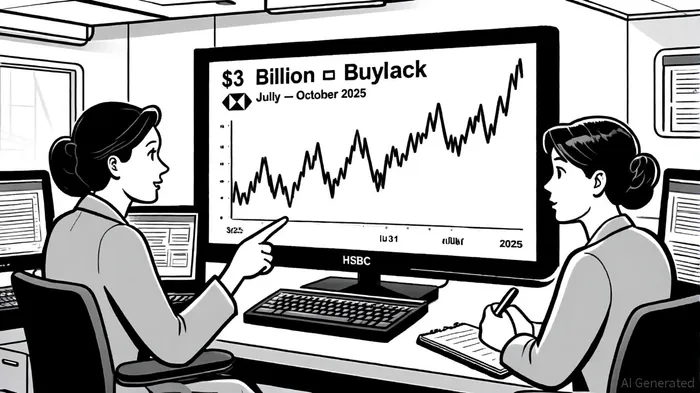
HSBC's recent $3 billion share buyback program, announced on July 31, 2025, has reignited debates about its strategic merit in a low-growth economic climate. While the move underscores the bank's commitment to shareholder value, it also raises questions about whether this capital return reflects long-term governance discipline or a response to underlying financial pressures.
Corporate Governance and Capital Allocation: A Dual Lens
HSBC's corporate governance framework, as outlined in its 2024 Annual Report, emphasizes transparency, stakeholder engagement, and a balanced approach to capital allocation, according to a Euronews report. The bank's Board of Directors, supported by a robust Group Audit Committee, has prioritized simplifying operations and focusing on high-growth markets like Asia, according to a Monexa analysis. This aligns with HSBC's strategic shift toward alternative investments, which now constitute 11% of affluent client portfolios, up from 5% in 2023, a Monexa report shows. By divesting non-core assets-such as its German custody business and U.S. retail banking operations-HSBC aims to streamline its balance sheet and redirect capital to higher-margin segments.
The 2025 buyback program, executed through non-discretionary agreements with Merrill Lynch, reflects this governance-driven strategy. By canceling repurchased shares, HSBCHSBC-- seeks to improve earnings per share (EPS) and signal confidence in its intrinsic value, even as it navigates a 29% year-on-year decline in Q2 2025 pre-tax profits. This decline, attributed to a $2.1 billion impairment on its Bank of Communications stake and Hong Kong real estate provisions, highlights the risks of operating in a low-growth environment. Yet, HSBC's CET1 ratio of 14.5%-aligned with its 14%-14.5% target-demonstrates its ability to maintain capital adequacy while rewarding shareholders.
Financial Metrics: Strengths and Vulnerabilities
HSBC's 2024 financial performance provides a mixed picture. The bank reported $143.29 billion in revenue and a 22.55% operating margin, supported by a $284.51 billion net cash surplus. These figures justify the $3 billion buyback as a capital-efficient use of excess liquidity. However, a debt-to-equity ratio of 14.69 raises concerns about leverage, particularly in a low-interest-rate environment where refinancing risks could amplify volatility, according to MacroTrends data. Analysts at Autonomous Research note that HSBC's RoTE of 14.6% in 2024 (excluding impairments) and ROE of 13.76% indicate strong profitability relative to peers, as reflected in HSBC's annual results, yet the low dividend sustainability score of 50% suggests potential challenges in maintaining current payout levels, according to the StockInvest dividend page.
The buyback's strategic rationale is further bolstered by HSBC's focus on Asia, where it has acquired Citigroup's wealth management arm and expanded digital banking capabilities. These investments, coupled with a 50% dividend payout ratio target, reflect a disciplined approach to capital allocation. However, the 25% drop in Q1 2025 pre-tax profits compared to 2024, as reported by Euronews, underscores the fragility of HSBC's earnings in a macroeconomic climate marked by U.S.-China trade tensions and sluggish global growth.
Strategic Resilience or Short-Term Signal?
HSBC's buyback program must be evaluated against its broader restructuring under CEO Georges Elhedery. By reducing divisions and automating processes, the bank aims to achieve mid-teens RoTE and a 5% annual growth in operating expenses. This operational efficiency, combined with a 5.64% dividend yield and a P/E ratio of 11.3x, positions HSBC as a compelling value play. Yet, the timing of the buyback-executed amid a 29% profit decline-risks being perceived as a defensive maneuver to stabilize investor sentiment rather than a proactive strategy.
Analysts at Bank of America Securities argue that HSBC's governance framework, including its debt-free balance sheet and strong liquidity position, provides a buffer against short-term shocks. However, the high debt-to-equity ratio and reliance on non-core asset sales to fund buybacks suggest that HSBC's resilience may be contingent on sustained capital returns rather than organic growth.
Conclusion: A Calculated Bet in Uncertain Times
HSBC's $3 billion share buyback represents a calculated attempt to balance capital returns with governance discipline in a low-growth environment. While the program leverages the bank's strong liquidity and strategic focus on Asia, it also exposes vulnerabilities in its capital structure and earnings sustainability. For investors, the key question is whether HSBC's governance-driven approach can translate into long-term value creation or if the buyback is a temporary salve for deeper structural challenges.
As HSBC navigates a complex macroeconomic landscape, its ability to execute its restructuring plan-while maintaining a CET1 ratio above 14%-will be critical. The coming quarters will test whether this buyback is a strategic masterstroke or a glimpse of financial resilience under pressure.





Comentarios
Aún no hay comentarios