
HSBC's $5,000 Gold Target: A Structural Shift or a Volatile Peak?
The stage for a historic debate was set by gold's own performance. In 2025, the metal delivered its strongest year since 1979, rallying a staggering 64% to reach a new all-time high in late December. This wasn't a fleeting surge but a sustained move, with gains of nearly 140% since 2023. The momentum carried into the new year, with the metal reclaiming record territory by the end of December. This powerful rally, driven by a mix of geopolitical tensions, USD weakness, and robust demand, created the context for a bold new forecast.
Enter HSBCHSBC--. In a move that has sent shockwaves through commodity markets, the bank has issued a landmark projection: gold prices could soar to $5,000 per ounce by the second quarter of 2026. The bank's Chief Precious Metals Analyst, James Steel, frames this target as a response to a "volatile cocktail" of unprecedented fiscal deficits and a fundamental shift in global trust. The immediate catalyst is the deteriorating fiscal health of Western economies, most notably the United States, where the federal deficit is projected to hit a staggering $2.05 trillion for the 2026 fiscal year. HSBC argues the market is beginning to price in the "inevitable monetization" of this debt, a process viewed as the ultimate form of currency debasement.
The central question now is whether this is a sustainable structural move or a speculative peak. The bank's cited drivers point to deep-seated forces: the structural move toward de-dollarization as central banks diversify away from the U.S. dollar, and the sharp rise in government debt across advanced economies, projected to reach around 110% of GDP this year. These are not transient market whims but long-term trends that could provide a hard floor for prices. Yet, the very volatility of the "cocktail" suggests the path to $5,000 may be anything but smooth.
The Structural Drivers: Fiscal Stress and De-dollarization
The case for gold's long-term ascent rests on a convergence of powerful macroeconomic and geopolitical forces. At the core is a profound shift in the global financial architecture, where traditional safe-havens are losing credibility. The most immediate pressure point is the deteriorating fiscal health of the world's largest economy. The United States is on a path toward a federal deficit nearing $2 trillion for the 2026 fiscal year. The sheer pace of borrowing is staggering, with the Treasury already $439 billion in debt for the first two months of the fiscal year. This relentless monetization of debt is the ultimate form of currency debasement, a process that historically has been a primary driver of gold's value. When a government's ability to service its obligations is questioned, the incentive to hold gold-a tangible, non-sovereign asset-intensifies.
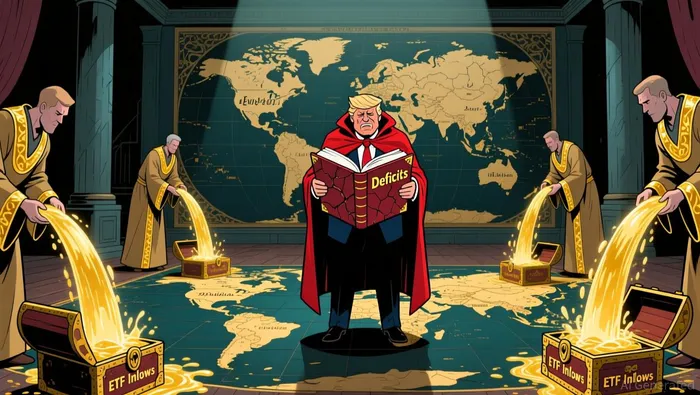
This fiscal stress is colliding with a historic realignment in global reserves. Central banks and sovereign investors are actively diversifying away from the U.S. dollar, a trend known as de-dollarization. This is not a theoretical shift but a material, on-the-ground movement. It is powerfully illustrated by the record flows into gold-backed exchange-traded funds. In 2025, global gold ETFs saw annual inflows surge to US$89 billion, the largest on record. This capital influx doubled assets under management to $559 billion, a clear signal of institutional and sovereign demand seeking a store of value independent of any single nation's fiscal policy. This institutional embrace provides a structural floor for prices, as these investors are less prone to short-term volatility.
Finally, the fundamental tailwind for gold is the collapse in its opportunity cost. Gold pays no interest, so its appeal is inversely related to the return available on other assets. The sharp decline in U.S. real interest rates-the true cost of holding a non-yielding asset-has been a key catalyst. With real rates at their lowest level since mid-2023, the trade-off for holding gold has become far more favorable. This dynamic, combined with the persistent demand from central banks and the erosion of trust in fiat currencies, creates a multi-year support structure for gold prices. It is a setup where the drivers are structural, not cyclical, suggesting the recent rally is anchored in a new, higher equilibrium.
The Path to $5,000 and the Risk of a Correction
The trajectory to HSBC's landmark $5,000 target is not a straight climb but a volatile ride with a built-in correction. The bank's latest forecast paints a picture of a market poised for a powerful first-half surge, followed by a potential retreat. Analysts see gold prices rising to a high of $5,050 an ounce within the first six months of 2026, a slight upward revision from their prior peak target. Yet, for the full year, they expect a wide range that could go as low as $3,950 per ounce following a correction later in the year. This implies a potential drawdown of over 20% from the peak, a significant volatility that underscores the speculative nature of the rally.
The bank's explicit warning highlights the fragility of the current setup. A steep correction, they argue, could be triggered by two key developments: a subsidization of geopolitical risks or the U.S. Federal Reserve stopping its cutting of interest rates. Both are plausible turning points. If tensions ease, the primary safe-haven demand driving the rally could wane. Similarly, if the Fed pauses its dovish policy, it would lift the real interest rate floor that has made gold so attractive. This creates a clear binary risk: the rally is priced for continued stress and easing, and any relief could spark a sharp reversal.
Gold's current trading level, just below its record high, illustrates how far the metal has already come and how sensitive it remains to macro data. As of Friday, the metal was trading above $4,500 an ounce, nearly $50 off its record high. This proximity to the peak means the market is already in a high-stakes zone. Every piece of economic data-be it inflation prints, employment reports, or central bank commentary-will now be scrutinized for clues about the trajectory of interest rates and the persistence of global uncertainty. The path to $5,000, therefore, is not just about the structural drivers of fiscal stress and de-dollarization, but about navigating a volatile near-term landscape where sentiment can shift on a dime.
Catalysts and Watchpoints for the Thesis
For the $5,000 thesis to hold, the powerful structural forces must manifest in concrete data and events. Investors should monitor a clear checklist of catalysts and risks in the coming months.
First, the fiscal narrative must deteriorate further. The United States is already on a path toward a federal deficit nearing $2 trillion for the fiscal year, with the Treasury borrowing $439 billion in just the first two months. The key watchpoint is whether this trend accelerates or stabilizes. A failure to see a meaningful reduction in the deficit trajectory, or any signs of fiscal consolidation, would validate the "inevitable monetization" argument. Conversely, any credible policy proposal aimed at deficit reduction would be a direct challenge to the core driver of the rally.
Second, institutional demand must remain robust. The record annual inflows of US$89 billion into global gold ETFs in 2025 provided a critical floor. Investors should track monthly ETF flows for any signs of a reversal. Sustained inflows, particularly from North America and Asia, would signal continued institutional conviction. A shift to outflows would be a red flag, suggesting that the safe-haven demand is becoming speculative rather than structural.
Third, geopolitical tensions must persist or intensify. The metal's recent strength has been fueled by a "volatile cocktail" of risks, including ongoing tensions between the U.S. and Iran and domestic instability in Japan. The watchlist includes developments in the Middle East and Asia, where any escalation could reignite safe-haven flows. A period of geopolitical calm would remove a key near-term catalyst and likely pressure prices.
Finally, monetary policy signals are paramount. The rally has been supported by the decline in real interest rates. The Federal Reserve's stance is a direct counterweight. Any indication that the Fed is pausing its rate-cutting cycle or shifting toward a more hawkish tone would lift the real rate floor, making gold less attractive. The market's reaction to the next FOMC meeting and accompanying economic data will be a critical test.
The bottom line is that the path to $5,000 is not a passive journey. It requires a sustained acceleration of fiscal stress, unwavering institutional buying, and persistent global uncertainty. Any deviation from this script could trigger the sharp correction the bank itself has warned about.





Comentarios
Aún no hay comentarios