
HSBC's 3Q 2025 Natural Gas Price Adjustment: Navigating Volatility and Energy Investment Shifts
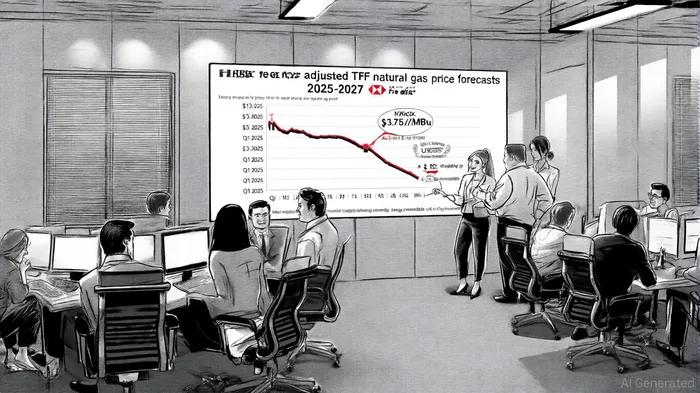
The recent mark-to-market adjustment by HSBCHSBC-- for third-quarter 2025 natural gas prices underscores a pivotal shift in market dynamics, with far-reaching implications for energy sector investment strategies. By lowering its Title Transfer Facility (TTF) price forecast to $12.5/MMBtu for 3Q 2025—a $1/MMBtu reduction—HSBC reflects a bearish outlook driven by structural and geopolitical factors[2]. This adjustment, part of a broader 2025 forecast revision to $13.10/MMBtu (down from $13.75/MMBtu), highlights the fragility of demand in the EU gas market amid oversupply risks and policy-driven headwinds[5].
Drivers of the Adjustment: A Bearish Confluence
HSBC's revised forecast is anchored in three key factors. First, U.S. tariffs on EU goods, announced in early 2025, are expected to curb industrial gas demand in Europe by reducing manufacturing activity[4]. Second, robust liquefied natural gas (LNG) availability, particularly from the U.S. and Qatar, has flooded global markets, easing price pressures[2]. Third, elevated renewable energy output—particularly wind and solar—has further weakened demand elasticity, with Europe's gas stocks currently at 64% of capacity, well above the five-year average of 43%[2]. These factors collectively signal a market nearing equilibrium post-Russia-Ukraine conflict but one that remains vulnerable to external shocks.
Volatility Trends: Stability Amid Uncertainty
While HSBC's adjustment points to a bearish near-term outlook, broader volatility in natural gas markets has shown a marked decline in 2025. According to the U.S. Energy Information Administration (EIA), Henry Hub front-month futures volatility dropped from 81% in Q4 2024 to 69% by mid-2025, driven by storage inventories returning to near-average levels[4]. Robust net injections into storage—exceeding 100 billion cubic feet (Bcf) weekly for seven consecutive weeks in late 2025—have further stabilized prices[4]. However, European markets remain sensitive to geopolitical developments, such as reduced Norwegian gas output and Kremlin announcements, while weather patterns continue to introduce uncertainty[3].
Investment Implications: Hedging, Diversification, and Infrastructure
The evolving volatility landscape is reshaping energy investment strategies. With lower volatility reducing the need for complex hedging mechanisms, energy consumers are adopting more predictable procurement models[3]. For instance, natural gas ETFs—such as the U.S. Natural Gas Fund and the First Trust Natural Gas ETF—have gained traction as tools for exposure to price movements, though investors must navigate risks like contango and high expense ratios[1].
Meanwhile, the sector is pivoting toward infrastructure and diversified energy assets. LNG terminals and midstream operations are now central to energy portfolios, reflecting a shift from speculative trading to long-term value creation[5]. Investment advisors are also emphasizing structural changes, such as income-generating assets and real estate exposure, to mitigate macroeconomic risks[5].
Strategic Considerations for Investors
For investors, HSBC's adjustment signals a critical inflection point. While 2025 prices are expected to remain subdued, the 2026–2027 outlook—pegged at $11.25/MMBtu and $8.50/MMBtu, respectively—suggests a gradual normalization[5]. This trajectory aligns with the International Energy Agency's (IEA) Q2 2025 Gas Market Report, which notes that geopolitical tensions and weather-driven demand swings will continue to influence short-term volatility[3].
To navigate this environment, investors should prioritize:
1. Dynamic Hedging: Utilize natural gas ETFs and futures to hedge against residual volatility while balancing cost efficiency.
2. Infrastructure Exposure: Allocate capital to LNG terminals and midstream operations, which offer stable cash flows amid price fluctuations.
3. Scenario Planning: Incorporate geopolitical and weather risk models into procurement strategies, leveraging advanced analytics to optimize decision-making[4].
Conclusion
HSBC's 3Q 2025 TTF price adjustment encapsulates the interplay of structural oversupply, policy shifts, and renewable energy growth in the EU gas market. While reduced volatility offers a degree of stability, the sector remains exposed to external shocks. For investors, the path forward lies in balancing short-term hedging with long-term infrastructure investments, ensuring resilience in an era of evolving market dynamics.





Comentarios
Aún no hay comentarios