
HPE-JNPR Merger: A Risky Gamble or a Strategic Masterstroke?
The $14 billion merger of Hewlett PackardHPE-- Enterprise (HPE) and Juniper Networks (JNPR) has finally cleared its biggest hurdle: the U.S. Department of Justice (DOJ) settlement. This deal, now set to redefine the networking landscape, presents a compelling yet fraught opportunity for investors. Let's dissect its valuation, regulatory risks, strategic potential—and whether it's worth betting on.
The DOJ Settlement: A Necessary Compromise
The DOJ's approval of the merger hinges on HPEHPE-- divesting its Aruba Instant On business and licensing Juniper's Mist AIOps software to rivals. While this reduces antitrust risks, it also strips HPE of a niche campus networking segment and dilutes its control over AI-driven software (via the Mist license).
The settlement removes regulatory uncertainty but introduces execution risks: HPE must auction the Instant On business within 180 days and ensure smooth handover of Mist's source code to bidders. Failure here could delay synergies or spark litigation.
Valuation: Limited Upside for JNPR, Ambiguous Value for HPE
Juniper shareholders received $40 per share in HPE stock, but the lock-up period for their shares expired in July. With HPE's stock trading near $15.50—a 30% discount to its pre-merger peak—the upside for JNPR investors is now capped unless HPE's valuation rebounds.
HPE's own financials raise red flags. Despite a $5.2 billion net cash position, its Q2 2025 free cash flow hit -$847 million, driven by margin pressures and AI/cloud investments. The company forecasts $450 million in annual synergies by 2028, but realizing these depends on seamless integration of Juniper's AI tools with HPE's hybrid cloud infrastructure.
Strategic Synergies: Can HPE Challenge Cisco?
The merger's core thesis is to create a powerhouse in AI-native networking, leveraging Juniper's Mist AIOps (which automates network management) and HPE's GreenLake cloud platform. CiscoCSCO--, which dominates 45% of the enterprise WLAN market, faces a credible challenger.
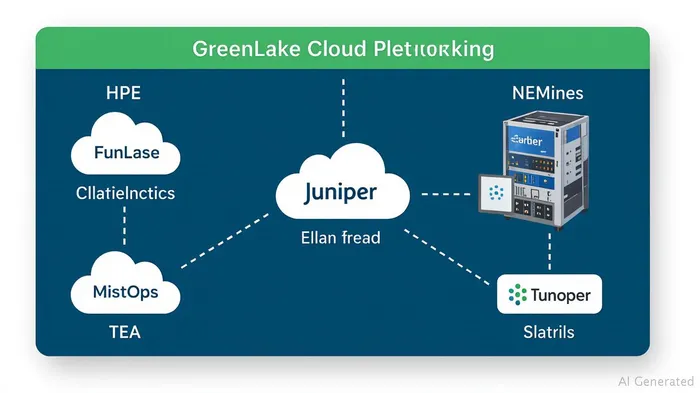
Analysts estimate the combined entity could capture $10 billion in expanded addressable markets by 2030. However, Cisco's entrenched position and aggressive pricing tactics remain hurdles. HPE must also navigate cultural alignment between Juniper's software engineers and its hardware-centric sales teams—a task that could delay product launches or alienate clients.
Risks: Integration Woes and Cash Flow Concerns
- Operational Overload: HPE's Server division, which accounts for half its revenue, is already strained (Q2 revenue fell 6% year-over-year). Integrating Juniper's 11,000 employees and aligning product roadmaps could stretch resources thin.
- Debt Pressure: The merger was 80% cash-funded, raising HPE's leverage. If free cash flow doesn't rebound by 2026, refinancing costs could squeeze margins further.
- Regulatory Lingering: The DOJ retains oversight until divestitures are completed. A buyer for Instant On hasn't been named, raising execution risks.
The Safer Bet: Trefis' High Quality Portfolio
For investors seeking steady returns without HPE's volatility, the Trefis High Quality (HQ) Portfolio offers a compelling alternative. Since its 2020 launch, it's returned 93% (15% annualized), outperforming its benchmark by 32 percentage points while losing only 75% of the benchmark's downside. Its 30-stock, equal-weighted structure avoids the concentration risks of the S&P 500.
Investment Thesis: A Speculative Buy for HPE, Wait-and-See for JNPR
- HPE: Long-term investors willing to endure execution risks might buy now at $15.50, targeting a 30% upside to $20 if synergies materialize. However, near-term catalysts (e.g., Instant On sale completion, Q3 earnings) are critical.
- JNPR: Post-lockup, JNPR's stock is a “wait-and-see” play. Upside is limited unless HPE's valuation improves significantly.
- Trefis HQ: A must-consider for risk-averse investors. Its low volatility and quality focus align with current market uncertainties.
Final Word
The HPE-Juniper merger is a high-stakes gamble. While it could redefine HPE's valuation as a tech infrastructure leader, its execution risks—cash flow, integration, and regulatory—demand caution. For now, the safer route lies with diversified, low-volatility portfolios like Trefis' HQ. But for tech bulls, HPE's stock offers a speculative bet on reshaping the $35 billion networking landscape.





Comentarios
Aún no hay comentarios