
HPCL's Residue Upgradation Facility: A Strategic Catalyst for Refinery Margins and ESG Alignment
India's energy transition is reshaping the refining sector, with companies like Hindustan Petroleum Corporation Limited (HPCL) leveraging advanced technologies to align operational efficiency with environmental sustainability. At the forefront of this transformation is HPCL's Residue Upgradation Facility (RUF) at its Visakhapatnam refinery, a project that not only enhances refining margins but also positions the company as a leader in ESG (Environmental, Social, and Governance) compliance. By converting low-value heavy residues into high-value fuels, the RUF exemplifies how strategic infrastructure investments can harmonize profitability with sustainability goals in a carbon-conscious era.
Operational Efficiency: A New Benchmark in Refining
The RUF, with a capacity of 3.55 million metric tonnes per annum, is a cornerstone of HPCL's operational strategy. According to a report, the facility employs India's first residue hydrocracking unit and the world's first LC-Max unit, enabling the conversion of approximately 93% of low-value bottom-of-the-barrel oils into high-value petroleum products. This deep-conversion capability is critical for refining majors, as it reduces dependence on imported crude and maximizes output from existing feedstocks.
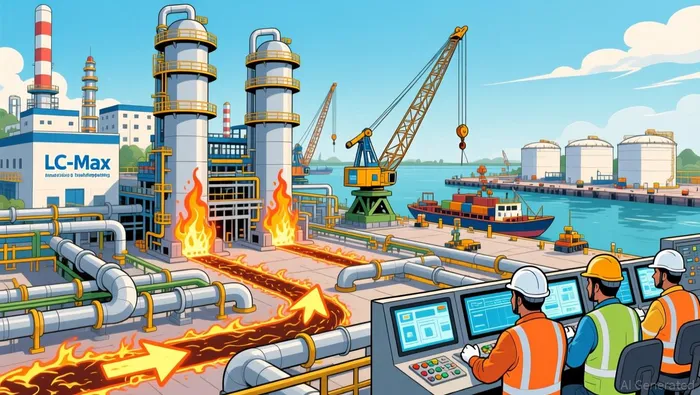
The technological innovation extends to sulfur reduction, a key challenge in refining. While exact sulfur reduction percentages are not disclosed, the RUF's advanced hydrocracking processes inherently improve desulfurization efficiency, aligning with global regulatory standards for cleaner fuels. Additionally, the facility's 10% increase in distillate yields-attributed to improved heat integration and process efficiency-directly boosts gross refining margins. For investors, this represents a tangible enhancement in operational leverage, particularly in a market where refining margins are increasingly tied to product quality and regulatory compliance.
ESG Alignment: Carbon Intensity and Energy Transition
The RUF's environmental impact is equally compelling. Data from HPCL's Annual Report 2024-25 highlights the project's role in reducing energy intensity through optimized heat integration and digital-first analytics, such as AI-driven process monitoring. These measures have lowered the refinery's Energy Intensity Index (EII), a metric critical for ESG assessments. While specific carbon intensity reduction figures are not quantified in the research, the project's alignment with India's energy transition goals-such as reducing fossil fuel imports and decarbonizing the energy mix-positions HPCL as a forward-thinking player.
The facility's reliance on indigenous engineering further strengthens its ESG credentials. For instance, the three LC-Max reactors, each weighing 2,200 metric tonnes, were designed and fabricated domestically, supporting Aatmanirbhar Bharat (self-reliance) initiatives. This localization not only reduces supply chain risks but also fosters domestic industrial expertise, a factor that could attract ESG-focused investors prioritizing sustainable supply chains.
Financial Implications: Profitability and Resilience
From a financial perspective, the RUF's impact is multifaceted. The 10% rise in distillate yields directly enhances refining margins, a critical metric for refining majors operating in volatile markets. According to , the project has already contributed to improved profitability in the past quarter, with operating costs declining due to energy efficiency gains. These improvements are particularly significant in the context of India's push for energy security, where refining capacity expansion is a strategic priority.
Moreover, the RUF's ability to reduce reliance on imported fuels-by maximizing domestic crude utilization-strengthens HPCL's supply chain resilience. In a sector where geopolitical risks and crude price fluctuations are persistent challenges, this diversification of feedstock sources offers a competitive edge. For investors, the project underscores HPCL's capacity to navigate macroeconomic headwinds while maintaining growth trajectories.
Conclusion: A Model for the Future of Refining
HPCL's Residue Upgradation Facility is more than a technical achievement; it is a strategic response to the dual imperatives of profitability and sustainability. By integrating cutting-edge technology with ESG-aligned practices, the project sets a benchmark for refining majors navigating the energy transition. For investors, the RUF demonstrates how infrastructure investments can drive both operational excellence and environmental stewardship-a combination increasingly valued in capital markets. As India's refining sector evolves, HPCL's proactive approach to innovation and sustainability positions it as a key player in the global energy transition.







Comentarios
Aún no hay comentarios