
HP's 14.6% Slide: A Market-Beating Drop on Guidance Reset
The market's reaction to HP's report was a classic case of "sell the news." The company delivered a solid quarterly performance, but the stock fell because the real story was in the future. The gap between a slight earnings beat and a significantly reset outlook created a clear expectation gap that the market punished.
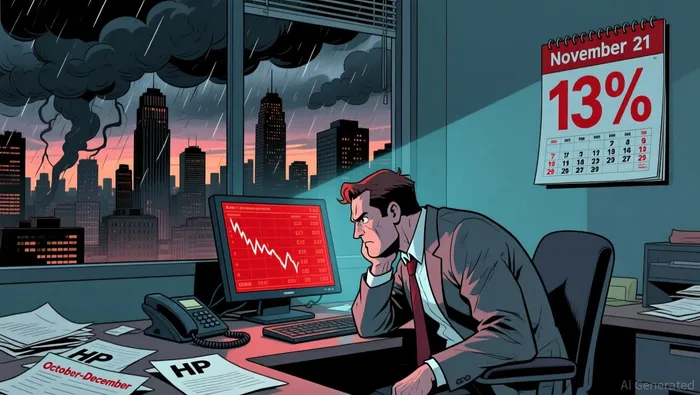
On the surface, the print was positive. HP's Q4 EPS of $0.93 slightly beat the $0.92 consensus, and revenue came in above forecasts. Yet, the stock declined on the news. The catalyst was the guidance that followed. For the full fiscal year, HPHPQ-- set its adjusted EPS guide at $2.90 to $3.20, which sits well below the $3.33 consensus. This reset was the primary driver of the stock's 13.0% slide over the past 21 trading days.
The company explicitly linked the lower outlook to external pressures, citing "added cost driven by the current U.S. trade-related regulations in place" as a key headwind. This guidance reset overshadows the quarterly beat. In other words, the market had priced in a certain trajectory for fiscal 2026, and HP just told investors that trajectory is now lower. The slight beat in the current quarter was already in the price; the bad news for next year was not.
The setup is now clear. HP is guiding for a fiscal year where its profit per share is expected to be less than what analysts were forecasting. This is a direct guidance reset that sets a new, lower baseline for expectations. The stock's drop reflects the market's judgment that the future outlook is more important than the past quarter's results.
The Priced-In Reality: A Low Valuation Reflecting Weakness
The market's verdict is clear in the numbers. HP's stock now trades at a valuation that reflects deep skepticism about its future. The company's P/E multiple of 8.1 and P/EBIT multiple of 6.3 are low, signaling that investors have already priced in significant operational weakness. This isn't a sign of bargain hunting; it's a reflection of a reset expectation for growth and profitability.
The stock's recent dip to $21.66 leaves it well below its 52-week high, a level that has not been seen since 2024. This gap suggests the market is pricing in the worst-case scenario, where the guidance reset and external pressures become permanent. The forward P/E of 7.38 is even more telling. It implies the market is assigning minimal value to HP's anticipated earnings growth, effectively discounting any near-term acceleration.
Put differently, the stock's cheapness is a direct function of its poor outlook. The valuation metrics are not a separate story; they are the market's quantification of the expectation gap. The company's fundamentals-like a last 12-month revenue growth of 3.2% and an operating margin of 6.6%-support this low multiple. For investors, this creates a paradox. The stock appears cheap, but the low multiple is a warning sign, not an invitation. It means the market's baseline expectation is one of stagnation, and any deviation from that path would be required to drive a re-rating.
The Restructuring Plan: Can $1B in Savings Close the Gap?
HP's response to its guidance shortfall is a high-stakes bet. The company announced a fiscal 2026 plan targeting $1.0 billion in gross run-rate savings by fiscal 2028, achieved through a workforce reduction of 4,000 to 6,000 jobs globally. This is framed as an AI-driven efficiency play, with management saying the savings will come from applying AI tools to product development, customer support, sales and manufacturing. The goal is clear: to offset the cost headwinds that forced the guidance reset.
Yet this plan introduces a near-term earnings drag that must be weighed against future benefits. The company expects roughly $650 million in restructuring charges, with about $250 million of that booked in fiscal 2026. This is a direct hit to profits in the year that just saw its outlook reset lower. For investors, the math is straightforward: the market is already pricing in weak growth. The restructuring adds a layer of near-term cost that could pressure the bottom line further before the promised savings materialize.
The plan's success hinges on execution and timing. HP has a history here, having previously delivered $2.2 billion in annualized savings from a similar-sized workforce cut. But the current environment is different, with memory costs and trade regulations adding new pressure. The $1 billion target is significant, but it must be achieved while the company navigates these external headwinds. The market will be watching closely to see if the promised savings can close the expectation gap-or if they simply buy time for the underlying challenges to persist.
Catalysts and Risks: The Path to a "Beat and Raise" Scenario
The path back to a "beat and raise" scenario is now defined by a few critical near-term milestones. The market has reset its expectations to a lower baseline, so any deviation from that path will be scrutinized. The first major test arrives with the Q1 FY26 results, expected late February. Investors will be watching for signs that the planned cost savings are beginning to materialize and that margins are stabilizing. The company's own guidance for the quarter, calling for 73 cents to 81 cents in adjusted EPS, is already below consensus. A beat here would signal the restructuring is working faster than expected, while a miss would confirm the near-term earnings drag is real.
A second key watchpoint is the timeline for the $650 million in restructuring charges, with about $250 million booked in fiscal 2026. Any update on how effectively HP is mitigating the added costs from U.S. trade-related regulations will directly impact this charge and the company's cash flow. The company has been shifting manufacturing outside China to mitigate tariffs, but the success of these strategies will be a factor in whether the cost headwinds are truly offset by the savings plan.
The overarching risk, however, is that the ambitious $1 billion in gross run-rate savings target is too aggressive. The company's prior program delivered $2.2 billion in annualized savings, but that was in a different cost environment. If the savings take longer to materialize or if external pressures like memory costs persist, the company could be forced into further guidance cuts. This would break the narrative that the restructuring is a successful AI-driven efficiency play and could trigger another round of pessimism.
The bottom line is that the current setup offers a clear, if narrow, path to a re-rating. A strong Q1 print that shows margin stabilization and early cost savings could start to close the expectation gap. Yet the execution risks are high. The market has already priced in weakness; the company must now deliver a credible plan for improvement that exceeds even that low bar.





Comentarios
Aún no hay comentarios