
Howmet Aerospace's Valuation Discrepancy: Intrinsic Value vs. Market Pricing in 2025
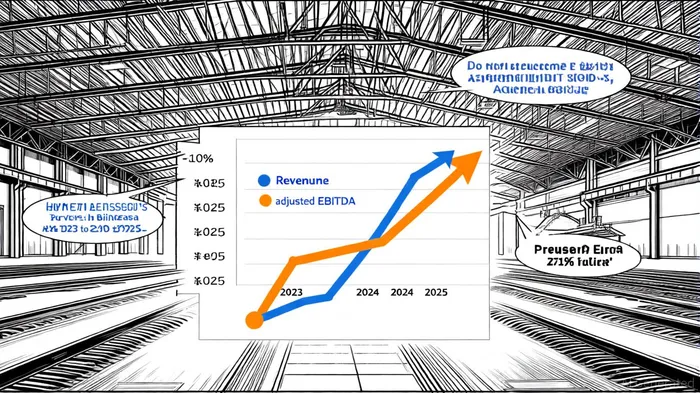
Howmet Aerospace Inc. (NYSE: HWM) has emerged as a standout performer in the aerospace sector, with 2024 results showcasing a 12% revenue increase to $7.4 billion and adjusted EBITDA surging 27% to $1.9 billion, according to Howmet's annual report. Yet, as of October 9, 2025, its stock trades at $188.83, a price that appears to diverge from its intrinsic value when analyzed through discounted cash flow (DCF) and earnings-based metrics. This discrepancy raises critical questions about whether the market is underestimating the company's long-term potential or overcorrecting for sector-specific risks.
Financial Performance: A Foundation of Strength
Howmet's 2024 results underscore its operational resilience. Free cash flow conversion hit 88%, with $977 million generated despite $321 million in capital expenditures, as detailed in the annual report. The company reduced net debt by $365 million, maintaining a net debt-to-EBITDA ratio of 1.4x, a level that suggests prudent leverage management. For 2025, the company has raised its revenue guidance to $7.88–$8.18 billion, with adjusted EBITDA projected to reach $2.3–$2.34 billion, per MarketBeat's forecast. These figures reflect robust demand for its engine components and defense-related products, particularly its critical role in the F-35 stealth fighter program, as reported in a Yahoo Finance article.
Intrinsic Value: A DCF Perspective
To estimate intrinsic value, a DCF model using Howmet's 2025 guidance and a weighted average cost of capital (WACC) of 12.59% reported by GuruFocus provides a compelling framework. Assuming free cash flow for 2025 falls at the midpoint of its guidance range ($1.225 billion) and grows at a conservative 5% annually thereafter (aligned with its 2025 EPS growth expectations per the annual report), the terminal value calculation yields an enterprise value of approximately $74.5 billion. This implies a fair value per share of $192.30, slightly above the current price of $188.83.
However, this analysis hinges on key assumptions. The 5% long-term growth rate may be optimistic if aerospace demand softens, though Howmet's diversified client base and defense contracts mitigate this risk. Additionally, GuruFocus reports a return on invested capital (ROIC) of 17.23%-well above its WACC-which suggests the company can sustain value creation.
Market Pricing: A Puzzle of Expectations
The current stock price implies a price-to-earnings (P/E) ratio of roughly 52x, based on 2025 EPS guidance of $3.60. This premium to the S&P 500's average P/E of ~25x reflects investor confidence in Howmet's margins and growth trajectory. Yet, it also highlights a potential disconnect. Analysts project a 22% earnings growth rate for 2025 (per the annual report), but the stock's recent 1.47% decline reported by MarketBeat suggests market skepticism about sustaining this pace.
Moreover, while Bernstein's $217 price target and the "Moderate Buy" consensus reported on MarketBeat signal optimism, the average analyst target of $172.13 implies a 6.24% downside from current levels. This tension between bullish fundamentals and cautious pricing may stem from macroeconomic concerns, such as interest rate uncertainty or potential aerospace sector cyclicality.
Valuation Discrepancy: Why the Gap?
The modest gap between intrinsic value ($192.30) and the current price ($188.83) appears narrow, but context matters. Howmet's WACC of 12.59% (per GuruFocus) is relatively high for a company with a 17.23% ROIC (GuruFocus data), indicating undervaluation if its competitive advantages persist. However, the market's focus on short-term risks-such as debt servicing costs ($3.26 billion in total debt, according to Finbox) and exposure to volatile commercial aerospace markets-could justify a discount.
Conclusion: A Case for Cautious Optimism
Howmet Aerospace's valuation discrepancy reflects a nuanced interplay of strong fundamentals and market caution. While its intrinsic value suggests the stock is fairly priced, the margin of safety is slim. Investors should monitor its ability to maintain margin expansion, navigate defense contract dependencies, and execute on its $500 million stock repurchase program. For now, HWMHWM-- remains a compelling case study in how aerospace firms balance long-term growth with near-term volatility.





Comentarios
Aún no hay comentarios