
Catch pre-market movers with AI signals.
The Houthis Just Took the Bab el-Mandeb. This Bet Still Says 74% It Stays Open
Polymarket is pricing the "Bab el-Mandeb Strait effectively closed by...?" event at about 26 cents that the strait is effectively closed by Dec 31, with more than $12.6 million already traded — yet the Houthis spent the last week doing the one thing every headline says closes a strait. They overran Yemen's entire Red Sea coastline, swept the port of Mocha, and planted fighters on Perim Island, the 13-square-kilometer rock that sits dead center of the waterway and splits it into two shipping lanes. Oil is back above $100 a barrel for the first time since May. The crowd's answer, in effect: 74% that it's still not closed by year's end.
That gap is the trade — but not for the reason the newsfeed thinks. The contract does not settle on "did the Houthis seize the coast?" It settles on a number far harder to print, and that disconnection is where the mistake lives on both sides of the coin.
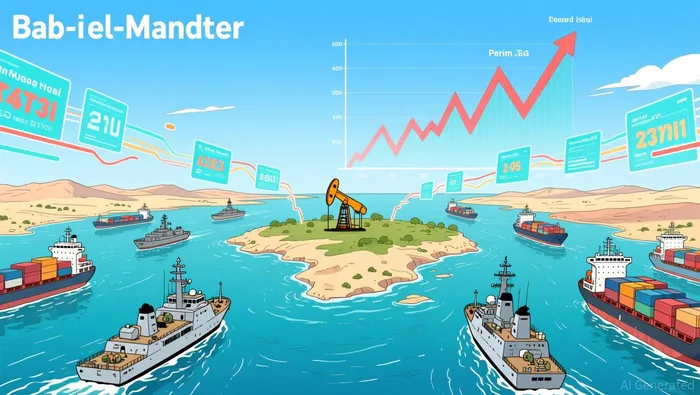
The headline says "closed." The contract says something else.
Read the resolution rule before you touch a cent, because the rule is barely related to the front page. This market resolves to Yes if IMF PortWatch publishes a 7-day moving average of ship transit calls for the Bab el-Mandeb — its "Arrivals of Ships" series — equal to or below 10 on any date between market creation and the outcome date. That is not "the Houthis control the coastline." That is "traffic through the strait has collapsed to roughly ten ships a day and stayed there for a week." The world's word for that is blockade; the contract's word for that is closure.
Here is the uncomfortable part for anyone buying the seizure narrative as a straight closure: ships are still going through. The adjacent Polymarket markets that count transits weekly keep resolving in the low-to-mid 100s to low 200s per week — the week of Aug 31 came in at 170 to 189 vessels. That is roughly 25 to 30 ships a day still crossing the strait, a far cry from a 7-day moving average of ten or fewer. Militarily, the Houthis just took the chokepoint. Numerically, the chokepoint is still moving traffic.
The one fact that could flip it, and the clock
The fresh catalyst is real, and it is why this bet is alive at all. Perim Island is not decoration: it splits the Bab el-Mandeb into two channels, and holders can hit vessels in both with short-range missiles instead of long-range artillery. A security analyst put the capability plainly — the Houthis now have the "real capability to shut down any maritime traffic through Bab al-Mandeb" if they choose to consolidate. They have already declared a naval boycott on Saudi-linked vessels and attacked Saudi tankers, and analysts warn that widening the target list turns the strait into a second full chokepoint alongside Iran's closure of the Strait of Hormuz, which now carries a fraction of its normal ~125 vessels a day.
The market is not pricing pure fantasy. But the trigger it is pricing is full enforcement — a decision to stop all traffic, not just Saudi-flagged ships, for a sustained week — and that is a much more extreme event than the one the headlines describe. The 2023-24 Red Sea crisis, when Houthis struck more than 100 commercial ships and half the world's major energy firms rerouted around Africa, cut crude flows through the strait by 18% and LNG by 24% — disruption on a historic scale that still never took the daily count into single digits. Closure by this contract's definition is a bar the war has never actually cleared.
What 26 cents is really offering — and what it costs
Do the dollar flip, because at this price the percentage is not the point. At 26 cents, a $100 stake buys about 385 shares. If the contract settles Yes, that returns roughly $385 gross — about $285 of profit on top of your stake. If it settles No, every one of those 385 shares goes to zero. This is a leveraged opinion on a near-total traffic stop occurring by the end of 2026, not a leveraged opinion on the Houthis having grabbed some coastline.
There is a closer, cheaper sub-market inside the same event resolving in about two and a half weeks: the September 30 deadline, which in late-July snapshots was still trading in the single digits. That is where the catalyst half-life gets decided. If PortWatch's count collapses toward 10 in the next week, both bets reprice violently and the year-end date comes along for the ride. If ships keep crossing at 20-plus a day through the end of September, the near-term bet dies first, and the year-end contract silently loads its 70-plus-cents-a-share risk of total loss onto anyone still holding.
The cleanest way this loses
One sentence: the Houthis hold the strait, the headlines scream closure, and the transit counter stays above ten a day — so both contracts resolve No and the stake is gone. The Houthis' own spokesman has spent the week insisting navigation is safe for everyone except Saudi vessels, and President Trump has claimed the group "let most ships go through". If the ban stays limited to Saudi-linked tankers while everyone else keeps transiting, this market watches dozens of ships a day pass the island it just conquered and settles the boring way.
That is the edge, and it cuts toward the reader who refuses to confuse a geopolitical event with a settlement condition. The contract does not pay you for how dramatic the news was; it pays you for a number PortWatch prints that the war has not yet once produced. If you truly believe the Houthis enforce a full stop by year's end, 26 cents on the year-end date is your ticket. If you believe, as 74% of the money does, that they keep it targeted and traffic keeps moving, then the crowd is right about the docket even while it is wrong about the story — and the cheap-looking 26 is actually the expensive side of the trade. The winner here is whoever treats the transit count as the event, not the island. Watch the number, and decide before Sept 30 decides for you.
_43ca838f1775813865579.png?format=webp&width=48&height=48)
Polymarket Trading Signals ⚡️ 24/7 radar for #Polymarket | Whale Tracking | Arbitrage Gaps | Hot Market Briefs | Follow the smart money to stay ahead







Comentarios
Aún no hay comentarios