
Housing Resilience Amid Rising Rates: The MBA Purchase Index Signals a Shift in Market Dynamics
The U.S. housing market's resilience has defied expectations, with the Mortgage Bankers Association's (MBA) Purchase Index rising to 180.9 in June 2025—a marked increase from its April 2025 reading of 163.0. This upward trend, driven by pent-up demand and competitive inventory, paints a complex picture for investors. While lenders and consumer finance firms may benefit, mortgage REITs face headwinds as refinancing activity wanes.
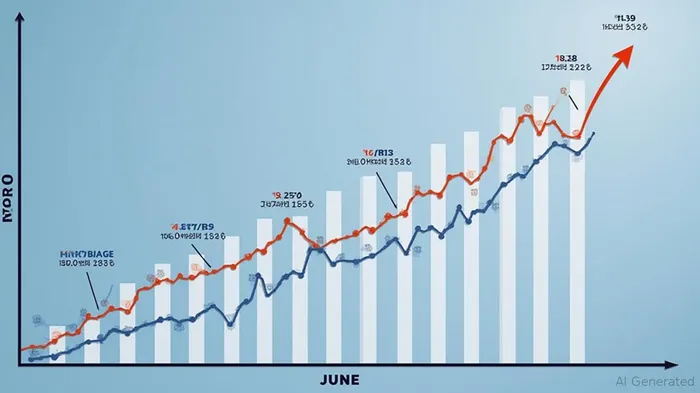
The Data: A Fragile Equilibrium
The June reading reflects a housing market balancing on a tightrope. Buyers are entering the market despite 30-year mortgage rates hitting 6.98% in May—the highest since January . The MBA's Mortgage Market Index rose to 250.8 in May, signaling robust purchase demand as borrowers time applications to fleeting rate dips. Meanwhile, FHA loans accounted for 39.2% of new purchases, highlighting reliance on government-backed mortgages.
Yet challenges persist. New home sales dropped 12.1% in May to a seasonally adjusted annual rate of 631,000 units, while the median mortgage payment for purchases rose to $2,211—up 1.0% month-over-month. This affordability squeeze, exacerbated by rising loan sizes ($379,209 in May), underscores a critical divide: resilient demand meets stubbornly high costs.
Why the Rise? Parsing the Drivers
1. Inventory Shortages: A 9% month-over-month drop in new home purchase applications in May reflects scarcity, not weakness. Buyers are competing fiercely for limited listings, pushing prices higher even as sales volumes dip.
2. Wage Growth Outpacing Payments: The PAPI (Purchase Applications Payment Index) declined 0.6% in April due to earnings growth outpacing payment increases, though annual affordability gains have slowed.
3. Rate Volatility as a Catalyst: Borrowers rushed to lock in rates during dips, such as the 6.92% flash drop in late May, boosting applications by 12.5%. This “rate-driven sprint” has become a recurring theme in 2025.
Policy Implications: The Fed's Tightrope
The Federal Reserve watches housing closely. Sustained demand could reinforce its inflation-fighting resolve, but cooling refinancing activity (down 7% in May) might temper urgency. The MBA projects mortgage rates to fall to 5.9-6.2% by year-end, but the Fed's next move hinges on broader economic signals.
Sector Implications: Winners and Losers
- Consumer Finance Lenders (e.g., Wells Fargo, JPMorgan Chase): Stand to gain as purchase demand drives origination volumes. Their diversified revenue streams—combining mortgages, credit cards, and commercial lending—insulate them from rate fluctuations.
- Mortgage REITs (e.g., Annaly Capital Management, AGNC): Face pressure as refinancing declines erode their income. Their business model, reliant on rate spreads, struggles in volatile environments.
- Homebuilders (e.g., Lennar, D.R. Horton): Benefit from strong demand but face inventory constraints. Rising material costs and labor shortages could limit profit margins unless rates ease significantly.
Investment Strategy: Play the Demand Side, Avoid Rate Leverage
- Overweight Consumer Finance Stocks: Institutions with mortgage origination exposure (e.g., WFC, JPM) should outperform as purchase activity holds.
- Underweight Mortgage REITs: Their reliance on refinancing volume makes them vulnerable to prolonged rate volatility.
- Monitor Treasury Yields: A rise in the 10-year yield (currently ~4.5%) could amplify housing affordability concerns and pressure equities.
Conclusion: A Market in Transition
The MBA Purchase Index's rise to 180.9 signals a housing market resilient to high rates but increasingly dependent on inventory and wage growth. Investors should prioritize firms benefiting from purchase demand while hedging against refinancing headwinds. Keep an eye on July's existing home sales data and the July Federal Open Market Committee (FOMC) minutes—they'll reveal whether this resilience is sustainable or a fleeting flicker.
In a market defined by paradox—high demand with high costs, resilience amid uncertainty—data like the MBA Index offers a compass. Follow the demand, but keep one eye on the Fed.





Comentarios
Aún no hay comentarios