
Housing Market Momentum and the Dislocation Between Mortgage Rates and Home Sales Sentiment: Implications for Real Estate and Financial Assets
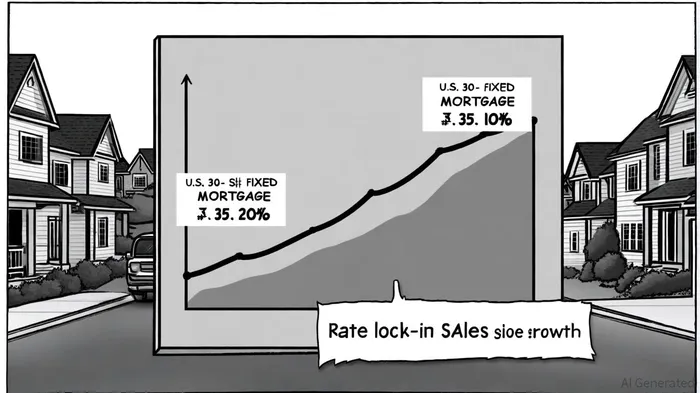
The U.S. housing market in 2025 is defined by a stark dislocation between persistently high mortgage rates and fragile home sales sentiment. Despite a modest 3.4% rise in existing home sales in October 2024, the 30-year fixed mortgage rate has averaged 6.7% year-to-date, locking in homeowners and deterring new buyers[1]. This "rate lock-in" effect has created a paradox: while homebuilder sentiment dipped in 2025, constrained supply and elevated prices have paradoxically supported wealth effects, with median home values rising 3% year-to-date[6]. The result is a market where affordability challenges coexist with latent demand, poised to shift as rates ease.
The Mortgage Rate-Home Sales Dislocation: A Structural Challenge
High mortgage rates have fundamentally altered buyer behavior. According to a report by MorningstarMORN--, 30% of median monthly mortgage payments now consume household income, disproportionately affecting first-time buyers[1]. This affordability crisis has led to a surge in renter-occupied households, which grew 4.2% in 2025 compared to 1.8% for owner-occupied households[1]. Meanwhile, homebuilder sentiment, though briefly rebounding in July 2025, remains below pre-pandemic levels, reflecting uncertainty over near-term demand[5].
The Federal Reserve's projected rate cuts—expected to bring mortgage rates to 5.9% by September 2026—have not yet translated into market optimism. As noted by JPMorganJPM--, the housing market remains sensitive to inflation and deficit dynamics, with experts forecasting a 3–14% rise in home sales only if rates fall as anticipated[6]. This lag between policy expectations and market behavior underscores the structural rigidity of the current dislocation.
Implications for Real Estate and Financial Assets
1. REITs: Resilience Amid Volatility
Real Estate Investment Trusts (REITs) have demonstrated surprising resilience despite the challenging environment. The Morningstar US Real Estate Index rose 2.31% year-to-date, outperforming the S&P 500, as disciplined balance sheets and access to capital insulated them from broader market volatility[4]. Multifamily REITs, in particular, have thrived, with strong occupancy rates (92% in Q2 2025) and rising rents driven by limited housing supply[6].
However, sector performance is uneven. Industrial and lodging REITs face headwinds from trade policy uncertainty and construction cost inflation, while data center REITs benefit from long-term demand for digital infrastructure[4]. Office REITs are in a slow recovery, with companies gradually returning to in-person work, but their performance remains tied to broader economic confidence[4].
2. Mortgage-Backed Securities and Delinquency Risks
The surge in mortgage rates has also exposed vulnerabilities in mortgage-backed securities (MBS). Delinquency rates for FHA loans have risen 2.5 percentage points compared to pre-pandemic levels, signaling early-stage distress among middle-income borrowers[2]. Commercial mortgage-backed securities (CMBS) face similar risks, with Q1 2025 delinquency rates at 5.2%[4]. These trends are exacerbated by a $929 billion maturing commercial real estate loan pipeline in 2025–2026, particularly in office and retail sectors[4].
3. Cap Rates and Investor Sentiment
Investor sentiment for commercial real estate has turned cautious. CBRE's H1 2025 Cap Rate Survey revealed a 9-basis-point decline in cap rates, with nearly a quarter of respondents in retail, industrial, and hotel sectors anticipating further declines over six months[3]. This pessimism is fueled by macroeconomic uncertainty, including volatile Treasury yields and tariffs announced in April 2025, which 16% of CBRE professionals expect to significantly reduce CRE sales volume[3].
Strategic Opportunities and Risks
For investors, the dislocation between mortgage rates and home sales sentiment presents both risks and opportunities. REITs with exposure to rental markets—particularly single-family and senior housing—offer defensive appeal, while construction and sustainability-focused firms may benefit from pent-up demand for housing[1]. Conversely, rising delinquencies in MBS and CMBS could lead to a wave of distressed assets, creating acquisition opportunities for capital with risk tolerance[5].
Long-term structural demand for housing and climate-resilient infrastructure remains intact, but short-term volatility will persist. As Morgan Stanley notes, the U.S. needs 18 million new housing units by 2035 to meet demographic and economic shifts, a goal complicated by labor shortages and material costs[1].
Conclusion
The 2025 housing market is a study in contradictions: high rates suppress activity but support wealth effects, while shifting demographics and policy uncertainty reshape asset valuations. For real estate and financial assets, the path forward hinges on the Federal Reserve's ability to engineer a soft landing and the market's capacity to absorb structural imbalances. Investors who prioritize sectors with pricing power (e.g., multifamily REITs) and avoid overexposure to delinquency-prone assets may navigate this dislocation with resilience.







Comentarios
Aún no hay comentarios