
US Housing Market Downturn: A Systemic Risk for Australia's Export-Dependent Builders?
The Australian construction and building materials industry has long been a cornerstone of the nation's economy, driven by domestic demand for housing, infrastructure, and commercial projects. However, as the U.S. housing market faces a prolonged slump—marked by high interest rates, affordability crises, and shifting demographic trends—investors must ask: Is Australia's construction sector truly insulated from these global headwinds?
Indirect Dependencies: A Web of Global Supply Chains
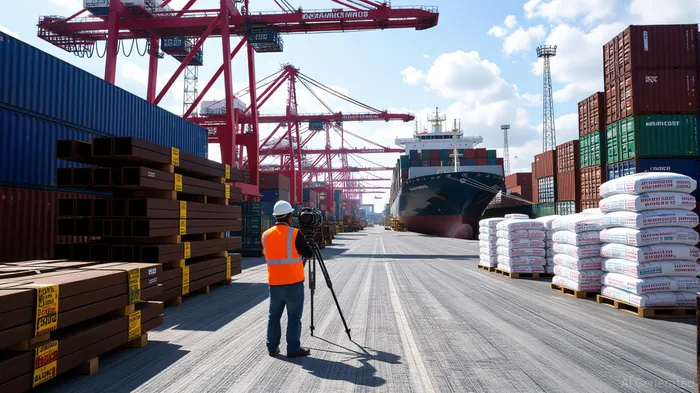
While direct exports from Australian construction firms to the U.S. remain minimal, the industry's indirect ties to the U.S. housing market are far more complex. Over the past five years, U.S. trade policies, particularly the Trump-era tariffs on Chinese imports (peaking at 145%), have disrupted global supply chains. These tariffs redirected trade flows, forcing Australia to import higher-cost materials like steel and cement from alternative suppliers. For instance, Chinese steel exports to Australia surged as domestic production struggled with high energy costs and limited economies of scale.
The depreciation of the Australian dollar since 2020 further exacerbated costs, making imported materials 20–30% more expensive. This has placed pressure on Australian firms, which rely on 40% of their steel and 30% of their timber from international markets. The ripple effects of U.S. trade tensions have thus indirectly inflated input costs for Australian builders, squeezing profit margins.
Financial Performance: A Tale of Two Sectors
The financial health of Australia's construction firms reflects this duality. Between 2020 and 2025, the industry's revenue contracted at a compound annual growth rate (CAGR) of -1.2%, reaching $521.2 billion in 2025. Residential construction, once a growth engine, has faltered due to mortgage rate hikes and reduced government subsidies. In contrast, non-residential and infrastructure projects—fueled by public-private partnerships (PPPs) and government spending—have provided a lifeline.
Key players like CIMIC Group (ASX: CIM), Downer Limited (ASX: DOW), and John Holland (ASX: JHOL) have maintained market dominance, with revenues of $8.3 billion, $4.0 billion, and $3.8 billion in 2025, respectively. These firms have leveraged infrastructure contracts and energy transition projects to offset residential sector declines. However, their earnings remain vulnerable to material price volatility and labor shortages.
Systemic Risks: Beyond Material Costs
The U.S. housing market's weakness has also amplified systemic risks for Australian builders. For example:
1. Supply Chain Fragility: Australia's reliance on imported materials leaves it exposed to geopolitical tensions and shipping bottlenecks. The 2024–2025 period saw a 35.5% year-on-year increase in construction insolvencies, with firms like Roberts Co collapsing under cost pressures.
2. Currency Volatility: A weaker Australian dollar increases debt servicing costs for firms with U.S. dollar-denominated loans, compounding financial strain.
3. Labor Shortages: A national shortfall of 197,000 infrastructure workers has slowed project timelines, reducing returns on capital.
Investment Implications: Navigating the Downturn
For investors, the key lies in discerning firms that can adapt to these challenges. Here's a framework for assessing long-term viability:
- Diversification: Prioritize companies with a balanced portfolio of residential and non-residential projects. Firms like Lendlease (ASX: LLC) and Altrad Group (ASX: ALG) have shown resilience by pivoting to infrastructure and renewable energy projects.
- Cost Management: Look for firms adopting modular construction and digital tools to reduce waste and improve efficiency. The rise of “dry construction” methods, which use prefabricated components, is a promising trend.
- Government Partnerships: Firms with contracts under initiatives like the Northern Australia Action Plan (AUD 30 billion allocated to housing and transport) are better positioned to weather market cycles.
- Currency Hedging: Companies with robust hedging strategies against the U.S. dollar can mitigate exposure to material price swings.
Conclusion: A Sector at a Crossroads
The U.S. housing market's downturn is not a direct threat to Australia's construction firms but a catalyst for systemic risks through global supply chains and financial interdependencies. While the industry's domestic demand remains robust, its long-term viability hinges on innovation, diversification, and strategic alignment with government priorities.
For investors, the path forward is clear: Avoid overexposure to firms reliant on imported materials and residential construction alone. Instead, focus on companies with infrastructure expertise, cost-efficient operations, and a track record of navigating macroeconomic volatility. In a world of interconnected markets, resilience is the ultimate competitive advantage.







Comentarios
Aún no hay comentarios