
Household Debt Trends and Financial Vulnerability: A Global Perspective on Macroeconomic Risks and Investment Opportunities
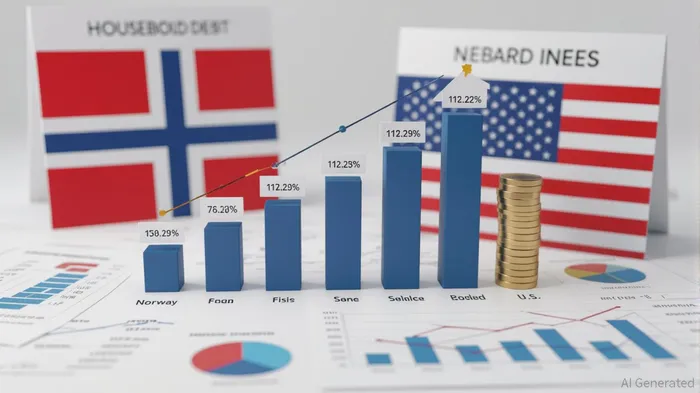
The global financial landscape in 2025 is marked by a paradox: while the U.S. grapples with a household debt burden of $17.57 trillion, it remains the 10th most indebted nation when measured by debt-to-income ratios. Nine developed economies—Norway, Australia, Canada, Switzerland, Denmark, Sweden, Luxembourg, New Zealand, and the Netherlands—have higher ratios, some exceeding 160%. These figures, derived from QuickLoan Pte Ltd's 2024 report, reveal not just the scale of household leverage but also the nuanced interplay between economic resilience, policy frameworks, and global macroeconomic risks.
The Debt-to-Income Divide: A Global Ranking
- Norway (169.79%): With an average household debt of $74,629 against an annual income of $43,955, Norway's high leverage is offset by strong employment growth and stabilizing mortgage rates.
- Australia (163.37%): Housing prices remain resilient, but policymakers warn of overvaluation risks. The Australian dollar's role as a global stabiliser could mitigate trade tensions.
- Canada (157.68%): A variable-rate mortgage-heavy system is easing, yet financial stress persists among renters and low-income households.
- Switzerland (143.75%): Robust banking liquidity buffers and a diversified economy provide a buffer against shocks, though commercial real estate faces long-term demand shifts.
- Denmark, Sweden, Luxembourg, New Zealand, and the Netherlands: These nations share similar profiles—declining debt-to-income ratios, rising consumer credit arrears, and concentrated vulnerabilities in specific demographic segments.
Macroeconomic Risks: A Shared but Uneven Burden
The Global Financial Stability Report (GFSR) highlights three interconnected risks shaping these economies:
Geoeconomic Confrontation:
Tariff escalations between the U.S. and China, coupled with the EU's Carbon Border Adjustment Mechanism, threaten trade-dependent economies like Australia and Canada. For instance, Australia's reliance on Chinese demand for commodities makes it particularly vulnerable to protectionist shifts.Supply Chain Fragility:
The report notes that 70% of the nine countries have high exposure to global supply chains, with Switzerland and the Netherlands facing acute risks from geopolitical disruptions. Diversification efforts are underway, but progress is uneven.Debt and Inequality:
While Norway and Denmark have strong household resilience, rising consumer credit arrears in Canada and Sweden signal growing pressure on low-income households. Inequality, ranked #7 in the 2025–2027 risk outlook, exacerbates these vulnerabilities, particularly in countries with high debt-to-income ratios.
Investment Opportunities: Resilience in the Shadows
For investors, the key lies in identifying underleveraged or more financially resilient economies within this group. Consider the following strategies:
Norway and Switzerland: Defensive Plays:
Norway's stabilizing mortgage rates and Switzerland's banking sector liquidity buffers make them attractive in a risk-off environment. The latter's commercial real estate market, though depressed, could rebound as remote work trends normalize.Australia and the Netherlands: Trade Resilience:
Australia's dollar is poised to benefit from a global slowdown, acting as an automatic stabiliser. The Netherlands, with its diversified economy and declining debt ratios, offers long-term stability.Luxembourg and Denmark: Policy-Driven Growth:
Luxembourg's corporate sector, though exposed to European banking risks, benefits from strong earnings. Denmark's focus on green energy and public investment could yield long-term gains.
The Underleveraged Edge: A Case for the Netherlands
While the U.S. is the 10th most indebted nation, its debt-to-income ratio (112.21%) is 30% lower than the average of the nine countries. The Netherlands, with a ratio of 117.60%, stands out for its declining household debt and strong public investment in infrastructure. This suggests a unique opportunity: economies with moderate debt levels but robust policy frameworks and diversified trade relationships.
Conclusion: Navigating the Debt-Resilience Paradox
The nine countries with higher debt-to-income ratios than the U.S. offer a mixed bag of risks and opportunities. While geoeconomic tensions and supply chain vulnerabilities loom large, resilience in employment, policy adaptability, and diversified economies can mitigate these challenges. For investors, the path forward lies in hedging against overleveraged markets while capitalizing on underleveraged, policy-driven economies like the Netherlands and Switzerland.
As the global economy navigates the next phase of uncertainty, the interplay between debt, resilience, and geopolitical dynamics will remain central to investment decisions. The key is to balance caution with opportunity, leveraging data-driven insights to identify where risk and reward align most favorably.







Comentarios
Aún no hay comentarios