
Hormel Foods' Q3 Fiscal 2025 Performance and Strategic Turnaround Potential: A Path to Sustainable Recovery
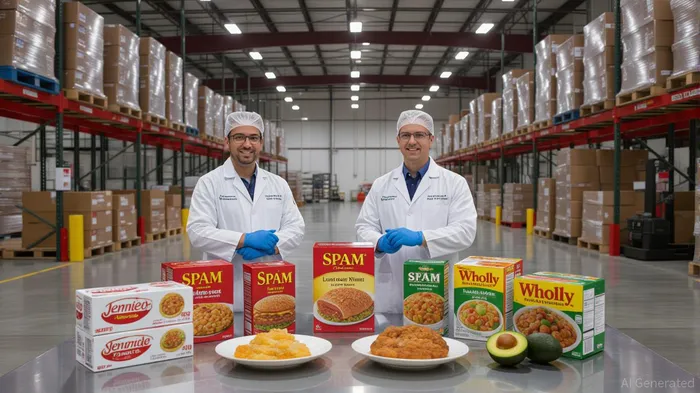
The global food industry is no stranger to volatility, but Hormel FoodsHRL-- (HRL) has navigated the third quarter of fiscal 2025 with a mix of resilience and strategic recalibration. While the company's top-line performance—$3.03 billion in net sales, a 6% organic growth year-over-year—signals robust demand for its core products, the earnings shortfall ($0.33 EPS vs. $0.40 estimated) underscores the persistent headwinds of inflationary pressures and operational inefficiencies. For investors, the question is whether Hormel's ongoing transformation can bridge the gap between revenue strength and profitability, or if the challenges will erode long-term value.
Top-Line Resilience Amid Cost Pressures
Hormel's Q3 results reflect a company balancing growth with cost constraints. The Retail segment, driven by strong demand for Jennie-O® turkey and SPAM® products, saw a 5% volume increase and a 6% rise in net sales. However, segment profit declined by 4%, primarily due to higher commodity input costs. Similarly, the Foodservice segment managed a 3% net sales increase despite a 4% volume drop, but profit fell by 1%. The International segment, though growing in volume and sales, faced a 13% profit decline in Brazil due to competitive pressures.
The effective tax rate rose to 22.3%, and operating margins contracted to 7.9% from 8.4% in the prior year. These metrics highlight a critical tension: Hormel's ability to capture market share is outpacing its ability to convert revenue into earnings. The company's cash flow from operations ($157 million) and inventory strategy (stockpiling amid supply chain risks) suggest short-term liquidity is intact, but long-term sustainability hinges on cost discipline.
Portfolio Innovation and the Transform & Modernize Initiative
Hormel's strategic response to these challenges is twofold: portfolio innovation and the Transform & Modernize (T&M) initiative. The company has launched products like SPAM® singles in bacon and hot and spicy flavors, Wholly® guacamole in chili lime, and Applegate® frozen breakfast sandwiches, all targeting evolving consumer preferences for convenience and global flavors. In the Foodservice segment, Hormel® premium pepperoni's 20% volume growth and the introduction of Fontanini® hot honey sliced sausage demonstrate a focus on high-margin, differentiated offerings.
The T&M initiative, now in its second year, has delivered measurable value. Approximately 90 projects in Q3 optimized the manufacturing network, including facility closures and production reallocation, projected to yield $100–150 million in annual savings. Modernized packaging for Hormel® pepperoni and the “Boldly Irresistible” campaign aim to reinvigorate brand equity. These efforts are critical to offsetting input cost inflation, which the company explicitly cited as the primary drag on earnings.
Leadership Realignment and Strategic Execution
July 2025 marked a pivotal shift in Hormel's leadership structure. John F. Ghingo, a seasoned executive with experience at Mondelēz International and Applegate Farms, was appointed President, overseeing Retail, Foodservice, and International segments. His consumer-centric approach aligns with Hormel's push for innovation, while interim CEO Jeff Ettinger's return ensures continuity in financial stewardship. This dual-leadership model balances agility with stability, a rare but effective combination in a sector prone to disruption.
The realignment also includes operational overhauls, such as the Memphis, Tennessee, distribution center and the closure of a California dry sausage plant. These moves, part of the T&M initiative, are designed to streamline supply chains and reduce costs. Christie Crouch's appointment as Vice President of Marketing for Snacking and Entertaining further signals Hormel's commitment to revitalizing legacy brands like Planters® and Corn Nuts®.
Risks and Opportunities for Value Creation
While Hormel's strategy is ambitious, risks remain. Commodity price volatility, particularly in pork and poultry, could persist, squeezing margins even with T&M savings. Execution risks in the T&M initiative—such as facility closures disrupting production or innovation pipelines failing to resonate—could delay profitability. Additionally, the International segment's performance in Brazil highlights the vulnerability of Hormel's global expansion to local market dynamics.
However, the opportunities are equally compelling. Hormel's focus on high-growth categories—plant-based proteins, global flavors, and convenience-driven products—positions it to capitalize on secular trends. The leadership team's emphasis on operational efficiency and brand modernization addresses key pain points in the food retail sector, including inflationary pressures and shifting consumer habits.
Investment Implications
For investors, Hormel's Q3 performance and strategic pivot present a nuanced case. The company's top-line resilience and innovation pipeline suggest a strong foundation for long-term growth, but near-term margin compression and execution risks warrant caution. The T&M initiative's projected $100–150 million in savings could begin to offset cost pressures in 2026, but the timeline for profitability improvement is not immediate.
A cautious, medium-term investment approach appears warranted. Hormel's narrowed fiscal 2025 outlook (2–3% organic sales growth, adjusted EPS of $1.58–$1.68) reflects disciplined cost management and strategic clarity. The board's plan to appoint a permanent CEO by October 2026 adds a layer of predictability, reducing governance risks.
In conclusion, HormelHRL-- Foods is navigating a complex operating environment with a dual focus on innovation and efficiency. While the path to sustainable recovery is not without hurdles, the company's strategic realignment and T&M initiative provide a credible roadmap for value creation. For investors willing to tolerate near-term volatility, Hormel's long-term potential in a resilient food sector remains compelling.





Comentarios
Aún no hay comentarios