
Horizen's Transition to Base: A Privacy-First Layer 3's Path to Scalable, Compliant DeFi
The blockchain landscape in 2025 is defined by a tension between scalability and privacy. As decentralized finance (DeFi) builders and institutional investors seek infrastructure that balances innovation with regulatory alignment, Horizen's strategic pivot to Base-a Layer 2 network developed by Coinbase-positions it as a unique contender. By rebranding as a privacy-first Layer 3 appchain, HorizenZEN-- has integrated Ethereum's security, Base's scalability, and proprietary privacy tools to create a platform tailored for confidential DeFi and enterprise-grade applications. This analysis evaluates the strategic and financial implications of Horizen's EVM-native privacy appchain for developers and institutional stakeholders.
Strategic Positioning: Privacy as a Core Differentiator
Horizen's migration to Base in July 2025 marked a pivotal shift. By anchoring its Layer 3 appchain to Base, Horizen leverages Ethereum's security and Base's throughput while introducing modular privacy features such as zero-knowledge proofs (ZKPs) and trusted execution environments (TEEs). This architecture enables developers to deploy applications with configurable privacy settings, a critical advantage for sectors like DeFi, gaming, and enterprise finance where data confidentiality is paramount. According to the roadmap, Horizen's privacy-centric infrastructure sets it apart.
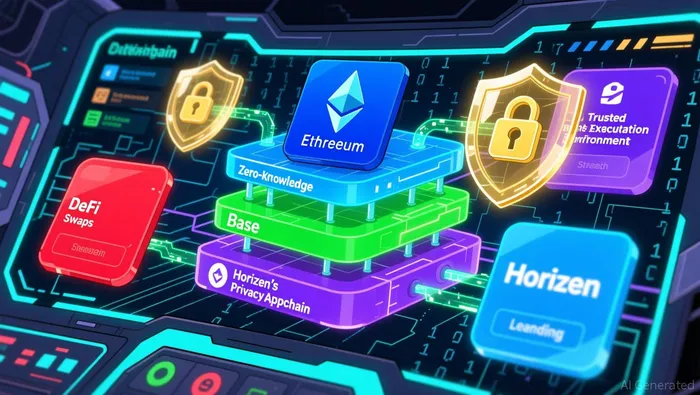 Compared to general-purpose Layer 3 solutions, Horizen's focus on privacy-centric infrastructure sets it apart. While competitors prioritize scalability and low fees, Horizen's integration of stealth addresses via Singularity and zkVerify's optimized ZK proofs addresses a growing demand for "compliant privacy", a balance between user anonymity and auditability required by regulators. This dual focus aligns with broader trends in modular blockchain design, where execution, consensus, and data availability layers are decoupled to enhance adaptability.
Technical Advancements: EVM Compatibility and Privacy Tools
Horizen 2.0, launched in June 2025, introduced an EVM optimized for ZK applications, enabling faster proof generation at minimal cost. This upgrade, coupled with EVM compatibility, allows developers to use familiar tools like Solidity and Node.js without relearning tooling, accelerating adoption. The platform's support for TEEs further strengthens its appeal, as these environments enable secure computation of sensitive data without exposing it to the network.
The migration of ZENZEN-- to Base as an ERC-20 token in July 2025 has also enhanced composability with Ethereum's DeFi ecosystem. ZEN's listing on decentralized exchanges like UniswapUNI-- and Aerodrome has improved liquidity, while its integration with Base's compliance infrastructure reduces friction for institutional investors. This transition underscores Horizen's commitment to bridging privacy and regulatory compliance-a rare combination in the blockchain space.
Financial Implications: Liquidity, Institutional Adoption, and Market Projections
While specific metrics like total value locked (TVL) or quarterly transaction volumes remain undisclosed, Horizen's strategic moves have attracted institutional interest. The allocation of 3 million ZEN (~$46 million) for liquidity pools, developer grants, and exchange listings signals confidence in the ecosystem's growth potential. According to market updates, ZEN's price surge of over 50% in November 2025, trading at $12.75, reflects growing demand for privacy-focused assets amid heightened concerns about surveillance.
Market analysts project ZEN could reach $15 by 2026 and $75 by 2030, contingent on successful upgrades like wallet-level privacy features and the deployment of a ZK proof verification chain in 2026. These forecasts hinge on Horizen's ability to navigate regulatory scrutiny, as 73 exchanges delisted privacy coins in 2025 due to compliance risks. However, Horizen's alignment with Base's compliance framework and its emphasis on "compliant privacy" may mitigate these challenges.
Regulatory Considerations: Navigating Compliance in a Privacy-First Ecosystem
Horizen's Layer 3 appchain is designed to operate within regulatory boundaries by offering tools for selective data disclosure. For instance, TEEs and ZKPs allow institutions to audit transactions without compromising user privacy, a critical feature for enterprises navigating anti-money laundering (AML) requirements. According to the CEO's advocacy, "compliant privacy" seeks to harmonize user anonymity with regulatory expectations.
However, the absence of explicit regulatory certifications in 2025 remains a caveat. While Horizen's integration with Base's compliance backbone is a strategic advantage, developers and investors must monitor evolving legal frameworks, particularly in jurisdictions with strict privacy laws. Certifications like the Certified Crypto Compliance Officer (C3O) or Certified Due Diligence Specialist in Virtual Asset Service Providers (CDD-VASP) could become essential for managing compliance risks.
Conclusion: A Strategic Bet on Privacy-Driven DeFi
Horizen's transition to Base represents a calculated move to address the scalability-privacy tradeoff in DeFi. By combining EVM compatibility, modular privacy tools, and institutional-grade compliance, the platform caters to a niche but growing segment of developers and enterprises prioritizing data confidentiality. For institutional investors, Horizen's alignment with Ethereum's ecosystem and its focus on compliant privacy present a compelling case, albeit with inherent regulatory uncertainties.
As the Layer 3 market expands-with over 35 application-specific chains launched by 2025-Horizen's ability to differentiate itself through privacy-centric innovation will determine its long-term success. For DeFi builders, the platform offers a unique sandbox to experiment with confidential applications, while institutional stakeholders gain access to a privacy-first infrastructure that balances innovation with regulatory alignment.





Comentarios
Aún no hay comentarios