
Hongli Group's Delisting Crossroads: Reverse Split Gamble or Turnaround Necessity?
Hongli Group Inc. (NASDAQ: HLP) faces a critical juncture: its shares have fallen below Nasdaq's $1 minimum bid price requirement, sparking a countdown to potential delisting by January 2026. The company now must choose between a technical fix—a reverse stock split—or a far more challenging path of operational and financial turnaround. For investors, the decision hinges on whether to bet on a short-term compliance maneuver or demand evidence of sustainable business improvements. Here's why the latter may hold the key to survival.
The Delisting Dilemma
Hongli received a Nasdaq deficiency notice on July 10 after its shares closed below $1 for 30 consecutive days. To regain compliance by January 6, 2026, it must either lift its stock price above $1 for 10 straight days or execute a reverse split. A reverse split would artificially boost the price by reducing shares outstanding, but it would not address the root causes of the company's struggles: declining revenue, negative margins, and deteriorating cash flow.
The stakes are high. If delisted, HLP's shares could lose liquidity, face a potential delisting discount, and struggle to attract institutional investors. The company's current valuation—$50.5 million with shares at $0.69—already reflects deep skepticism about its future.
The Technical Fix: Reverse Split Pros and Cons
A reverse split offers an immediate path to compliance. For example, a 1-for-4 split would boost the price to $2.76 (assuming no market reaction), but this would come at a cost.
- Pros: Quick compliance, avoids delisting in the short term, and may stabilize short-term trading.
- Cons: Does nothing to fix underlying financial weaknesses. Investors could revolt, fearing a “death spiral” where the split masks deeper problems.
Historically, the stock's performance around support levels has been inconsistent, with a 47-48% win rate over short-term periods and a maximum return of just 0.32% on day 8. This limited upside potential underscores the fragility of relying on technical bounces alone.
Critically, Nasdaq requires the company to meet all other listing standards for an extension period. Even if HongliHLP-- executes a reverse split, its ability to stay listed depends on maintaining metrics like market cap, share liquidity, and reported earnings—a tall order given its current financial state.
The Fundamental Challenge: Can Hongli Turn Around?
The company's financials paint a dire picture.
- Revenue: Trailing 12-month revenue fell to $14.1 million in 2024, down from $14.3 million in 2023. Revenue per share dropped to $2.4, far below the steel industry median of $56.1.
- Margins: Gross profit margin dipped to 32%, but EBIT and net margins turned negative (-10.1% and -13.3%, respectively).
- Cash Flow: Operating cash flow turned negative (-$0.04 million), while free cash flow declined sharply.
- Debt: While leverage ratios improved (debt-to-equity at 0.18), interest coverage is negative, signaling an inability to service debt from earnings.
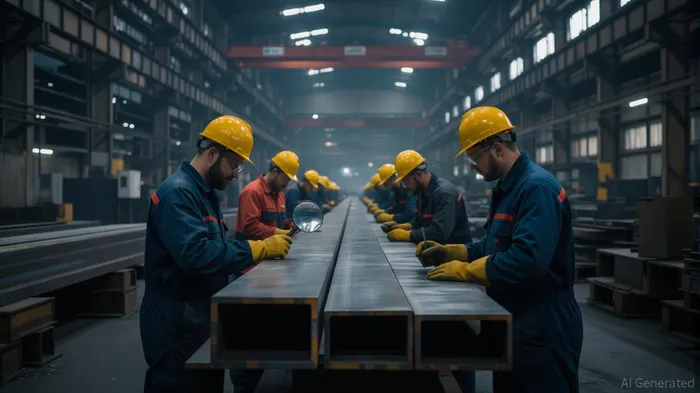
The company's core business—cold-rolled steel profiles for mining, construction, and agriculture—faces headwinds. Global steel demand is volatile, with oversupply and price declines in key markets like China. Hongli's lackluster revenue growth (1.6% annually) and weak profitability suggest it is failing to differentiate itself in a competitive sector.
Industry Context: A Tough Road Ahead
Hongli operates in a mature, capital-intensive industry. Competitors like NucorNUE-- (NUE) and ArcelorMittalMT-- (MT) dominate global markets with scale advantages. Hongli's reliance on China's slowing infrastructure projects and export markets adds further risk. Without cost-cutting, pricing power, or product innovation, its path to profitability remains unclear.
Investment Implications
Investors must ask: Does Hongli have a credible plan to improve operations, or will it rely solely on a reverse split? Key watch points:
- Stock Price Momentum: Can HLP's shares climb above $1 without a split? Current trading at $0.69 suggests little investor confidence.
- Operational Updates: Will the company announce cost reductions, new contracts, or efficiency gains? Silence here weakens the turnaround narrative.
- Reverse Split Timeline: If announced, the split must be finalized by December 20, 2025, to meet the deadline.
Risk Factors:
- Delisting would trigger a liquidity crisis and potential lawsuits.
- Even if listed, negative margins and cash flow could deter investors.
- Reverse splits often fail to restore confidence long-term.
Conclusion: A Gamble with High Stakes
Hongli Group is at a crossroads. A reverse split buys time but does not fix its fundamentals. Investors must decide whether to bet on management's vague “monitor and evaluate” approach or demand evidence of operational restructuring. Given the company's declining revenue, negative margins, and weak cash flow, the odds favor a bleak outcome unless drastic changes occur.
For now, the stock's $0.69 price reflects a market that sees little hope. Until Hongli proves it can stabilize profitability or innovate in its niche, HLPHLP-- remains a high-risk speculation.
In short, Hongli must choose: a temporary technical fix or a costly, uncertain turnaround. Shareholders should ask themselves: Is this a company worth betting on, or just a fading steel profile in a crowded market?





Comentarios
Aún no hay comentarios