
Hong Kong's Commercial Property Crisis and Its Ripple Effects on Global Real Estate Strategies
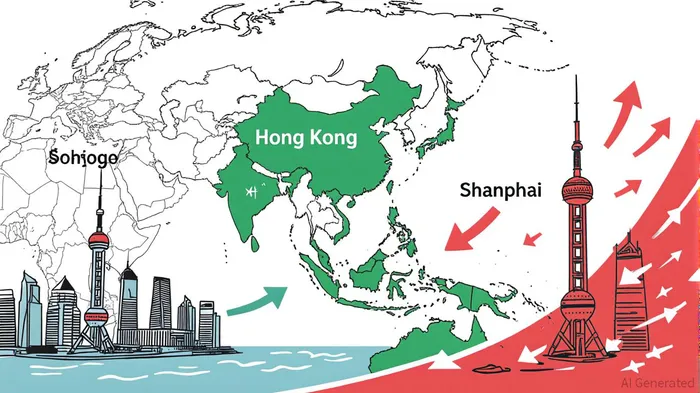
The commercial property market in Hong Kong has entered a prolonged downturn, marked by elevated vacancy rates, declining rents, and cautious investor sentiment. In Q2 2025, the city's Grade A office market recorded an overall vacancy rate of 14.8%, with non-core areas like Kowloon East experiencing a record low net absorption of -273,100 sq. ft. in H1 2025[1]. Prime office rents fell 7.8% year-on-year, and analysts anticipate further declines as oversupply and remote work trends persist[1]. The retail sector, while showing modest improvements in core districts like Tsim Sha Tsui and Mong Kok, faces a 7.3% year-on-year sales decline in 2024, underscoring the sector's fragility[4].
This crisis has triggered a recalibration of risk assessment frameworks and portfolio reallocation strategies across Asian real estate markets. Investors are increasingly shifting capital toward markets perceived as more stable, with Singapore, Tokyo, and Shanghai emerging as key beneficiaries—or, in some cases, cautionary tales.
Singapore: A Magnet for Capital Amid Uncertainty
Singapore has become a focal point for real estate investment, driven by its institutionalized market structure and strategic location. In Q2 2025, the city-state saw a 31% year-on-year increase in commercial real estate investment volumes, reaching US$7.6 billion[3]. This surge was fueled by domestic and foreign investors targeting suburban shopping malls and business parks, as well as REIT privatizations[2]. The Monetary Authority of Singapore's (MAS) accommodative monetary policy, including a 30-basis-point decline in debt costs, has further enhanced the city's appeal[1].
However, risks persist. Despite robust transaction volumes, Singapore's market capitalization relative to GDP fell by 65 percentage points from 2000 to 2024, reflecting structural shifts in capital allocation[1]. Investors are also wary of prolonged due diligence timelines and compressed yield spreads, which could dampen future inflows[3].
Tokyo: Resilience in a Fragmented Market
Tokyo's real estate market has maintained its position as a key APAC destination, supported by strong leasing fundamentals in the office and multifamily sectors. Foreign investors accounted for several high-profile acquisitions in 2025, including a $2.1 billion purchase of a central Tokyo office tower by a European fund[3]. The city's office rents grew 1.2% quarter-on-quarter in Q2 2025, outpacing regional peers[3].
Yet, challenges loom. Rising vacancy risks in the office sector—driven by hybrid work models—and a 45-basis-point decline in debt costs have prompted investors to adopt a more cautious stance[1]. While Tokyo's market remains resilient, its ability to sustain growth hinges on Japan's broader economic recovery and the Bank of Japan's policy trajectory.
Shanghai: A Subdued Market Amid Policy Interventions
In contrast to Singapore and Tokyo, Shanghai's commercial real estate sector remains subdued. Weak liquidity and investor sentiment have persisted despite aggressive fiscal and monetary stimulus from Beijing[3]. The city's industrial and logistics sectors, in particular, face exposure to U.S.-China trade tensions, with punitive tariffs dampening demand[1].
Government interventions, including interest rate cuts and tax incentives, have provided some stabilization. However, the sector's recovery is constrained by high savings rates and weak consumer confidence[1]. Institutional investors have shifted capital toward less cyclical assets, such as senior housing and healthcare facilities, which saw a 12% increase in acquisition volumes in Q2 2025[3].
Implications for Global Real Estate Strategies
Hong Kong's crisis has accelerated a broader trend of portfolio diversification and risk mitigation in Asian real estate. Institutional investors are prioritizing markets with strong governance, liquidity, and yield stability, while avoiding overexposure to cyclical sectors. For example, Nuveen's 2025 Global Trends report notes a shift from over-allocation to under-allocation in real estate, as investors rebalance portfolios amid macroeconomic uncertainty[1].
The ripple effects of Hong Kong's downturn also highlight the interconnectedness of Asian markets. As capital flows realign, policymakers in Singapore, Tokyo, and Shanghai must navigate the dual challenges of attracting investment and managing systemic risks. For global investors, the lesson is clear: in an era of geopolitical volatility and shifting trade dynamics, agility and diversification are paramount.







Comentarios
Aún no hay comentarios