
Hong Kong's 2026 Stablecoin Regulatory Rollout: A Strategic Entry Point for Institutional Investors
Hong Kong's 2026 stablecoin regulatory framework, operational since August 2025, represents a pivotal shift in the global digital asset landscape. By establishing a licensing regime for fiat-referenced stablecoin (FRS) issuers under the Hong Kong Monetary Authority (HKMA), the city has positioned itself as a regional benchmark for balancing innovation with systemic safeguards. For institutional investors, this framework introduces a risk-adjusted opportunity set that merits careful evaluation, particularly as custody infrastructure and compliance standards evolve to meet global expectations.
Regulatory Foundations: Prudence and Transparency
The core of Hong Kong's stablecoin regime lies in its emphasis on capital adequacy, reserve asset management, and AML/CFT compliance. Issuers must maintain a minimum paid-up capital of HK$25 million and segregate reserves into high-quality, highly liquid assets (e.g., cash or government securities) denominated in the same reference currency as the stablecoin. These requirements, outlined in the Stablecoins Ordinance, ensure that stablecoins are fully backed and redeemable without undue burden on holders. For institutional investors, this creates a lower-risk environment compared to unregulated stablecoins, where reserve opacity and redemption risks have historically posed systemic threats.
The HKMA's mandate for public disclosures, including reserve asset policies and independent audit results, further enhances transparency. This aligns with global trends, such as the EU's MiCA framework and the U.S. GENIUS Act, which prioritize reserve standards and redemption rights. By adhering to these principles, Hong Kong's framework reduces counterparty risk for institutional investors, who can now engage with stablecoins backed by verifiable, liquid collateral.
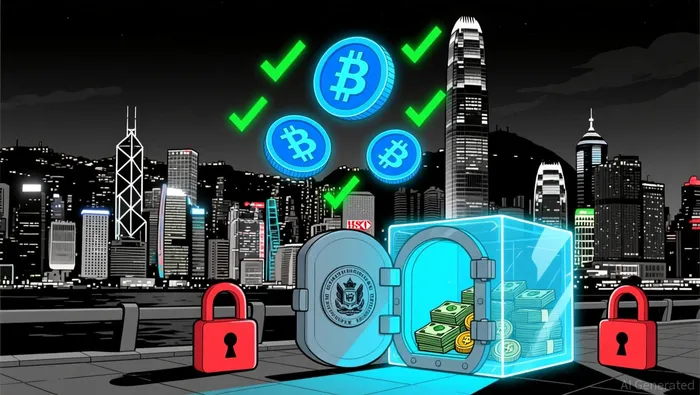
Custody Infrastructure: A Catalyst for Institutional Adoption
A critical enabler of institutional participation is the maturation of regulated custody infrastructure. Hong Kong's rules require stablecoin issuers to maintain segregated reserves protected from creditor claims, a measure that directly addresses past failures in unregulated stablecoin ecosystems. This infrastructure, combined with the Hong Kong Insurance Authority's (IA) proposed rules, allowing insurers to invest in regulated stablecoins, unlocks approximately $82 billion in insurance capital for digital assets. For institutional investors, this signals a shift from speculative exposure to a more structured, risk-managed approach.
Moreover, the HKMA's transitional licensing provisions-offering provisional licenses until January 2026-have facilitated a smooth transition for existing issuers, ensuring continuity while enforcing compliance. This stability is crucial for institutional investors, who require predictable regulatory environments to deploy capital effectively. The city's focus on proportionate governance and operational resilience also aligns with the needs of large-scale investors, who prioritize systemic risk mitigation.
Risk-Adjusted Opportunities: Balancing Innovation and Caution
While the regulatory framework reduces inherent risks, institutional investors must still navigate market volatility and operational constraints. For instance, the IA's requirement for insurers to hold capital equal to the full value of crypto holdings-though conservative-limits leverage and liquidity flexibility. However, the lower risk charges for regulated stablecoins (compared to unpegged cryptocurrencies) offer a compelling middle ground, enabling diversified portfolios that balance yield generation with capital preservation. The broader institutional crypto market in 2026 further amplifies these opportunities. The approval of staking-enabled ETFs for assets like SolanaSOL-- has introduced yield-generating avenues, with global ETF trading volumes reaching $880 billion for BitcoinBTC-- and $277 billion for EthereumETH-- in 2025. Hong Kong's regulated stablecoin ecosystem, coupled with its strategic location as a bridge between East and West, positions the city to capture a significant share of this institutional demand.
Strategic Implications for Institutional Investors
Hong Kong's 2026 regulatory rollout is not merely a compliance exercise but a strategic lever for institutional investors. By adhering to the HKMA's stringent reserve and governance standards, investors gain access to a regulated, transparent stablecoin market that mitigates the risks associated with unbacked tokens. The city's alignment with global frameworks also facilitates cross-border capital flows, particularly as jurisdictions like the U.S. and EU refine their own stablecoin regimes.
However, success hinges on proactive engagement with the evolving custody and compliance infrastructure. Institutional investors must assess their capacity to integrate these requirements into existing risk management frameworks while leveraging Hong Kong's position as a digital asset hub. The city's three-month transitional period for issuers and its emphasis on proportionate regulation suggest a regulator-friendly environment, but vigilance remains essential in a sector prone to rapid innovation and regulatory iteration.
Conclusion
Hong Kong's 2026 stablecoin regulatory framework represents a calculated step toward institutional adoption, blending prudential safeguards with innovation-friendly policies. For investors, the risk-adjusted opportunities are clear: a regulated market with transparent reserves, robust custody infrastructure, and alignment with global standards. Yet, as with any emerging asset class, the path forward demands a nuanced understanding of both the regulatory terrain and the operational realities of digital asset management. In this context, Hong Kong's framework is not just a regulatory milestone-it is a strategic entry point for institutions seeking to navigate the next phase of the digital asset revolution.







Comentarios
Aún no hay comentarios