
Honda's Waning Grip on Vietnam's Motorbike Market: A Golden Opportunity for EV Investors
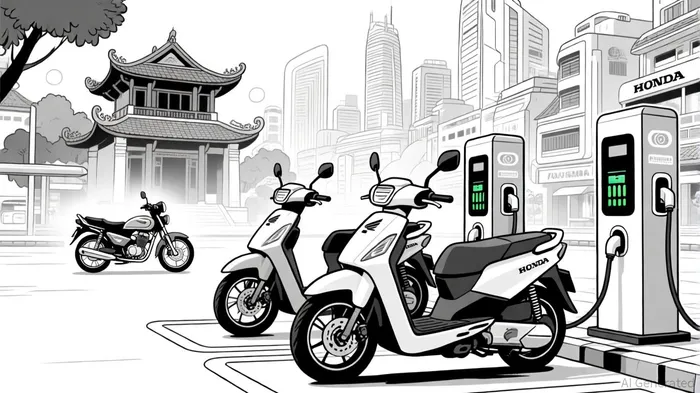
Vietnam's motorbike market, long dominated by HondaHMC--, is undergoing a seismic shift as electrification accelerates. While the Japanese automaker still commands over 80% of the market in 2025, its reign is increasingly precarious. A Reuters analysis reported that Honda Vietnam sold nearly 2.3 million motorcycles in fiscal 2025, but sales plummeted by 18% in August 2025 compared to July, signaling growing consumer hesitation amid government-led electrification policies. Prime Minister Pham Minh Chinh's directive to phase out gasoline-powered motorbikes in Hanoi by 2030 has already begun reshaping demand, with 54% of Hanoi residents now prioritizing electric motorbikes for their next purchase. For investors, this transition represents a critical inflection point-and a chance to capitalize on the rise of Vietnam's electric mobility revolution.
The Cracks in Honda's Empire
Honda's dominance has been built on decades of reliability, affordability, and a near-monopoly on petrol-powered motorbikes. However, its response to the EV transition has been sluggish. While the company has launched electric models like the ICON e: and CUV e: series, consumer adoption remains low compared to local and Chinese competitors, as highlighted in The Investor article. A September 2025 Reuters analysis found that Honda's electric models account for less than 5% of its total sales, a stark contrast to VinFast's 71,000 electric motorbike deliveries in the same period.
Government policies are further eroding Honda's position. Hanoi's planned 2026 ban on gasoline motorbikes in city centers will force a rapid shift in consumer behavior, with infrastructure investments already favoring EVs. For example, VnExpress reports that VinFastVFS-- aims to deploy 150,000 battery-swapping stations nationwide by 2028, while Yadea and TMT Motors are expanding charging networks to address range anxiety. Honda's lack of a comparable infrastructure strategy puts it at a significant disadvantage.
The Rise of EV Pioneers: Strategic Investment Opportunities
The vacuum left by Honda's slow pivot has created fertile ground for emerging players. VinFast, Vietnam's most aggressive EV contender, has positioned itself as a market leader with a dual-pronged strategy: affordable models for mass adoption and premium offerings for urban professionals. The Business Times reports that VinFast's battery-swapping technology, set to launch in October 2025, could redefine convenience in the sector. Meanwhile, Chinese giant Yadea is leveraging its global supply chain to scale production, planning to increase output from 300,000 to 2 million units annually in Vietnam, according to local coverage.
For investors seeking high-growth opportunities, startups like Dat Bike and Selex are particularly compelling. Tuoi Tre reports that Dat Bike raised $22 million in a September 2025 Series B round and is scaling production from 30,000 to 100,000 units annually by 2026 while expanding into Thailand. VOV notes that Selex, a battery-swapping specialist, is targeting delivery services and logistics firms with its modular energy systems, a niche underserved by larger competitors. These companies are not only addressing local demand but also aligning with global sustainability trends, such as the World Economic Forum report on technology convergence.
The Infrastructure Play: Why EVs Are Winning
Infrastructure is a key differentiator in Vietnam's EV race. VinFast's 50,000 battery-swapping stations by 2025 and Yadea's automated swap stations are addressing the "last-mile" challenge of charging, as earlier VnExpress coverage noted. Meanwhile, Dat Bike's partnerships with ride-hailing platforms and financial service providers are accelerating adoption by reducing upfront costs-a critical barrier in a price-sensitive market, according to Tuoi Tre. Honda, by contrast, has yet to announce a comparable infrastructure plan, leaving it vulnerable to a market where 60% of consumers prioritize charging convenience.
Government incentives are amplifying this trend. Zero-upfront-cost schemes in Hanoi, tax breaks for EV manufacturers, and subsidies for battery production are creating a virtuous cycle of demand and supply. Analysts project Vietnam's electric motorbike market will grow from $2.93 billion in 2025 to $6.69 billion by 2030, driven by these policies and rising environmental awareness, a projection cited in Business Times coverage.
Conclusion: Reallocating Capital for the Future
Honda's waning dominance underscores a broader truth: the global motorbike industry is at a crossroads. For investors, the lesson is clear-capital must shift from legacy players to innovators who can scale with the EV transition. VinFast's infrastructure bets, Yadea's production scalability, and Dat Bike's regional ambitions represent three distinct but complementary pathways to capitalize on Vietnam's $6 billion EV market by 2030.
As one industry analyst notes, "The companies that master battery technology, charging networks, and localized production will define the next decade of mobility in Southeast Asia." For Honda, the challenge is to adapt-or risk becoming a footnote in a market it once owned.





Comentarios
Aún no hay comentarios