
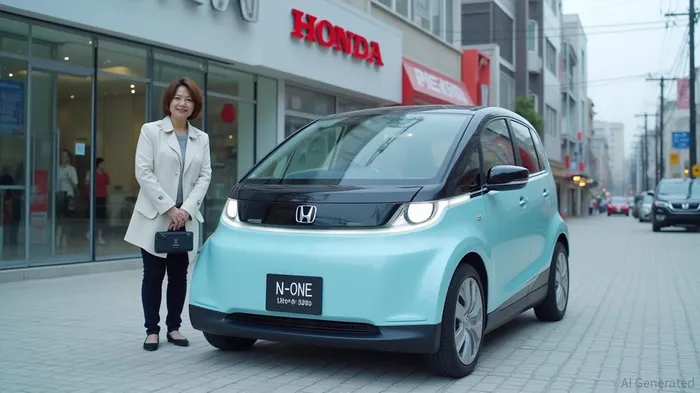
Honda Unveils $18,000 N-ONE e Mini Electric Car in Japan
PorAinvest
jueves, 11 de septiembre de 2025, 6:39 am ET2 min de lectura
HMC--
Honda's entry into the electric vehicle market underscores the growing demand for eco-friendly vehicles and the company's strategy to stay competitive in the industry. The N-ONE e is Honda's first lightweight electric car for Japan and is designed to appeal to the kei car segment, which accounts for about a third of Japan's auto market. Honda already dominates this segment with its gasoline-powered N-Box, the country's top-selling car [1].
The launch of the N-ONE e comes as rivals such as Suzuki Motor and Toyota Motor plan to introduce their own kei EVs later this year, and China's BYD is set to introduce one in 2025 [1]. Meanwhile, Nissan, which is facing its deepest crisis in a quarter century, is also under pressure to accelerate its EV offerings. The N-ONE e's introduction adds to the competitive landscape in Japan's EV market.
Honda's U.S.-listed stock has risen by 19% so far in 2025, while Nissan's U.S.-listed shares have declined by nearly 20% over the same period, reflecting the market's sentiment towards the two companies' EV strategies [1]. The retail sentiment on Stocktwits was 'bearish' for Honda and 'bullish' for Nissan, indicating differing investor views on the companies' EV strategies [1].
Honda's focus on EVs is part of a broader push towards sustainability and energy integration. The company has announced plans to unveil its vision for its electric vehicle and home energy future at RE+ 2025 in Las Vegas, highlighting technologies that aim to transform cars into mobile energy hubs [2]. The company's commitment to turning future EVs into "Virtual Power Plants" could help families trim their monthly energy bills and provide local utilities with a distributed network of small, mobile energy storage units [2].
Honda's partnership with Southern California Edison (SCE) to pilot vehicle-to-home (V2H) and vehicle-to-grid (V2G) systems further underscores the company's commitment to integrating EVs into the broader energy ecosystem [2]. The trials aim to create protocols that let owners tap their vehicles as emergency backup generators during power outages or as dynamic energy sources during high-demand periods [2].
In conclusion, Honda's introduction of the N-ONE e mini electric car in Japan marks a significant step in the company's efforts to expand its electric vehicle offerings and stay competitive in the industry. The car's range and pricing position it well to appeal to the Japanese market, while Honda's broader push towards energy integration positions the company to play a key role in the future of sustainable mobility.
Honda Motor unveiled its $18,000 N-ONE e mini electric car in Japan. The car is part of Honda's efforts to expand its electric vehicle offerings. The N-ONE e has a range of up to 180 kilometers and is aimed at the Japanese market. Honda's entry into the electric vehicle market highlights the growing demand for eco-friendly vehicles and the company's strategy to stay competitive in the industry.
Honda Motor has expanded its electric vehicle (EV) offerings with the introduction of the N-ONE e mini electric car in Japan. The N-ONE e, priced at 2.7 million yen (approximately $18,300), was unveiled on September 10, 2025, and is aimed at the Japanese market [1]. The car, which is part of Honda's strategy to accelerate Japan's transition to electric mobility, offers a range of up to 295 kilometers on a single charge, outperforming Nissan's Sakura EV, which has a range of 180 kilometers [1].Honda's entry into the electric vehicle market underscores the growing demand for eco-friendly vehicles and the company's strategy to stay competitive in the industry. The N-ONE e is Honda's first lightweight electric car for Japan and is designed to appeal to the kei car segment, which accounts for about a third of Japan's auto market. Honda already dominates this segment with its gasoline-powered N-Box, the country's top-selling car [1].
The launch of the N-ONE e comes as rivals such as Suzuki Motor and Toyota Motor plan to introduce their own kei EVs later this year, and China's BYD is set to introduce one in 2025 [1]. Meanwhile, Nissan, which is facing its deepest crisis in a quarter century, is also under pressure to accelerate its EV offerings. The N-ONE e's introduction adds to the competitive landscape in Japan's EV market.
Honda's U.S.-listed stock has risen by 19% so far in 2025, while Nissan's U.S.-listed shares have declined by nearly 20% over the same period, reflecting the market's sentiment towards the two companies' EV strategies [1]. The retail sentiment on Stocktwits was 'bearish' for Honda and 'bullish' for Nissan, indicating differing investor views on the companies' EV strategies [1].
Honda's focus on EVs is part of a broader push towards sustainability and energy integration. The company has announced plans to unveil its vision for its electric vehicle and home energy future at RE+ 2025 in Las Vegas, highlighting technologies that aim to transform cars into mobile energy hubs [2]. The company's commitment to turning future EVs into "Virtual Power Plants" could help families trim their monthly energy bills and provide local utilities with a distributed network of small, mobile energy storage units [2].
Honda's partnership with Southern California Edison (SCE) to pilot vehicle-to-home (V2H) and vehicle-to-grid (V2G) systems further underscores the company's commitment to integrating EVs into the broader energy ecosystem [2]. The trials aim to create protocols that let owners tap their vehicles as emergency backup generators during power outages or as dynamic energy sources during high-demand periods [2].
In conclusion, Honda's introduction of the N-ONE e mini electric car in Japan marks a significant step in the company's efforts to expand its electric vehicle offerings and stay competitive in the industry. The car's range and pricing position it well to appeal to the Japanese market, while Honda's broader push towards energy integration positions the company to play a key role in the future of sustainable mobility.


Divulgación editorial y transparencia de la IA: Ainvest News utiliza tecnología avanzada de Modelos de Lenguaje Largo (LLM) para sintetizar y analizar datos de mercado en tiempo real. Para garantizar los más altos estándares de integridad, cada artículo se somete a un riguroso proceso de verificación con participación humana.
Mientras la IA asiste en el procesamiento de datos y la redacción inicial, un miembro editorial profesional de Ainvest revisa, verifica y aprueba de forma independiente todo el contenido para garantizar su precisión y cumplimiento con los estándares editoriales de Ainvest Fintech Inc. Esta supervisión humana está diseñada para mitigar las alucinaciones de la IA y garantizar el contexto financiero.
Advertencia sobre inversiones: Este contenido se proporciona únicamente con fines informativos y no constituye asesoramiento profesional de inversión, legal o financiero. Los mercados conllevan riesgos inherentes. Se recomienda a los usuarios que realicen una investigación independiente o consulten a un asesor financiero certificado antes de tomar cualquier decisión. Ainvest Fintech Inc. se exime de toda responsabilidad por las acciones tomadas con base en esta información. ¿Encontró un error? Reportar un problema


SOBRE NOSOTROS
Nuestra historiaAutores de noticiasBase de conocimientosPolítica de privacidadTérmino de usoDescargo de responsabilidad de corretaje de tercerosTérminos de uso de AIMEDivulgaciones de riesgos de AInvest AICarrerasCONTÁCTENOS
Email: support@ainvest.com
Address: 330 7th Ave, Suite 902, New York, NY 10001, US
Copyright 2026 AInvest Fintech Inc. All rights reserved.


Comentarios
Aún no hay comentarios