
Honda's $300 Million Investment in Ohio Auto Plants: A Strategic Move Towards EV Market Penetration
Generado por agente de IAWesley Park
miércoles, 29 de enero de 2025, 4:58 pm ET2 min de lectura
AEP--
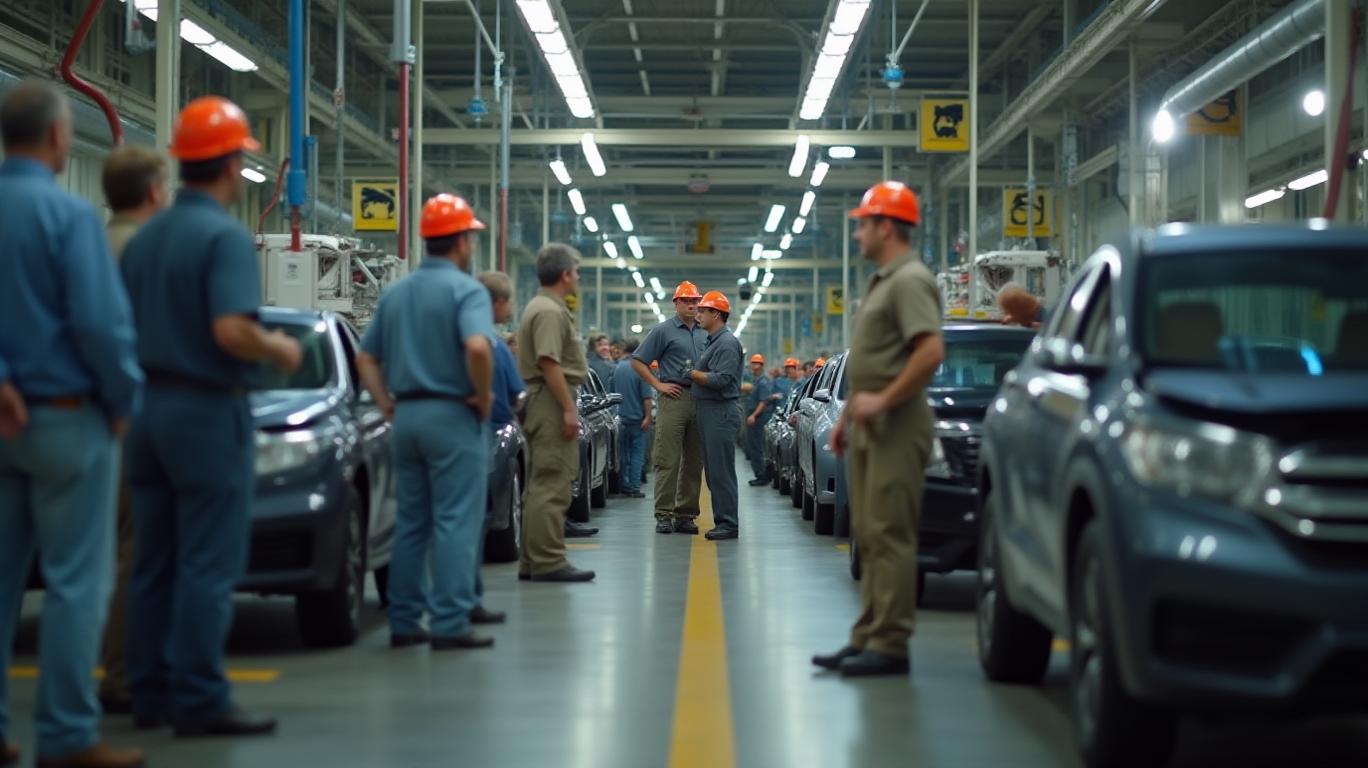
Honda Motor Co., Ltd. has announced a significant investment of $300 million in its three Ohio auto plants, marking a strategic move towards increasing its presence in the North American electric vehicle (EV) market. This investment is part of Honda's broader commitment to achieving carbon neutrality by 2050 and meeting the growing demand for sustainable transportation options.
The $300 million investment will enable Honda to convert its Marysville Auto Plant (MAP), East Liberty Auto Plant (ELP), and Anna Engine Plant (AEP) to begin EV production in North America. This will create an Ohio EV Hub that will play an integral role in Honda's development of knowledge and expertise in EV production (JessHunt, 2022).
By consolidating production lines and reallocating space, Honda will prepare MAP for EV production, with associates undergoing training programs for EV production. This will ensure that every MAP associate has a position during the transition, demonstrating Honda's commitment to its workforce (JessHunt, 2022).
The Indiana Auto Plant (IAP) will take over the production of the top-selling Honda Accord, allowing MAP to transition to EV production while maintaining the production volume of an important core model for Honda customers (JessHunt, 2022).
The Anna Engine Plant (AEP) will re-allocate space for future IPU Case production, supporting the EV production efforts at the Ohio EV Hub (JessHunt, 2022).
The Transmission Plant – Georgia (TMP-G) will partner with a Honda supplier to install a new line to build e-axles, further expanding Honda's EV production capabilities (JessHunt, 2022).
This investment in the Ohio EV Hub will not only enable Honda to produce EVs in North America but also help the company meet its long-term environmental goals, such as achieving carbon neutrality for all products and corporate activities by 2050 (JessHunt, 2022). By accelerating its preparations for EV production and sustaining its current production of internal combustion engine (ICE) and hybrid-electric vehicles, Honda aims to meet strong customer demand through 2030 and beyond (JessHunt, 2022).
Honda is planning to produce several EV models at its Ohio plants, including a mid- to large-size crossover or SUV, an Accord-sized sedan-style EV, and a sub-$30,000 compact EV as part of the "Honda 0 Series." These models will be based on the automaker's own e:Architecture platform, rather than GM's Ultium platform.
1. Mid- to large-size crossover or SUV: This model will be positioned above the Prologue and will likely have three rows of seats, allowing Honda to differentiate it from the Prologue and its Acura ZDX twin, both of which are two-row models. This model will compete with other affordable electric SUVs like the Tesla Model Y, Ford Mustang Mach-E, and Volkswagen ID.4.
2. Accord-sized sedan-style EV: This model was previewed by the Saloon concept at CES and will likely be a futuristic-looking production car. It will compete with other affordable electric sedans like the Tesla Model 3, Chevrolet Bolt EV, and Nissan Leaf.
3. Sub-$30,000 compact EV: This model will be part of the "Honda 0 Series" and will be produced locally in North America. It will compete with other affordable compact EVs like the Chevrolet Bolt EUV, Nissan Leaf, and Hyundai Kona Electric.
Honda's strategy for these EV models is to offer attractive, unique features that set them apart from competitors. The company is focusing on introducing models with Honda's distinctive appeal, advancing production technologies, and expanding charging infrastructure. By doing so, Honda aims to achieve a return on sales (ROS) of 5% for its EV business as of 2030, further increasing its profit margin to make its BEV business self-sustaining.
In conclusion, Honda's $300 million investment in its three Ohio auto plants is a strategic move towards increasing its presence in the North American EV market. By converting these plants to produce EVs, Honda is not only meeting the growing demand for sustainable transportation options but also contributing to its long-term environmental goals. With a diverse lineup of EV models planned for production at these plants, Honda is well-positioned to compete in the rapidly evolving EV market.
HMC--
Honda Motor Co., Ltd. has announced a significant investment of $300 million in its three Ohio auto plants, marking a strategic move towards increasing its presence in the North American electric vehicle (EV) market. This investment is part of Honda's broader commitment to achieving carbon neutrality by 2050 and meeting the growing demand for sustainable transportation options.
The $300 million investment will enable Honda to convert its Marysville Auto Plant (MAP), East Liberty Auto Plant (ELP), and Anna Engine Plant (AEP) to begin EV production in North America. This will create an Ohio EV Hub that will play an integral role in Honda's development of knowledge and expertise in EV production (JessHunt, 2022).
By consolidating production lines and reallocating space, Honda will prepare MAP for EV production, with associates undergoing training programs for EV production. This will ensure that every MAP associate has a position during the transition, demonstrating Honda's commitment to its workforce (JessHunt, 2022).
The Indiana Auto Plant (IAP) will take over the production of the top-selling Honda Accord, allowing MAP to transition to EV production while maintaining the production volume of an important core model for Honda customers (JessHunt, 2022).
The Anna Engine Plant (AEP) will re-allocate space for future IPU Case production, supporting the EV production efforts at the Ohio EV Hub (JessHunt, 2022).
The Transmission Plant – Georgia (TMP-G) will partner with a Honda supplier to install a new line to build e-axles, further expanding Honda's EV production capabilities (JessHunt, 2022).
This investment in the Ohio EV Hub will not only enable Honda to produce EVs in North America but also help the company meet its long-term environmental goals, such as achieving carbon neutrality for all products and corporate activities by 2050 (JessHunt, 2022). By accelerating its preparations for EV production and sustaining its current production of internal combustion engine (ICE) and hybrid-electric vehicles, Honda aims to meet strong customer demand through 2030 and beyond (JessHunt, 2022).
Honda is planning to produce several EV models at its Ohio plants, including a mid- to large-size crossover or SUV, an Accord-sized sedan-style EV, and a sub-$30,000 compact EV as part of the "Honda 0 Series." These models will be based on the automaker's own e:Architecture platform, rather than GM's Ultium platform.
1. Mid- to large-size crossover or SUV: This model will be positioned above the Prologue and will likely have three rows of seats, allowing Honda to differentiate it from the Prologue and its Acura ZDX twin, both of which are two-row models. This model will compete with other affordable electric SUVs like the Tesla Model Y, Ford Mustang Mach-E, and Volkswagen ID.4.
2. Accord-sized sedan-style EV: This model was previewed by the Saloon concept at CES and will likely be a futuristic-looking production car. It will compete with other affordable electric sedans like the Tesla Model 3, Chevrolet Bolt EV, and Nissan Leaf.
3. Sub-$30,000 compact EV: This model will be part of the "Honda 0 Series" and will be produced locally in North America. It will compete with other affordable compact EVs like the Chevrolet Bolt EUV, Nissan Leaf, and Hyundai Kona Electric.
Honda's strategy for these EV models is to offer attractive, unique features that set them apart from competitors. The company is focusing on introducing models with Honda's distinctive appeal, advancing production technologies, and expanding charging infrastructure. By doing so, Honda aims to achieve a return on sales (ROS) of 5% for its EV business as of 2030, further increasing its profit margin to make its BEV business self-sustaining.
In conclusion, Honda's $300 million investment in its three Ohio auto plants is a strategic move towards increasing its presence in the North American EV market. By converting these plants to produce EVs, Honda is not only meeting the growing demand for sustainable transportation options but also contributing to its long-term environmental goals. With a diverse lineup of EV models planned for production at these plants, Honda is well-positioned to compete in the rapidly evolving EV market.

Divulgación editorial y transparencia de la IA: Ainvest News utiliza tecnología avanzada de Modelos de Lenguaje Largo (LLM) para sintetizar y analizar datos de mercado en tiempo real. Para garantizar los más altos estándares de integridad, cada artículo se somete a un riguroso proceso de verificación con participación humana.
Mientras la IA asiste en el procesamiento de datos y la redacción inicial, un miembro editorial profesional de Ainvest revisa, verifica y aprueba de forma independiente todo el contenido para garantizar su precisión y cumplimiento con los estándares editoriales de Ainvest Fintech Inc. Esta supervisión humana está diseñada para mitigar las alucinaciones de la IA y garantizar el contexto financiero.
Advertencia sobre inversiones: Este contenido se proporciona únicamente con fines informativos y no constituye asesoramiento profesional de inversión, legal o financiero. Los mercados conllevan riesgos inherentes. Se recomienda a los usuarios que realicen una investigación independiente o consulten a un asesor financiero certificado antes de tomar cualquier decisión. Ainvest Fintech Inc. se exime de toda responsabilidad por las acciones tomadas con base en esta información. ¿Encontró un error? Reportar un problema


SOBRE NOSOTROS
Nuestra historiaAutores de noticiasBase de conocimientosPolítica de privacidadTérmino de usoDescargo de responsabilidad de corretaje de tercerosTérminos de uso de AIMEDivulgaciones de riesgos de AInvest AICarrerasCONTÁCTENOS
Email: support@ainvest.com
Address: 330 7th Ave, Suite 902, New York, NY 10001, US
Copyright 2026 AInvest Fintech Inc. All rights reserved.


Comentarios
Aún no hay comentarios