
Is M/I Homes, Inc. (NYSE:MHO) Still a Viable Long-Term Housing Sector Play?
The U.S. housing market in 2025 is navigating a complex landscape of high interest rates, affordability challenges, and shifting demand dynamics. For investors evaluating M/I Homes, Inc. (NYSE:MHO), the question of its long-term viability hinges on three critical factors: market timing, sector tailwinds, and valuation attractiveness. This analysis synthesizes recent financial performance, industry trends, and valuation metrics to assess whether MHOMHO-- remains a compelling investment in the housing sector.
Market Timing: A Mixed Bag of Strengths and Weaknesses
M/I Homes reported record second-quarter revenue of $1.2 billion in Q2 2025, a 5% year-over-year increase, driven by the delivery of 2,348 homes—a 6% rise compared to 2024[1]. However, profitability metrics tell a different story. Gross margins contracted to 24.7%, down 320 basis points year-over-year, contributing to an 18% decline in pre-tax income to $160 million[1]. Analysts attribute this to rising material costs (e.g., lumber up 26% YoY) and labor expenses, which have squeezed margins across the industry.
Despite these challenges, MHO's balance sheet remains robust. Shareholders' equity reached $3.1 billion, a 12% increase YoY, with a book value per share of $117[1]. The company's debt-to-capital ratio of 18%[1] underscores its conservative leverage, a stark contrast to peers like D.R. Horton and LennarLEN--, which carry higher debt burdens[4].
Yet, forward-looking indicators are mixed. New contracts fell 8% YoY to 2,078 units, and backlog units declined 25%, signaling potential revenue headwinds[1]. A rising cancellation rate (13% in Q2 2025 vs. 10% in 2024[1]) further highlights buyer hesitation in a high-rate environment. While MHO's stock has outperformed the S&P 500 with a 10% return over the past month[2], the broader housing sector's volatility suggests caution in timing entry points.
Historical backtesting of MHO's stock performance around earnings releases from 2022 to 2025 reveals mixed signals. While average short-term abnormal returns were negative (–0.72% in 1 day, –1.73% in 5 days), medium-term drift showed a cumulative return of +3.44% over 30 days, though this underperformed the benchmark's +4.22%. The win rate of 42.9% suggests no consistent edge from timing purchases around these events[1].
Sector Tailwinds: Structural Challenges and Long-Term Opportunities
The U.S. housing market in 2025 is shaped by elevated mortgage rates (6.7% projected by year-end[2]) and a "lock-in" effect, where homeowners with low-rate mortgages are reluctant to sell. This has kept inventory levels below historical averages, creating a supply-demand imbalance[1]. For MHO, this dynamic could be a double-edged sword: while low inventory supports new home sales, it also limits the pool of potential buyers.
Affordability remains a critical constraint. The total cost of homeownership—encompassing maintenance, insurance, and utilities—has surged by $21,400 annually for single-family homes[1], making new construction less attractive to price-sensitive buyers. However, MHO's ability to offer incentives (e.g., mortgage rate buy-downs[1]) may help offset some of these pressures.
Long-term demand drivers, however, remain intact. By 2035, an estimated 18 million new housing units will be needed to meet demographic shifts, including aging populations and rising single-person households[4]. Policy reforms, such as streamlined zoning for multifamily and accessory dwelling units (ADUs), could also unlock supply-side growth[3]. For MHO, which focuses on single-family homes, these reforms may present indirect opportunities by normalizing housing diversity and easing affordability bottlenecks.
Valuation Attractiveness: Undervalued or Overlooked?
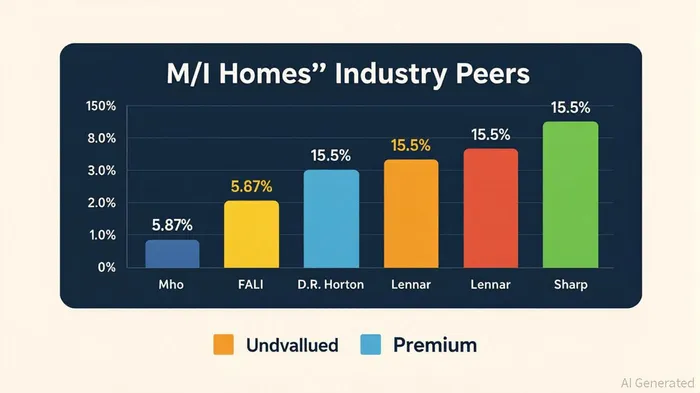
MHO's valuation metrics suggest it is trading at a discount relative to both historical averages and industry peers. As of July 2025, its trailing P/E ratio stands at 5.87–6.12[2], below its 10-year average of 7.39 and significantly lower than the peer group average of 8.11[4]. This gap implies either undervaluation or tempered growth expectations.
A discounted cash flow (DCF) analysis projects a fair value of $97.97 as of April 2025[3], well below the current price of $154.15. However, this model assumes modest growth (0.27%–2.65% CAGR over 10 years[3]), which may understate MHO's potential if housing demand rebounds with rate cuts. Analysts, meanwhile, are more optimistic. A consensus "Buy" rating from five Wall Street analysts[1] and a 12-month price target average of $162.50 (5.4% upside[1]) suggest confidence in MHO's ability to navigate near-term challenges.
Comparative metrics reinforce this view. MHO's EV/EBITDA ratio of 6.49[4] is significantly lower than D.R. Horton's 10.74[4], indicating it is priced for lower growth. While this could reflect skepticism about MHO's margin resilience, it also creates a margin of safety for long-term investors.
Conclusion: A Calculated Bet on Resilience
M/I Homes' position as a housing sector play is neither unassailable nor unwarranted. Its strong balance sheet, conservative leverage, and industry-leading revenue growth position it to weather near-term headwinds. However, structural challenges—such as high rates, affordability gaps, and margin compression—demand a cautious approach.
For long-term investors, MHO's valuation discount and alignment with enduring demand trends (e.g., urbanization, housing shortages[4]) make it an intriguing opportunity. Yet, success hinges on the company's ability to adapt to a shifting landscape: whether through cost optimization, product innovation, or leveraging policy-driven supply-side reforms. As J.P. Morgan notes, "The housing market's path to stabilization will be neither linear nor swift[2]." For MHO, the key will be balancing short-term pragmatism with long-term vision.





Comentarios
Aún no hay comentarios