
Home Depot: A Superior Housing Sector Play Amid Consumer and Professional Market Shifts
The housing sector's resilience during economic uncertainty hinges on its ability to adapt to shifting consumer and professional demand. As of 2025, Home DepotHD-- (HD) emerges as a compelling investment over Fortune Brands Innovations (FBIN) and traditional builders, driven by its dual strength in consumer and professional markets. This analysis examines how Home Depot's strategic positioning and operational flexibility outperform Fortune Brands' fragmented segment performance, particularly in navigating macroeconomic headwinds like high interest rates and housing market pressures.
Market Resilience: Home Depot's Diversified Demand Base
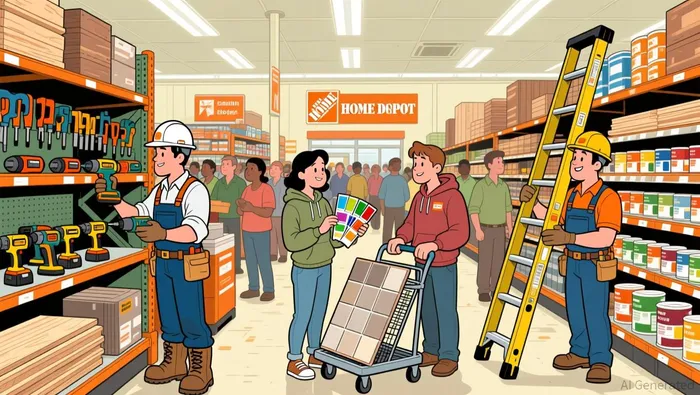 Home Depot's 2024 total sales of $159.5 billion reflect a 4.5% year-over-year increase, with Q4 sales surging 14.1% to $39.7 billion, partly fueled by a 14th week in the quarter. While the company acknowledged challenges in large remodeling projects due to elevated interest rates, it emphasized robust engagement in smaller home improvement initiatives. This duality-balancing consumer DIY enthusiasm with professional contractor demand-creates a buffer against sector-specific downturns.
In contrast, Fortune Brands' 2024 performance was mixed. Its Water Innovations segment (e.g., Moen) achieved $2.6 billion in sales, outperforming the market despite disruptions like hurricanes and software outages. However, the Security segment (Master Lock, SentrySafe) saw a 17% sales decline, attributed to operational issues and competition from smart home providers. This volatility underscores Fortune Brands' reliance on niche segments, which lack the broad-based demand that sustains Home Depot's growth.
Professional Market Leverage: Home Depot's Strategic Edge
Home Depot's focus on professional customers has been a key differentiator. In Q4 2024, all professional cohorts recorded positive comparable sales, driven by investments in store experience, fulfillment, and sales teams. The acquisition of SRS Distribution added $6.4 billion in sales over seven months, further solidifying its B2B footprint. This professional segment growth is critical during economic shifts, as contractors remain active even when consumer demand for large projects wanes.
Fortune Brands' professional market exposure is less pronounced. While its Water Innovations segment maintained a 23.5% operating margin in Q4 2024, the Security segment's margin plummeted to 8.9% due to destocking and distribution issues. Such disparities highlight Fortune Brands' vulnerability to operational disruptions, whereas Home Depot's integrated supply chain and scale provide greater stability.
Consumer Demand: Navigating Macroeconomic Pressures
Home Depot's ability to adapt to consumer behavior shifts is another strength. Despite a 1.8% decline in full-year 2024 comparable sales, Q4 performance showed a 0.8% increase, with U.S. stores rising 1.3%. This resilience stems from a focus on smaller, more affordable projects-a trend accelerated by high borrowing costs. For instance, the company noted a 4% growth in online sales, reflecting its digital transformation.
Fortune Brands' consumer-facing segments, such as Outdoors (Fiberon, Therma-Tru), saw a 2% sales decline in Q4 2024. While the segment maintained a 17.9% operating margin, its modest growth contrasts with Home Depot's broader consumer engagement. Moreover, Fortune Brands' Q3 2025 results showed flat revenue at $1.1 billion, with only a 1% increase excluding China's impact. This stagnation signals weaker consumer demand traction compared to Home Depot's diversified approach.
Strategic Positioning for Long-Term Growth
Home Depot's strategic acquisitions and digital innovations further cement its leadership. The SRS acquisition not only expanded its professional offerings but also opened 20 greenfield locations. Additionally, its Moen Flo Smart Water Monitor drove a 200% year-over-year revenue surge in connected products, aligning with smart home trends.
Fortune Brands, meanwhile, faces margin compression and operational headwinds. Its 2025 Q3 results revealed an 80-basis-point margin decline to 17.9% due to mix and volume challenges. While the company emphasizes free cash flow generation ($177 million in Q3 2025), its reliance on high-margin segments like Water Innovations makes it susceptible to market-specific downturns.
Conclusion: Why Home Depot Outperforms
Home Depot's dual strength in consumer and professional markets, coupled with its strategic agility, positions it as a superior housing sector play. Unlike Fortune Brands, which faces segment-specific risks and margin volatility, Home Depot's diversified demand base and operational scale provide a buffer against economic shifts. As interest rates remain elevated and housing market pressures persist, investors should prioritize companies with the flexibility to adapt-Home Depot's track record of innovation and resilience makes it the clear choice.





Comentarios
Aún no hay comentarios