
S.F. Holding Co., Ltd.'s H Share Lock-Up Expiry and Market Implications
The expiration of lock-up periods for institutional and anchor investor shares in S.F. Holding Co., Ltd. (6936.HK) on May 26, 2025, marked a pivotal moment for the company's H Shares. With 46,407,600 shares-approximately 6.9% of the float-becoming tradable after a 184-day restriction, the market faced a significant liquidity event. Historical precedents and academic studies suggest such events often trigger short-term volatility, yet S.F. Holding's post-expiry performance revealed a nuanced interplay of market dynamics and company-specific fundamentals.
Historical Context and Market Impacts
Lock-up periods, typically lasting 90–180 days, are designed to stabilize post-IPO pricing by restricting early selling. However, their expiration often introduces volatility. For instance, Facebook's shares fell 6% in 2012, Uber's dropped 8.5%, and Beyond Meat's plunged 18.6% post-lock-up expiry, according to Yahoo Finance. These declines are attributed to increased supply overwhelming market absorption capacity. Academic research underscores that liquidity and volatility are inversely correlated, according to the FT.
For S.F. Holding, the May 2025 expiry released a substantial block of shares, raising concerns about downward pressure. Yet, the stock closed at 36.64 on October 2, 2025-a 14.14% increase from its 52-week low of 32.10 recorded on November 28, 2024 (FT data). This rebound contrasts with a 15.82% three-month price decline and a 10.34% annual decline, suggesting mixed investor sentiment (FT data).
Liquidity Dynamics Post-Expiry
The influx of 46.4 million shares into the market likely increased trading volume, a key liquidity metric. While specific post-May 2025 volume data is unavailable, the average daily trading volume of 5.82 million shares prior to expiry indicates a potential surge (Yahoo Finance). Higher trading activity can enhance liquidity but may also widen bid-ask spreads if buyers and sellers struggle to align on pricing. This tension is particularly acute for mid-cap stocks like S.F. Holding, where large institutional sales can disproportionately affect market depth, as discussed in a liquidity analysis guide.
Academic studies highlight that staggered lock-up releases mitigate volatility by distributing share supply over time, as noted in a CapX overview. S.F. Holding's expiry, however, involved a concentrated release, which could have exacerbated short-term liquidity constraints. The company's market capitalization of 208.76 billion HKD further suggests that while the stock is not micro-cap, the sudden availability of 6.9% of its float could test market resilience (Yahoo Finance).
Price Volatility and Investor Sentiment
Price volatility post-lock-up expiry is influenced by both supply-side factors and broader market conditions. S.F. Holding's business model-spanning logistics, freight forwarding, and financial services-faces headwinds such as rising operational costs and regulatory pressures (Yahoo Finance). These fundamentals may have dampened investor confidence, contributing to the 15.82% three-month decline. Conversely, the 14.14% rebound from the 52-week low suggests that bargain hunters or long-term investors perceived value, possibly offsetting some selling pressure (FT data).
Historical data indicates that markets often anticipate lock-up expiry, leading to preemptive price adjustments. For example, Uber's stock began declining weeks before its expiry (Yahoo Finance). In S.F. Holding's case, the October 2025 price of 36.64, while above the 52-week low, still reflects a 10.34% annual decline, implying lingering uncertainty about the company's ability to navigate operational and regulatory challenges (FT data).
Strategic Implications for Investors
Investors must weigh the interplay of liquidity and volatility against S.F. Holding's fundamentals. The company's logistics operations, while resilient in demand, face margin compression due to rising fuel and labor costs (Yahoo Finance). Regulatory scrutiny in China's financial services sector adds another layer of risk. However, the stock's post-expiry rebound suggests that the market may have priced in some of these risks, leaving room for recovery if the company demonstrates operational efficiency or strategic pivots.
For liquidity-sensitive investors, monitoring bid-ask spreads and trading volume in the months following expiry is critical. A narrowing spread would indicate improved liquidity, while a widening one could signal distress. Additionally, the company's ability to maintain core EBIT despite an 11% revenue growth-reported in Q3 2025-highlights its cost management capabilities, a factor that could stabilize investor sentiment, as reported by Morningstar.
Conclusion
S.F. Holding Co., Ltd.'s H Share lock-up expiry in May 2025 presented a textbook case of liquidity-driven volatility. While historical patterns and academic insights suggest short-term downward pressure, the stock's post-expiry performance revealed a complex mix of market forces and company-specific dynamics. Investors navigating this landscape must balance the risks of increased share supply with the potential for value-driven rebounds, all while keeping a close eye on the company's operational and regulatory trajectory.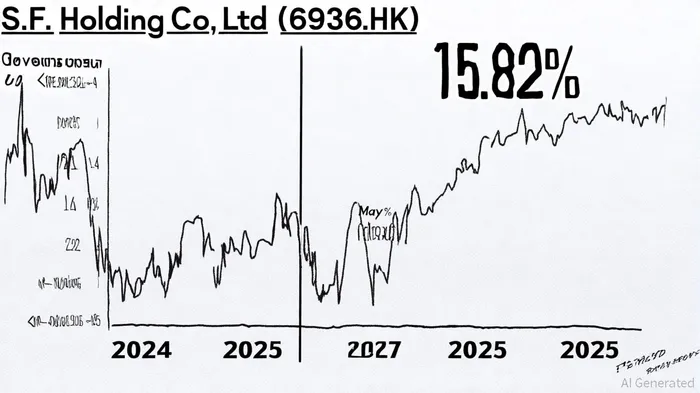







Comentarios
Aún no hay comentarios