
Holcim's 10.8% EBIT Growth and NextGen Growth 2030 Strategy: A Catalyst for Long-Term Outperformance
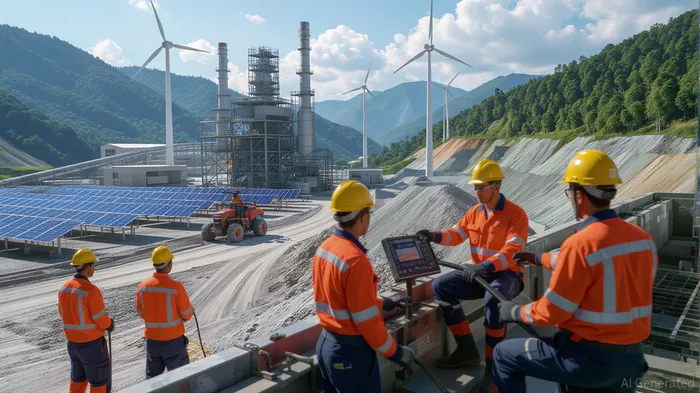
In an industry often criticized for its carbon footprint and commoditized margins, Holcim has emerged as a rare beacon of disciplined growth and sustainability leadership. With recurring EBIT up 10.8% in local currency for the first half of 2025—surpassing even its own full-year guidance—Holcim is not just adapting to the decarbonization megatrend but actively shaping it. This performance, coupled with the execution of its NextGen Growth 2030 strategy and the strategic spin-off of its North American business, positions the Swiss construction giant as a compelling long-term investment.
Margin Expansion and Strategic M&A: Fueling Sustainable EBIT Growth
Holcim's 10.8% EBIT growth in H1 2025 reflects a disciplined focus on margin expansion and high-value product differentiation. The company's recurring EBIT margin hit 22.9% in Q2 2025, a 110-basis-point improvement driven by its high-value strategy—a shift toward sustainable building materials, energy-efficient solutions, and premium pricing in markets like Latin America and Europe. This margin resilience is not accidental. Holcim has executed 11 value-accretive M&A deals since January 2025, targeting regional players with complementary technologies or access to high-growth markets.
The company's M&A playbook is particularly noteworthy. Unlike indiscriminate consolidation, Holcim's acquisitions are strategically aligned with its 2030 vision: expanding its Building Solutions portfolio (e.g., high-performance concrete and modular building systems) and strengthening its circular construction capabilities. For investors, this approach signals a commitment to capital-efficient growth—a critical differentiator in an industry where capex-heavy expansion can erode returns.
NextGen Growth 2030: A Roadmap for Decarbonization and Profitability
Holcim's NextGen Growth 2030 strategy is more than a sustainability pledge—it's a business model reimagined for a net-zero world. The strategy's financial targets—6–10% annual recurring EBIT growth and a 50/50 sales split between Building Materials (cement, aggregates) and Building Solutions (concrete, surfacing)—reflect a clear pivot toward higher-margin, less cyclical segments. By 2030, Holcim aims to derive over 50% of its ready-mix and cement sales from sustainable products like ECOPact (low-carbon concrete) and ECOPlanet (carbon-negative cement).
The environmental targets are equally ambitious: a 30% reduction in Scope 1 emissions by 2030 (versus 2020 levels) and the recycling of 20+ million tons of construction waste. These goals are not just ESG talking points—they're revenue drivers. For instance, Holcim's ECOCycle® technology, which transforms demolition waste into reusable aggregates, is already generating incremental cash flows in Europe. Investors who view decarbonization as a cost burden will be surprised to learn that Holcim's sustainable products now command premium pricing power, with margins outperforming traditional offerings by 3–5 percentage points.
The AmrizeAMRZ-- Spin-Off: A Strategic Divestiture with Strategic Gains
Holcim's June 2025 spin-off of its North American business—Amrize Ltd—marks a pivotal moment in its capital allocation strategy. By separating its largest market (North America) into an independent entity, Holcim has unlocked CHF 18–22 billion in capital for reinvestment in high-potential regions like Latin America and Southeast Asia. The spin-off also simplifies Holcim's structure, allowing it to focus on solutions-driven growth in decarbonization and circular construction.
Amrize's standalone positioning is equally strategic. With $3.4 billion in debt financing and investment-grade credit ratings (S&P: BBB+; Moody's: Baa1), the new entity is well-positioned to capitalize on North America's $1.2 trillion construction market. Its 1,000+ sites and leadership in cement production ensure stable cash flows, while its growth-focused capital plan (including M&A) mirrors Holcim's disciplined approach. For shareholders, the spin-off is a win-win: Holcim gains capital flexibility, and Amrize becomes a standalone high-conviction play on U.S. infrastructure spending.
Why This Is a High-Conviction Long-Term Investment
Holcim's success hinges on its ability to marry profitability with planetary impact. The company's NextGen Growth 2030 strategy is uniquely positioned to benefit from three overlapping megatrends:
1. Decarbonization: Governments and corporations are racing to meet net-zero targets, creating demand for low-carbon materials and energy-efficient solutions.
2. Circular Construction: Holcim's recycling capabilities and ECOCycle® technology position it to capture a growing share of the $400 billion global construction waste market.
3. Urbanization: By 2030, 70% of the global population will live in cities, driving demand for infrastructure and affordable, sustainable housing.
Moreover, Holcim's 50% dividend payout ratio and progressive buyback plan make it an attractive income and capital appreciation play. Its current valuation—trading at a 10x P/E on recurring EBIT—appears undemanding relative to its 2030 growth targets and ESG leadership.
Conclusion: A Model for the Future of Industrial Investing
Holcim's 10.8% EBIT growth is not an anomaly but a symptom of a broader transformation. By combining margin discipline, strategic M&A, and circular innovation, the company is proving that sustainability and profitability can coexist—and even reinforce each other. For investors seeking long-term value in a decarbonizing world, Holcim offers a rare combination of robust financials, strategic clarity, and mission-driven leadership.
As the construction sector grapples with regulatory pressures and shifting consumer preferences, Holcim's NextGen Growth 2030 strategy ensures it will not just survive but thrive. This is a high-conviction investment for those who believe the future of industry lies in building a better world—literally and financially.







Comentarios
Aún no hay comentarios