
Hingham Institution for Savings: Navigating the Low-Rate Labyrinth with Strategic Precision
In the shadow of a persistently inverted yield curve and historically low interest rates, regional banks have faced a dual challenge: preserving profitability while managing balance sheet fragility. Hingham Institution for SavingsHIFS-- (HIFS), a Massachusetts-based thrift with a $4.48 billion asset base, has emerged as a case study in strategic adaptation. Despite a 164-basis-point compression in its net interest margin (NIM) to 1.17% in 2023, according to Hingham's 2023 results, the institution has deployed a combination of funding discipline, loan portfolio optimization, and cost management to mitigate the headwinds of a low-rate environment.
The Funding Rebalancing Act
Hingham's response to rising short-term rates has centered on recalibrating its funding mix. According to its Q3 2023 earnings report, the bank reduced wholesale deposits-a costly liability source-by 26% year-to-date, while increasing borrowings from the Federal Home Loan Bank (FHLB) by 24%. This shift reflects a calculated effort to leverage the FHLB's lower-cost, longer-term advances over volatile wholesale markets. As stated by the bank's management in that report, this strategy "mitigated the negative impact on the cost of funds" amid a 171-basis-point decline in NIM to 1.05% in Q3 2023.
The move also underscores Hingham's agility in navigating regulatory and market constraints. By redirecting non-interest-bearing deposits to higher-yielding alternatives within its product suite, the bank has sought to enhance its interest income without sacrificing depositor relationships. This approach aligns with broader industry trends, where institutions are prioritizing stable, low-cost funding to offset margin pressures.
Loan Portfolio Resilience
While net interest margins have contracted, Hingham has fortified its loan portfolio to sustain revenue streams. Data from its 2023 annual report reveals a 7% year-over-year increase in net loans to $3.914 billion, driven by commercial real estate (CRE) growth in high-growth markets like Boston and Washington, D.C. Notably, CRE loans now constitute 80% of the total portfolio, with owner-occupied residential mortgages accounting for 13% according to the Second-quarter 2023 results. This focus on CRE-particularly in urban centers with resilient demand-has allowed Hingham to maintain asset quality, as evidenced by zero non-performing loans as of December 31, 2023.
The bank's underwriting discipline has been critical. Even as broader economic uncertainties persist, Hingham has maintained a stringent credit culture, avoiding speculative lending while capitalizing on its regional expertise. This strategy has not only preserved profitability but also reinforced investor confidence in its balance sheet stability.
Cost Management and Operational Efficiency
Hingham's ability to navigate a low-rate environment extends beyond its balance sheet. Its efficiency ratio improved to 57.18% in 2023, with operating expenses as a percentage of average assets falling to 0.67%, per the company's 2023 results. This reflects a deliberate focus on structural operating leverage, including automation and streamlined processes. The bank has also expanded its retail and business deposit base in the Washington, D.C. market following a branch approval in June 2023, as noted in its annual report, further diversifying revenue streams.
The Road Ahead
While Hingham's 2023 results-a 29% decline in net income to $26.37 million-highlight the challenges of a compressed margin environment, its strategic adjustments position it to weather prolonged low rates. The shift to FHLB borrowings, CRE-focused lending, and operational efficiency gains demonstrate a proactive approach to margin preservation. However, risks remain: a further inversion of the yield curve or a spike in non-performing loans could test these strategies.
For investors, Hingham's story is a reminder that in a low-rate world, survival hinges not on resisting the tide but on mastering the currents. By recalibrating its funding, refining its asset mix, and tightening its cost structure, Hingham has shown that even in a margin-squeezed landscape, there is room for resilience-and perhaps even reinvention.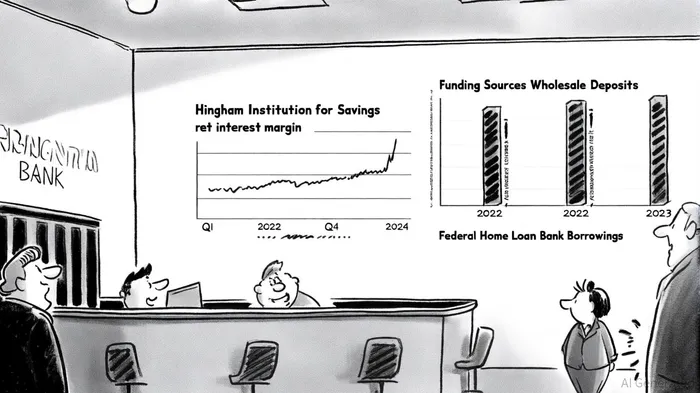





Comentarios
Aún no hay comentarios