
Hims' Strategic Expansion into Hormonal Health and Its Implications for Long-Term Growth
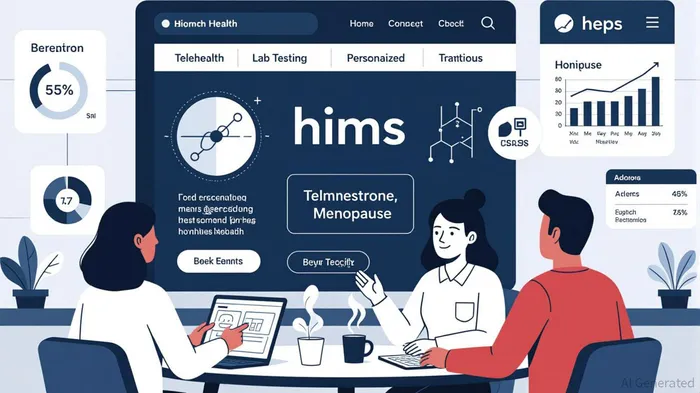
The digital health landscape is undergoing a seismic shift as companies like HimsHIMS-- & Hers Health, Inc. (HIMS) pivot toward preventive care and hormonal health. With the global testosterone replacement therapy (TRT) market projected to grow at a 4.10% CAGR, reaching $2.51 billion by 2030[1], Hims' expansion into low testosterone (low-T) treatment positions it at the intersection of a booming market and evolving telehealth capabilities. This analysis evaluates Hims' strategic moves, financial performance, and competitive positioning to assess its investment potential in this high-growth sector.
Market Opportunity and Telehealth Synergy
The low-T market is driven by aging populations, rising awareness of hypogonadism, and advancements in drug delivery. Telehealth platforms have become critical enablers, with 85% of direct-to-consumer (DTC) clinics offering virtual consultations to streamline lab ordering and improve privacy[1]. Hims has capitalized on this trend, leveraging its digital-first model to deliver TRT services alongside other men's health solutions. By integrating at-home lab testing and personalized treatment plans, the company addresses key barriers to care—geographic limitations and stigma—while aligning with guideline-concordant care[3].
Financially, Hims reported Q2 2025 revenue of $545 million, a 73% year-over-year increase, with 2.4 million subscribers[6]. Its revenue guidance of $2.3–2.4 billion for 2025 underscores confidence in sustaining growth. The company's focus on hormonal health, including low-T and menopause, is part of a broader strategy to transition from reactive treatment to proactive, longevity-focused care[5].
Competitive Advantages and Retention Metrics
Hims' success hinges on its ability to retain customers in a competitive market. Data from industry studies highlights its strength: in weight loss programs, only 25% of customers discontinue treatment at six months, compared to 80% in some public studies[3]. This retention edge is attributed to its subscription model, provider engagement, and app-based tools that foster continuous care. For hormonal health, the company reported 82% customer retention after three months[5], a metric that, if sustained, could drive long-term revenue stability.
The company's vertically integrated model further strengthens its position. By operating a 503a compounding pharmacy and acquiring at-home lab testing capabilities, Hims ensures control over supply chains and diagnostic accuracy[6]. Partnerships with health systems like Ochsner and Mount Sinai also enhance credibility, offering hybrid care models that combine virtual consultations with in-person follow-ups[4].
Challenges and Strategic Risks
Despite its momentum, Hims faces headwinds. The termination of its Novo NordiskNVO-- collaboration over Wegovy distribution issues[7] highlights vulnerabilities in pharmaceutical partnerships. While the company pivoted to compounded GLP-1s, branded drug agreements remain a double-edged sword, balancing revenue potential with regulatory and reputational risks.
Additionally, telehealth limitations—such as the inability to perform physical exams—pose challenges in TRT, where baseline assessments are critical[3]. Hims mitigates this by emphasizing shared decision-making and provider oversight, but these measures may not fully replicate in-person care.
Long-Term Vision and Market Expansion
Hims' ambition to reach $6.5 billion in revenue by 2030[5] hinges on its ability to scale hormonal health offerings. International expansion, including the acquisition of ZAVA in Europe and plans to enter Canada in 2026[6], diversifies its market reach. The integration of lab testing and compounding capabilities also positions Hims to capture a larger share of the preventive care market, where personalized treatment plans are increasingly valued[5].
Conclusion
Hims' strategic expansion into hormonal health aligns with macroeconomic trends in aging demographics and digital health adoption. Its financial performance, retention metrics, and ecosystem of partnerships suggest a resilient business model capable of navigating telehealth and pharmaceutical challenges. However, investors must weigh the risks of regulatory scrutiny, market saturation in GLP-1, and the need for sustained innovation in personalized care. For those willing to bet on the future of preventive healthcare, Hims' trajectory offers a compelling case—provided it can maintain its agility in a rapidly evolving landscape.







Comentarios
Aún no hay comentarios