
HII's Strategic Advancements in Naval Shipbuilding: A Deep Dive into Operational Progress and Growth Potential
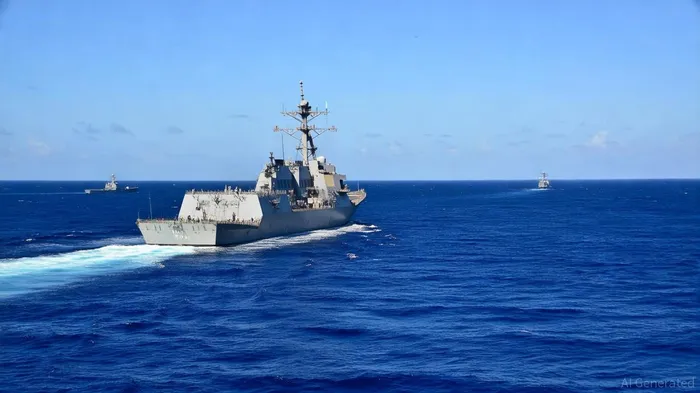
Huntington Ingalls Industries (HII) has cemented its leadership in U.S. naval shipbuilding with the recent completion of builder's sea trials for the Flight III Arleigh Burke-class destroyer Ted Stevens (DDG 128). This milestone, achieved by HII's Ingalls Shipbuilding division, underscores the company's operational excellence and technological prowess in delivering next-generation warships. The trials, conducted in the Gulf of Mexico, rigorously tested the ship's engineering, navigation, and combat systems, including the cutting-edge AN/SPY-6(V)1 radar array, a cornerstone of the Navy's modernization strategy [1]. The successful outcome not only validates HII's engineering capabilities but also positions the company to meet the Navy's urgent demand for advanced surface combatants in an era of rising geopolitical tensions.
Strategic Positioning: Flight III Program and Industrial Base Expansion
HII's Flight III program represents a pivotal shift in naval warfare, equipping destroyers with the Aegis Baseline 10 Combat System and the AN/SPY-6(V)1 radar, which enhances threat detection and engagement capabilities against hypersonic missiles and other advanced threats [2]. The completion of DDG 128 follows the launch and christening of DDG 129 (Jeremiah Denton) in 2025, demonstrating HII's ability to maintain a robust production pipeline. To scale output, HIIHII-- has partnered with Eastern Shipbuilding Group to produce structural units for future destroyers, including DDG-135 through DDG-139, ensuring domestic capacity meets the Navy's 90-ship goal by 2045 [3].
The company's strategic collaborations extend beyond destroyers. HII's acquisition of a manufacturing facility in Charleston, South Carolina, and its distributed shipbuilding model aim to streamline production for submarines and aircraft carriers, addressing long-standing bottlenecks in the defense industrial base [4]. These initiatives align with the Navy's emphasis on distributed lethality and rapid fleet expansion, positioning HII as a critical enabler of U.S. maritime dominance.
Financial Resilience and Analyst Outlook
HII's Q2 2025 financial results reflect its operational strength, with revenue rising to $3.1 billion—a 3.5% year-over-year increase—and a record $56.9 billion backlog, bolstered by $11.9 billion in new contract awards [5]. Free cash flow surged to $730 million, reversing a negative trend from the prior year, while the company reaffirmed its FY25 guidance, projecting shipbuilding revenue between $8.9 billion and $9.1 billion [5].
Despite these positives, analyst sentiment remains cautiously optimistic. A consensus “Hold” rating from 10 Wall Street analysts reflects mixed expectations, with a 12-month price target average of $267.00—slightly below the current stock price of $270.93 [6]. Notably, TD Cowen upgraded HII to “Buy” in late 2025, citing its technological edge and contract visibility, while Deutsche Bank downgraded it to “Hold,” highlighting near-term margin pressures [6]. These divergent views underscore the balance between HII's long-term growth potential and short-term execution risks.
Competitive Advantages and Market Dynamics
HII's dominance in nuclear-powered shipbuilding—exclusive to aircraft carriers, submarines, and Coast Guard National Security Cutters—provides a structural moat against competitors like General Dynamics and BAE Systems [7]. For instance, HII's Newport News Shipbuilding division leads the Virginia-class submarine program, with 24 delivered and 16 under contract, while its partnership with General Dynamics Electric Boat on a $1.2 billion contract modification highlights its role in sustaining the submarine industrial base [8].
Recent contract awards further solidify HII's market position. A $9.5 billion Navy contract for amphibious ships and a $458 million C5ISR modernization deal with the DoD illustrate the company's diversification into digital warfare and IT infrastructure [9]. These contracts, coupled with a 6.37% market share in the Ship & Boat Building Industry, position HII to outperform peers as the Navy prioritizes multi-domain operations and AI-driven systems [10].
Defense Policy and Future Growth
The Department of Defense's focus on rebuilding domestic industrial capacity and accelerating procurement timelines has directly benefited HII. The Navy's multiyear contract expansion, which allocates seven of the next 10 Flight III destroyers to Ingalls through 2027, ensures stable revenue streams [11]. Additionally, HII's retrofit initiative for older Flight IIA destroyers—equipping them with Flight III technologies—extends the lifecycle of its platforms while aligning with budget constraints [12].
Looking ahead, HII's investment in autonomous systems, such as the ROMULUS unmanned surface vessel, signals its intent to lead in next-generation naval tech. As the Navy shifts toward unmanned and AI-enhanced fleets, HII's partnerships with firms like C3 AI to optimize shipbuilding throughput could unlock further efficiency gains [13].
Conclusion
Huntington Ingalls Industries stands at the nexus of U.S. naval modernization, combining operational excellence, technological innovation, and strategic foresight. The successful completion of DDG 128's sea trials is not just a milestone but a testament to HII's ability to deliver complex systems under tight timelines—a critical factor in an era of great-power competition. While near-term analyst caution persists, the company's robust backlog, exclusive capabilities, and alignment with defense policy trends position it as a compelling long-term investment. As the Navy accelerates its fleet expansion and embraces digital warfare, HII's role as the backbone of American maritime power is unlikely to diminish.





Comentarios
Aún no hay comentarios