
HII and Shield AI's Strategic Alliance in Autonomous Defense: A Catalyst for Disruption in the Unmanned Systems Market
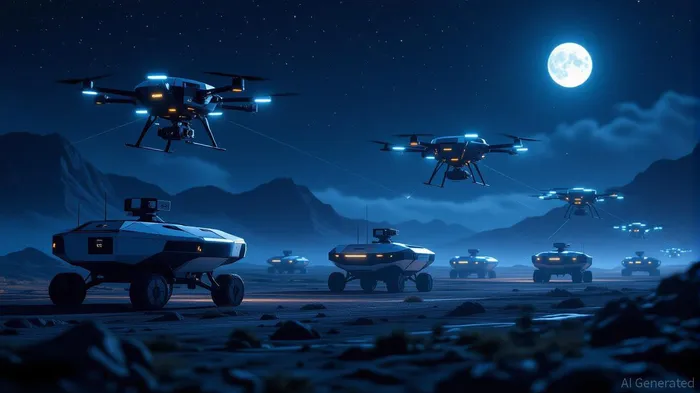
The defense technology landscape is undergoing a seismic shift as artificial intelligence (AI) and autonomy converge to redefine modern warfare. At the forefront of this transformation is the strategic alliance between Huntington Ingalls IndustriesHII-- (HII) and Shield AI, a partnership that promises to accelerate the development of cross-domain autonomous systems. By integrating HII's maritime expertise with Shield AI's cutting-edge mission autonomy software, the collaboration aims to create scalable, mission-critical solutions for air, land, surface, and undersea operations. For investors, the question is not just whether this partnership will succeed, but how it might reshape the $13.2 billion AI in military market, projected to grow at a compound annual rate of 13% through 2032 [3].
Strategic Synergy: Bridging Maritime and AI Expertise
HII's Odyssey suite has already demonstrated its reliability on over 35 unmanned surface vehicle (USV) platforms, accumulating more than 6,000 operational hours [1]. Shield AI's Hivemind software, meanwhile, has proven its mettle in autonomously piloting advanced air vehicles like the MQ-20 Avenger and F-16 [1]. Together, these technologies form a modular autonomy framework capable of adapting to diverse operational environments. This synergy is not merely technical—it is strategic. As the U.S. Department of Defense increasingly prioritizes AI-driven systems for intelligence, surveillance, and anti-submarine warfare, the HII-Shield AI partnership positions itself at the intersection of two high-growth sectors: maritime autonomy and AI-enhanced command systems [2].
The launch of HII's ROMULUS family of AI-enabled USVs further underscores this alignment. The ROMULUS 190, a 190-foot vessel capable of high-speed, long-range operations, is powered by Odyssey and designed for missions requiring rapid deployment and adaptability [2]. Shield AI's V-BAT drone, selected by Japan for electronic warfare support, and its collaboration with PalantirPLTR-- to enhance autonomous command systems, highlight the global demand for AI-driven defense solutions [4]. These developments suggest that the partnership is not just reacting to market trends but actively shaping them.
Market Dynamics and Long-Term Investment Potential
The AI in military market's projected 13% CAGR through 2032 [3] is driven by three key factors: enhanced decision-making, autonomous platforms, and cybersecurity applications. HIIHII-- and Shield AI's focus on cross-domain autonomy directly addresses these drivers. For instance, modular systems that operate seamlessly across air, land, and sea reduce the need for siloed, domain-specific platforms—a cost and logistical burden for defense budgets. This interoperability could unlock new revenue streams for HII, which reported $3.1 billion in Q2 2025 revenues and $152 million in net earnings [5], while Shield AI's VC-backed innovation model ensures agility in responding to rapidly evolving threats.
However, the lack of disclosed financial terms for the partnership raises questions about capital allocation and profit-sharing. While HII's broader financial performance is robust, investors must assess whether the collaboration will generate incremental revenue or merely consolidate existing market share. The answer lies in the broader defense industrial base (DIB) context. As noted in a CRS report, private capital is increasingly flowing into defense AI firms like Shield AI, signaling a shift toward hybrid public-private innovation ecosystems [2]. This trend suggests that the HII-Shield AI alliance could attract follow-on investment, amplifying its disruptive potential.
Risks and Considerations
Despite the optimism, challenges remain. The integration of AI into mission-critical systems faces regulatory and ethical scrutiny, particularly in lethal autonomous weapons. Additionally, the partnership's success hinges on HII's ability to scale its maritime platforms and Shield AI's capacity to maintain technological leadership in a crowded field. For now, the absence of detailed financial metrics for the collaboration means investors must rely on indirect indicators, such as HII's Q2 performance and the AI market's growth trajectory, to gauge long-term viability.
Conclusion
The HII-Shield AI alliance represents more than a technological partnership—it is a strategic bet on the future of warfare. By combining HII's maritime legacy with Shield AI's AI-driven autonomy, the collaboration addresses a critical gap in cross-domain operations. While financial specifics remain opaque, the broader market dynamics and the companies' individual strengths suggest a compelling long-term investment case. For investors, the key will be monitoring how this alliance navigates regulatory hurdles and capitalizes on the AI in military boom.





Comentarios
Aún no hay comentarios