
High-Yield Treasury Platforms: Navigating Explosive Returns and Escalating Risks in 2025
The U.S. Treasury yield market in 2025 is a theater of contradictions. On one hand, the 10-year Treasury yield has climbed to 4.495% as of February 2025, reflecting a market bracing for inflationary pressures and a Federal Reserve that remains "modestly restrictive," according to a Financial Times analysis. On the other, high-yield bonds-often dismissed as volatile-have become a magnet for income-starved investors, offering yields of 7.5% as of December 2024, a stark 217-basis-point premium over investment-grade bonds. This divergence is not accidental. It is the product of a macroeconomic environment where policy uncertainty, geopolitical tensions, and structural shifts in corporate credit fundamentals are converging to create both explosive opportunities and lurking dangers.
The Allure of High-Yield: A Yield Premium in a Low-Growth World
High-yield bonds, or "junk" bonds, have long been a tool for investors seeking to balance risk and reward. In 2025, their appeal has reached a fever pitch. According to a report by Morgan StanleyMS--, U.S. high-yield bonds delivered an 8.2% total return in 2024, outperforming equities and investment-grade debt. This performance is underpinned by robust corporate fundamentals: leverage ratios remain below historical averages, and interest coverage ratios are strong, suggesting companies can service their debt even in a higher-rate environment, as Northern TrustNTRS-- notes.
The yield premium is equally compelling. As of December 2024, U.S. high-yield bonds offered a 7.5% yield, compared to 5.33% for investment-grade counterparts, according to Morgan Stanley data. European high-yield bonds, while slightly riskier, also shine with yields of 5.7% versus 3.18% for their investment-grade peers, per T. Rowe Price. For investors, this represents a rare chance to capture double-digit returns in a world where traditional fixed-income assets struggle to keep pace with inflation.
Structural Shifts: Active Management and Sectoral Opportunities
The rise of high-yield platforms in 2025 is not merely about yields-it is about strategy. Passive high-yield funds, which track indices without selecting individual securities, are increasingly seen as inadequate in a market marked by dispersion. As Wellington Management notes, active managers with deep research capabilities are better positioned to exploit inefficiencies in sectors like energy and technology, where risks and rewards are asymmetric. This shift toward active management reflects a broader recognition that not all high-yield bonds are created equal.
For instance, energy sector credits have benefited from sustained commodity prices and infrastructure spending, while tech-related high-yield bonds face headwinds from regulatory scrutiny and margin pressures. A bottom-up approach allows investors to capitalize on these divergences, avoiding the "one-size-fits-all" pitfalls of passive strategies.
The Risks: Policy Whiplash and Credit Dispersion
Yet, the high-yield landscape is not without peril. The Trump administration's proposed tariffs and immigration reforms have injected a layer of policy uncertainty, with analysts warning of inflationary pressures that could force the Fed to maintain restrictive rates longer than anticipated, a concern highlighted by T. Rowe Price. This creates a dual risk: rising rates could depress bond prices, while policy-driven inflation could erode real returns.
Moreover, credit dispersion is widening. While the overall default rate remains low, individual issuers are experiencing divergent fortunes. AXA IM highlights that high-yield spreads are still below long-term averages, suggesting markets are pricing in optimism that may not materialize. For investors, this means rigorous due diligence is essential. A single "fallen angel" (a bond downgraded from investment grade) can disrupt a portfolio's risk-return profile.
Conclusion: A Balancing Act for 2025
High-yield treasury platforms in 2025 represent a paradox: they offer explosive short-term returns in a low-growth environment but require a nuanced approach to navigate policy risks and credit dispersion. For those willing to deploy active strategies and hedge against macroeconomic shocks, the rewards are substantial. However, as the Fed's hawkish stance and geopolitical tensions persist, caution remains warranted. The key is to treat high-yield not as a speculative gamble but as a calculated bet in a diversified portfolio.
In the end, the market's current fascination with high-yield bonds is a testament to the times. When Treasuries yield less than 4.5%, and inflation expectations hover near 2.4%, investors have little choice but to seek yield where they can. The challenge-and opportunity-lies in doing so without losing sight of the risks.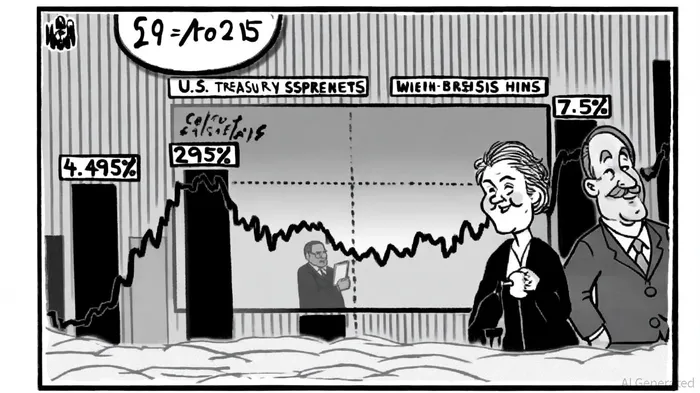







Comentarios
Aún no hay comentarios