
High-Yield Structured ETFs: Evaluating QDTY's $0.1785 Dividend as a Signal of Risk and Reward
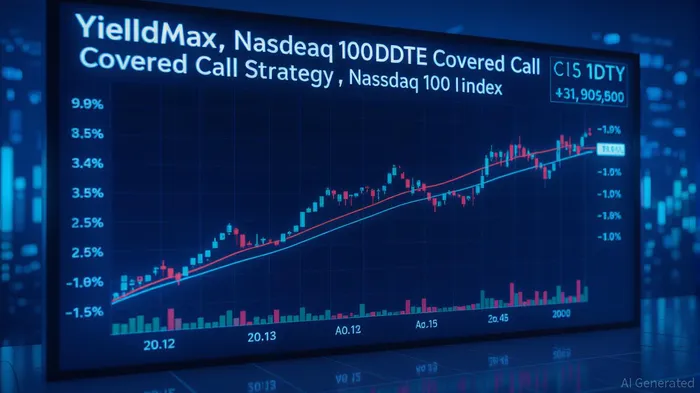
The YieldMax Nasdaq 100 0DTE Covered Call Strategy ETF (QDTY) has emerged as a focal point in the high-yield structured ETF space, offering investors a tantalizing 13.26% annualized dividend yield[1]. Its recent $0.1785 per-share distribution, paid on August 29, 2025, underscores the fund's aggressive income-generation strategy. However, beneath the surface of this attractive yield lies a complex interplay of structural mechanics, market positioning, and risk factors that demand closer scrutiny.
Structural Mechanics: Covered Calls and Return of Capital
QDTY employs a synthetic covered call strategy, writing out-of-the-money call options on the Nasdaq 100 Index or ETFs tracking it to generate income[2]. This approach caps upside potential while retaining exposure to the index's price return. Crucially, the fund's recent dividend distributions have included a significant return of capital component. For instance, the August 29 payout was entirely classified as return of capital[3], signaling that the fund may be returning investors' own money rather than distributing earnings. This raises concerns about sustainability, as return of capital erodes the fund's net asset value (NAV) over time and may indicate limited organic income generation.
According to a report by YieldMax, the fund's strategy involves daily option-writing to convert potential gains into regular income[4]. While this explains the high distribution frequency, it also highlights the fragility of the yield. The fund's 30-Day SEC Yield of 0.00% as of August 31, 2025[5], further complicates the picture, suggesting that recent performance metrics may not align with the headline yield.
Market Positioning: Volatility, Correlation, and Risk-Adjusted Returns
QDTY's market positioning reveals both opportunities and pitfalls. The ETF's 5-day volatility of 26.01% and 20-day volatility of 9.81%[6] indicate sharp short-term price swings, a byproduct of its options-based structure. While the Nasdaq 100's rally in 2025 has likely bolstered QDTY's income potential, the fund's limited exposure to gains means it trails the index during strong bull markets. For example, QDTY's 7.45% NAV gain in June 2025 paled in comparison to the Nasdaq 100's broader performance[7].
Risk-adjusted return metrics, however, remain opaque. The Sharpe ratio for QDTY is unavailable due to its recent launch in February 2025[8], making it difficult to assess its efficiency relative to benchmarks like the S&P 500, which boasts a Sharpe ratio of approximately 3[9]. This lack of data forces investors to rely on qualitative analysis, such as the fund's expense ratio of 1.01%[10], which is steep for an ETF targeting high yields.
The $0.1785 Dividend: Signal or Mirage?
The recent $0.1785 dividend appears to reflect QDTY's ability to capitalize on Nasdaq 100's volatility and options premiums. However, its significance as a performance signal is muted by structural limitations. For instance, the fund's synthetic covered call strategy exposes it to “downside risk without offsetting gains”[11], meaning a market pullback could erode capital while the high yield remains unearned.
Moreover, the dividend's composition—part income, part return of capital—suggests that investors should view the yield with caution. As stated by MarketBeat, QDTY's distribution history includes 13 decreases and 10 increases over three years[12], illustrating the active management's unpredictability. This volatility contrasts with traditional high-yield ETFs, which typically offer more stable cash flows.
Conclusion: Balancing Yield and Caution
QDTY's $0.1785 dividend is a double-edged sword. While it highlights the fund's aggressive income strategy, it also underscores structural risks, including return of capital distributions, limited upside participation, and high volatility. For income-hungry investors, the ETF may appeal in a rising market but could falter during downturns. As the fund matures, the availability of risk-adjusted return metrics will be critical to evaluating its true value proposition. Until then, due diligence on its structural mechanics and market positioning remains paramount.







Comentarios
Aún no hay comentarios