
High-Yield Safety in the Staffing Sector: Robert Half's Durable Business Model and Dividend Resilience
In an era of economic uncertainty, investors increasingly seek stocks that combine high-yield returns with defensive characteristics. The staffing sector, often perceived as cyclical, harbors exceptions like Robert HalfRHI-- Inc. (RHI), a company whose durable business model and consistent dividend performance position it as a compelling candidate for risk-averse portfolios. This analysis examines RHI's financial resilience, recurring revenue streams, and historical adaptability to volatility, underscoring its appeal as a high-yield safety play.
Balance Sheet Strength: A Foundation for Stability
Robert Half's financial health is a cornerstone of its defensive positioning. As of December 31, 2024, the company reported total assets of $2.85 billion, with total liabilities of $1.48 billion and shareholders' equity of $1.38 billion[2]. This equates to a debt-to-equity ratio of approximately 0.17, reflecting minimal leverage and a robust capital structure. Notably, RHI's working capital stood at $843 million, ensuring ample liquidity to navigate short-term challenges[2].
The company's low debt burden—$233 million in total debt as of Q3 2025[2]—further enhances its flexibility. This conservative approach contrasts with peers in more capital-intensive industries, enabling RHIRHI-- to maintain operational agility even during downturns. For context, RHI's cash and cash equivalents totaled $731.74 million as of December 31, 2023[1], providing a buffer against revenue fluctuations.
Recurring Revenue Streams: The Engine of Predictability
RHI's business model thrives on recurring revenue, a critical factor in its resilience. Contract Talent Solutions, its largest segment, accounted for 83.44% of annual revenue in 2025[3], while Permanent Placement Staffing contributed 16.56%. This concentration in contract services—temporary and project-based staffing—creates a sticky revenue base, as clients rely on RHI's expertise to meet fluctuating labor demands.
Despite a 7% year-over-year decline in global enterprise revenues in Q2 2025[1], RHI's quarterly revenue reached $1.37 billion, exceeding analyst expectations[3]. This performance highlights the durability of its recurring model, even amid macroeconomic headwinds. The company's operating margin of 2.9% in Q1 2025[3] further underscores its efficiency, as it converts a significant portion of revenue into profit.
Dividend Consistency: A 19-Year Track Record of Growth
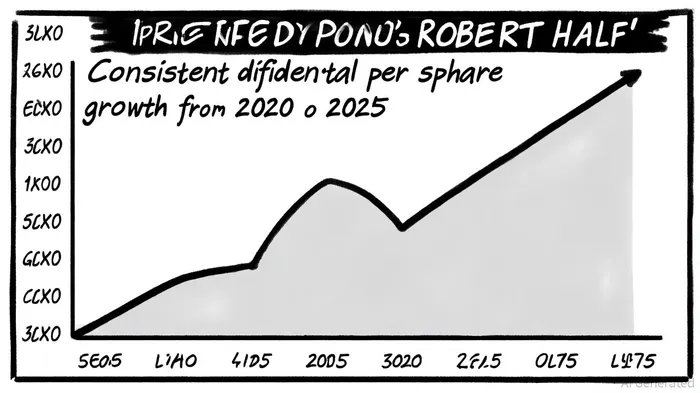
For income-focused investors, RHI's dividend history is a standout feature. The company has raised its dividend for 19 consecutive years[3], with a compound annual growth rate (CAGR) of 11.64% over the past five years[2]. As of 2025, RHI's annual dividend stands at $2.36 per share, translating to a yield of 1.56%[2]. While this yield may appear modest compared to riskier high-yield stocks, its consistency and growth trajectory make it a reliable income source.
Historically, RHI has demonstrated resilience in dividend preservation during downturns. During the 2008 financial crisis, the stock fell 48% from its peak but recovered 77% by early 2010[2]. Similarly, in 2020, the stock lost 42% amid the pandemic but rebounded 32% following stimulus measures[2]. These recoveries were underpinned by RHI's low debt load and diversified service offerings, which insulated it from the worst of market stress.
Defensive Positioning: Navigating Volatility with Agility
RHI's ability to adapt to economic cycles is a key differentiator. Management has emphasized its “industry-leading brand” and diversified business model as tools for navigating volatility[1]. For instance, the company's dual focus on contract and permanent staffing allows it to pivot based on client needs. During economic downturns, demand for temporary workers often declines, but RHI's Permanent Placement segment mitigates this risk by maintaining a steady flow of long-term placements.
Moreover, RHI's geographic and industry diversification—serving sectors like finance, technology, and healthcare—reduces exposure to sector-specific shocks. This broad footprint was evident in Q2 2025, where the company's revenue decline was tempered by strong performance in certain markets[3].
Conclusion: A High-Yield Safety Play in a Cyclical Sector
Robert Half's combination of a strong balance sheet, recurring revenue streams, and a 19-year dividend growth streak positions it as a rare high-yield safety play in the staffing sector. While the company faces near-term challenges, including a 7% year-over-year revenue decline[1], its historical resilience and conservative financial management suggest it is well-equipped to weather volatility. For investors prioritizing income stability and long-term growth, RHI offers a compelling case: a business that thrives on predictability, adapts to cycles, and rewards shareholders with consistent returns.





Comentarios
Aún no hay comentarios