
The High-Yield Gamble: Evaluating ULTY's Dividend Amid Risky Returns
The YieldMax Ultra Option Income Strategy ETF (ULTY) has long captivated income-focused investors with its audacious promise of high yields. On September 12, 2025, the fund distributed a dividend of $0.0928 per share, a 3.11% increase from the prior week's payout [1]. At first glance, this appears to validate ULTY's strategy of generating income through synthetic covered call options on U.S. equities. However, a deeper analysis reveals a more nuanced picture: the fund's 132.24% annualized forward dividend yield [2] is both a lure and a warning, masking structural risks that could undermine long-term returns.
Performance: A Tale of Two Metrics
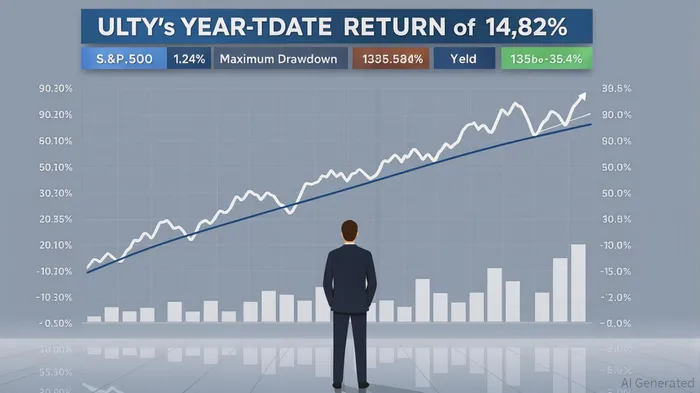
ULTY's year-to-date (YTD) return of 14.32% as of August 31, 2025, is impressive on paper [3]. Yet this figure obscures a 1-month loss of -1.23% [3], underscoring the volatility inherent in its options-based strategy. The fund's high expense ratio of 1.14% [3]—nearly triple the average for equity ETFs—further erodes returns.
Risk-adjusted metrics tell a starker story. ULTY's Sharpe ratio of 0.50 lags the broader market's 0.95 [3], while its Sortino ratio (0.81) and Calmar ratio (0.52) trail the market's 1.40 and 0.91, respectively [3]. These ratios measure returns relative to downside risk and drawdowns, highlighting ULTY's inefficiency in compensating investors for the volatility they endure.
Volatility: The Double-Edged Sword
ULTY's strategy thrives on market turbulence, as its synthetic covered calls generate income when underlying securities fluctuate [4]. However, this dependence also exposes the fund to sharp corrections. On April 8, 2025, ULTYULTY-- hit a maximum drawdown of 26.84% [3], a decline that took 52 trading days to recover. As of September 17, 2025, the fund remains in a 3.78% drawdown [3], suggesting ongoing fragility.
The September 2025 dividend increase, while enticing, raises questions. A 3.11% weekly rise in payouts [1] implies aggressive income generation, but this could strain the fund's liquidity if market conditions deteriorate. Investors must ask: Is ULTY's yield sustainable, or is it a function of forced asset sales during downturns?
Historical backtests of ULTY's dividend-announcement events from 2022 to 2025 reveal a mixed picture. While the fund showed an average 1-day post-announcement return of +2.16% with a 57% win rate, this positive edge faded rapidly. By day 10, cumulative returns turned negative (-8.95%), and the fund underperformed the benchmark for the remainder of the 30-day window. These findings suggest that short-term optimism around dividend announcements often reverses, compounding the risks for investors relying on ULTY's yield as a stable income source.
The Yield Paradox
ULTY's 132.24% dividend yield [2] dwarfs the S&P 500's 1.2% yield, making it a magnet for desperate income seekers. Yet this figure is artificially inflated by the fund's options strategies, which prioritize short-term payouts over capital preservation. As one analyst notes, “ULTY's yield is a mirage—it reflects the cost of volatility, not the value of dividends” [5].
Conclusion: A High-Stakes Proposition
ULTY's $0.0928 dividend is a signal, but not a clear one. It reflects the fund's ability to generate income in volatile markets, yet its risk-adjusted returns and drawdowns suggest a strategy more akin to speculation than disciplined investing. For investors with a high risk tolerance and a short time horizon, ULTY may offer a thrilling ride. But for those seeking stable, compounding returns, the fund's volatility and fees make it a perilous bet.







Comentarios
Aún no hay comentarios