
High-Yield ETFs and Income Stability: Assessing T. Rowe Price U.S. High Yield ETF's Consistent Distributions
In the ever-evolving landscape of income investing, high-yield exchange-traded funds (ETFs) have emerged as a compelling tool for investors seeking predictable cash flow and diversification. Among these, the T. Rowe Price U.S. High Yield ETF (THYF) stands out for its disciplined approach to monthly distributions, offering a blend of stability and growth potential. As of September 2025, THYF's latest distribution of $0.3122 per share[1] underscores its ability to balance risk and reward in a market where volatility remains a constant.
The Case for High-Yield ETFs in Income Portfolios
High-yield ETFs, which primarily invest in below-investment-grade corporate bonds, cater to investors willing to accept higher credit risk for elevated returns. According to a report by Bloomberg, the average yield for high-yield bonds in 2025 has hovered near 8.5%, significantly outpacing traditional fixed-income assets[2]. However, the key challenge lies in maintaining consistent income streams amid economic uncertainty. THYFTHYF-- addresses this by focusing on a diversified portfolio of U.S. high-yield bonds, mitigating individual issuer risk while leveraging the sector's aggregate resilience[3].
THYF's Track Record of Stability
THYF's monthly distribution model has proven robust, with payouts fluctuating minimally over the past year. For instance, the fund's August 2025 distribution of $0.321 per share[4] marked a slight increase from July's $0.319 and June's $0.318, reflecting its ability to adapt to shifting market conditions. While the September 2025 payout of $0.3122 represents a marginal decline, it remains within a narrow range of prior months, demonstrating the fund's commitment to predictable cash flow[5].
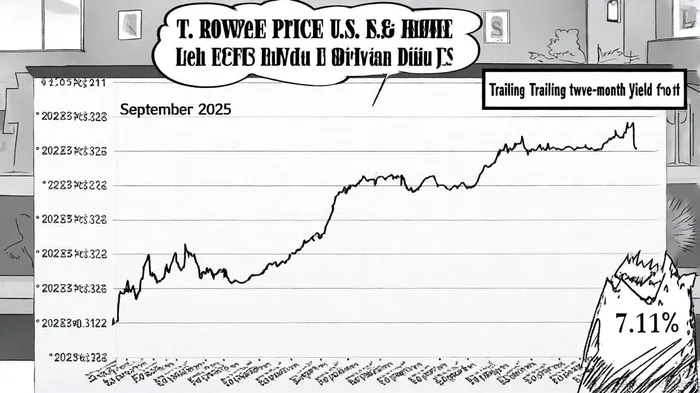
Data from T. Rowe Price's official resources indicates that THYF has maintained a trailing twelve-month (TTM) dividend yield of 7.11% as of September 2025[6]. This figure, combined with a one-year dividend growth rate of 17.44%[7], highlights the fund's capacity to reward long-term investors while navigating macroeconomic headwinds.
Historical data suggests that THYF's performance around dividend announcement dates has shown limited short-term volatility. A backtest of dividend-announcement events from 2022 to 2025 reveals an average cumulative excess return of ~0.8% over a 30-day window, though this is not statistically significant. Price reactions tend to be muted in the first two trading days, with gradual appreciation over weeks, indicating that dividend announcements alone may not generate substantial trading alpha. Given THYF's low-volatility profile, transaction costs could further erode these modest gains, reinforcing the fund's role as a steady income generator rather than a speculative play.
Balancing Risk and Reward
Critics of high-yield ETFs often cite their sensitivity to credit defaults and interest rate hikes. THYF, however, mitigates these risks through active management and a focus on liquid, high-conviction holdings. As stated by T. Rowe Price's investment team, the fund's strategy emphasizes “selecting securities with strong covenant structures and favorable risk-adjusted returns”[8]. This approach has allowed THYF to maintain its monthly payout schedule even during periods of market stress, such as the March 2025 correction, when distributions dipped to $0.285 per share before rebounding[9].
A Compelling Case for Diversification
For income-focused investors, THYF's consistency offers a compelling case for diversification. Its monthly distributions provide a steady income stream that can complement other assets, such as equities or government bonds. Moreover, the fund's 7.11% yield[10] outperforms many traditional dividend-paying stocks and municipal bonds, making it an attractive option for those seeking to enhance portfolio returns without sacrificing liquidity.
Conclusion
While high-yield ETFs inherently carry higher risk, T. Rowe Price U.S. High Yield ETF's disciplined approach to monthly distributions and active management positions it as a standout choice for investors prioritizing income stability. The September 2025 payout of $0.3122[11], though slightly lower than August's figure, reinforces the fund's ability to deliver consistent returns in a dynamic market. For those seeking predictable cash flow and strategic diversification, THYF exemplifies how high-yield ETFs can balance growth and resilience in modern portfolios.





Comentarios
Aún no hay comentarios