
High-Yield ETF Strategies for Passive Income in 2026: Options-Based vs. Traditional Dividend ETFs
In 2026, investors seeking passive income face a critical choice: pursue high-yield options-based ETFs like QQQIQQQI--, JEPQJEPQ--, SPYISPYI--, and MSTYMSTY--, or stick with traditional dividend-focused funds such as SCHDSCHD-- and VIG. Both approaches offer distinct advantages and risks, shaped by market conditions, tax efficiency, and investor risk tolerance. This analysis breaks down the trade-offs to help investors align their strategies with their financial goals.
The Allure of Options-Based Income ETFs
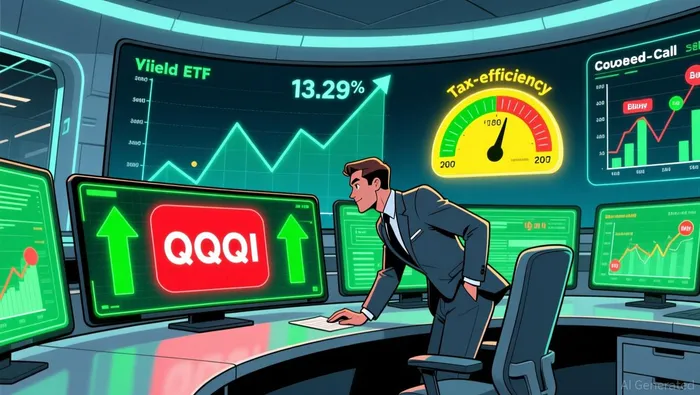
Options-based ETFs have gained traction for their ability to generate outsized yields through structured strategies like covered calls and synthetic long positions. For instance, QQQI (NEOS NASDAQ-100 High Income ETF) leverages a covered-call strategy on the Nasdaq 100, delivering a trailing yield of 13.29% as of 2025, with an expense ratio of 0.68%. Similarly, JEPQ (JPMorgan Nasdaq Equity Premium Income ETF) employs out-of-the-money call options to produce a 10.17% yield at a lower 0.35% expense ratio according to analysis. These funds benefit from Section 1256 tax treatment, which splits gains into 60% long-term and 40% short-term capital gains, offering a tax edge over ordinary income.
 However, the high yields come with caveats. MSTY (Yieldmax MSTR Option Income Strategy ETF), for example, boasts a yield exceeding 100% but is tied to MicroStrategy's stock, a high-risk, high-volatility asset. Its 0.99% expense ratio is also notably higher than traditional dividend ETFs according to data. Meanwhile, SPYI (NEOS S&P 500 High Income ETF) balances moderate risk with an 11-12% yield and 0.68% expense ratio, though its performance hinges on the S&P 500's stability according to reports.
A key advantage of these funds is their return-of-capital (RoC) structure. In 2024, 95.8% of QQQI's distributions and 93.91% of SPYI's were classified as RoC, deferring taxable events until shares are sold. This makes them attractive for tax-conscious investors, though it's important to note that RoC reduces the cost basis of holdings, potentially increasing future capital gains taxes.
Traditional Dividend ETFs: Stability Over Spectacle
Traditional dividend ETFs like SCHD (Schwab U.S. Dividend Equity ETF) and VIG (Vanguard Dividend Appreciation ETF) prioritize long-term dividend growth and lower volatility. SCHD, with a 3.72% SEC yield and 0.06% expense ratio, focuses on high-dividend-yield stocks, while VIG emphasizes dividend-appreciating companies with a 1.70% yield and identical 0.06% expense ratio.
Performance data from 2025 highlights their contrasting profiles: VIG outperformed SCHD with a 12.89% one-year return versus 9.48%, though both delivered similar long-term gains. Volatility metrics also diverge, with SCHD exhibiting 2.68% volatility compared to VIG's 2.44%, reflecting SCHD's concentration in high-yield sectors like utilities and real estate.
These funds appeal to conservative investors seeking predictable income and capital preservation. However, their yields pale in comparison to options-based ETFs, and they lack the tax-advantaged structures of their alternatives.
Risk, Cost, and Tax Efficiency: A Direct Comparison
The trade-offs between these strategies crystallize when comparing key metrics:
- Yield: Options-based ETFs (10-100% yield) dwarf traditional dividend ETFs (1.70-3.72%), but the former's yields are often inflated by RoC and synthetic structures.
- Expense Ratios: Traditional ETFs (0.06%) are significantly cheaper than options-based funds (0.35-0.99%), though the latter's higher costs are offset by yield generation.
- Risk Profiles: MSTY's exposure to MicroStrategy and the inherent volatility of options strategies make it unsuitable for risk-averse investors. In contrast, SCHD and VIG offer more predictable, albeit lower, returns.
- Tax Efficiency: Options-based ETFs benefit from Section 1256 treatment and RoC, while traditional ETFs distribute ordinary dividends, which are taxed at higher rates.
Strategic Implications for 2026
For investors prioritizing tax efficiency and high yield, options-based ETFs like QQQI and JEPQ are compelling, particularly in taxable accounts. However, their complexity and risk require careful due diligence. MSTY, while tempting with its astronomical yield, is best reserved for aggressive investors with a deep understanding of MicroStrategy's business model.
Conversely, traditional dividend ETFs remain ideal for those seeking simplicity, stability, and long-term growth. VIG's focus on dividend-appreciating companies aligns with a buy-and-hold philosophy, while SCHD's high-yield tilt suits retirees needing immediate income.
A balanced approach might involve allocating a portion of a portfolio to options-based ETFs for yield enhancement and another to traditional dividend ETFs for downside protection. As always, diversification and alignment with personal risk tolerance are paramount.
Conclusion
The 2026 income landscape offers no one-size-fits-all solution. Options-based ETFs deliver eye-catching yields and tax advantages but demand a nuanced understanding of options mechanics and market risks. Traditional dividend ETFs, while less glamorous, provide a bedrock of stability in uncertain times. By evaluating these strategies through the lenses of yield, cost, risk, and tax efficiency, investors can tailor their passive income approaches to thrive in 2026 and beyond.





Comentarios
Aún no hay comentarios