
High-Yield Energy Dividend Stocks in the Vanguard High Dividend Yield ETF: A 2026 Guide to Sustainable Income Growth
The Vanguard High Dividend Yield ETFVYM-- (VYM) has long been a go-to vehicle for income-focused investors seeking exposure to high-yield equities. Among its most significant holdings are energy sector giants, which collectively account for 8.3% of the fund's assets according to Nasdaq analysis. As of November 2025, ExxonMobilXOM-- (XOM), ChevronCVX-- (CVX), and ConocoPhillipsCOP-- (COP) stand out as the largest energy contributors, with allocations of 2.35%, 1.4%, and 0.5%, respectively per Nasdaq reporting. These companies, alongside Phillips 66PSX-- (PSX) and WilliamsWMB-- (WMB), form the backbone of VYM's energy portfolio. Their dividend sustainability and growth potential are critical to the fund's long-term appeal for income investors. This analysis evaluates their financial health, strategic priorities, and capacity to deliver consistent returns beyond 2030.
ExxonMobil: A Legacy of Dividend Growth and Operational Discipline
ExxonMobil remains a cornerstone of VYM's energy holdings, with its 2.35% weight reflecting its status as a global energy leader. The company's recent 4% dividend increase, extending its 43-year consecutive growth streak, underscores its commitment to shareholder returns according to The Globe and Mail. This growth is underpinned by a robust capital plan: ExxonMobil projects $28–$33 billion in annual capital expenditures from 2026 to 2030, targeting high-return, low-cost-of-supply projects per investor reports. By 2030, the company aims to generate $25 billion in additional earnings and $35 billion in cash flow, ensuring ample resources for dividends and buybacks as outlined in corporate guidance.
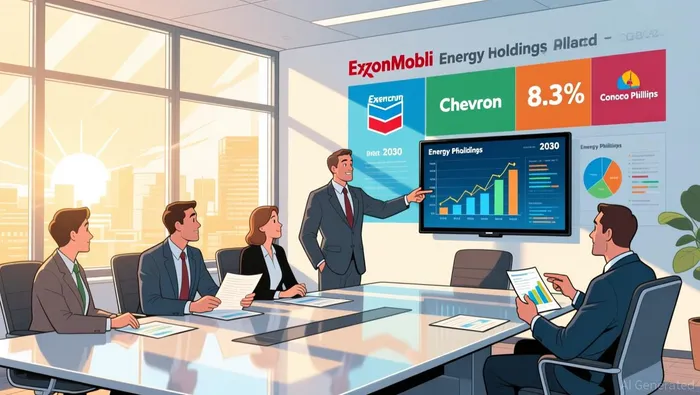 Beyond 2030, ExxonMobil's strategy emphasizes production expansion and energy transition. The company plans to boost upstream production to 5.5 million oil-equivalent barrels per day by 2030, with 65% of output from low-cost assets like the Permian Basin and Guyana as detailed in its 2025 plan. Simultaneously, it is investing $30 billion in lower-emission opportunities between 2025 and 2030, including a hydrogen facility in Baytown and large-scale carbon capture projects according to Nasdaq coverage. These initiatives not only align with global decarbonization trends but also position ExxonMobil to maintain profitability in a shifting regulatory landscape.
Chevron: Balancing Production Growth and Climate Innovation
Chevron's 1.4% allocation in VYMVYM-- highlights its role as a stable, high-yield energy play. The company's 38-year dividend growth streak, coupled with a 4.6% yield, makes it a compelling choice for income investors as reported by The Globe and Mail. Chevron's 2026–2030 guidance includes a 10%+ compound annual growth rate in free cash flow, driven by projects like the Ballymore oil field in the Gulf of Mexico and offshore developments in Cyprus as detailed in Yahoo Finance. These projects are expected to add 300,000 barrels per day of production by 2027 according to the same report.
Chevron's energy transition strategy is equally robust. The company is advancing renewable fuels and carbon capture technologies, with a focus on reducing the carbon intensity of its operations as reported by Nasdaq. Its long-term vision includes leveraging its scale to become a leader in lower-carbon energy solutions, ensuring relevance in a net-zero world. With a strong balance sheet and disciplined capital allocation, Chevron appears well-positioned to sustain its dividend growth trajectory.
ConocoPhillips: Resilient Free Cash Flow and Strategic Efficiency
ConocoPhillips, a 0.5% holding in VYM, has demonstrated resilience through its 8% dividend increase in 2025 as reported by The Globe and Mail. The company's preliminary 2026 guidance includes $12 billion in capital expenditures and $10.2 billion in adjusted operating costs, with production growth of 0–2% according to company announcements. This disciplined approach has generated $4.7 billion in cash flow from operations in Q2 2025, with expectations of stronger free cash flow by 2029 as noted in financial reports.
ConocoPhillips' long-term strategy emphasizes low-cost supply and climate risk management. The company aims to reduce greenhouse gas emissions intensity by 50–60% from 2016 levels by 2030 as stated in sustainability reports. Additionally, it is investing in LNG and low-carbon technologies to diversify its portfolio. These efforts, combined with its strong cost-reduction initiatives, reinforce its ability to sustain dividends even in volatile markets.
Phillips 66 and Williams: Midstream Strength and Energy Transition
Phillips 66 (0.3% in VYM) and Williams (0.4% in VYM) represent the midstream segment of the energy sector, offering distinct advantages. Phillips 66's $2.4 billion 2026 capital budget focuses on expanding midstream and refining operations, including the Iron Mesa gas processing plant and Coastal Bend NGL pipeline as detailed in investor reports. These projects are expected to enhance operational efficiency and secure its position in the NGL sector. The company's 157% total shareholder return over five years according to Yahoo Finance reflects its ability to balance dividends with growth.
Williams, meanwhile, has a 2.37x dividend coverage ratio based on available funds from operations (AFFO), ensuring strong dividend sustainability as reported by investor updates. Its strategic investments in natural gas infrastructure, including the Transco and Gulf assets, align with growing demand from AI-driven data centers according to Klover AI analysis. Williams' climate goals-30% reduction in Scope 1 and 2 emissions by 2028 and net-zero by 2050 as outlined in company sustainability reports-further underscore its adaptability to regulatory and market shifts.
Conclusion: A Diversified Energy Portfolio for Sustainable Income
The energy holdings in VYM offer a compelling mix of legacy producers and midstream innovators, each with strong dividend growth potential and long-term strategic clarity. ExxonMobil and Chevron provide stability through production growth and energy transition, while ConocoPhillips and Phillips 66 leverage operational efficiency and midstream expansion. Williams' infrastructure-focused approach complements these dynamics, ensuring resilience in a decarbonizing world.
For income investors, these companies collectively represent a diversified, high-yield energy portfolio capable of sustaining dividends through 2030 and beyond. Their alignment with global energy trends-whether through carbon capture, renewable fuels, or AI-driven infrastructure-positions them to deliver both income and capital appreciation in the years ahead.







Comentarios
Aún no hay comentarios