
High-Yield Crypto ETFs: Evaluating the Sustainability and Strategy of YieldMax's LFGY
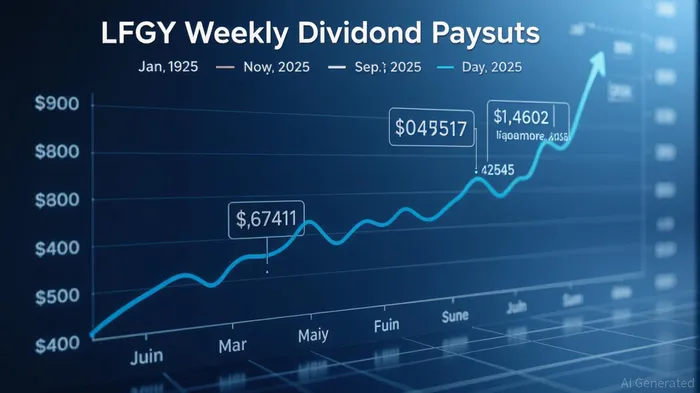
The crypto-related ETF space has become a battleground for high-yield strategies, with investors increasingly drawn to products that promise outsized returns amid a volatile macroeconomic environment. Among these, the YieldMax Crypto Industry & Tech Portfolio Option Income ETF (LFGY) stands out for its aggressive approach to generating income through options strategies and its focus on crypto-adjacent equities. However, the sustainability of its recent $0.4602 dividend—projected for September 19, 2025—raises critical questions about the fund's long-term viability and alignment with broader market trends.
Strategic Positioning: Options, Holdings, and Volatility
LFGY is an actively managed ETF that avoids direct exposure to digital assets like BitcoinBTC-- but instead targets companies positioned to benefit from the crypto ecosystem, including Coinbase GlobalCOIN--, MicroStrategy, and the iShares Bitcoin Trust ETF[2]. The fund employs options strategies such as collars, diagonals, and calendars to generate income[2], a tactic that amplifies yield potential but introduces complexity and volatility.
Data from DivvyDiary highlights the erratic nature of LFGY's dividend payouts: a 59.1% surge to $0.7511 on May 9, 2025, followed by a 36.8% drop to $0.4747 just a week later[3]. The most recent distribution on August 29, 2025, was entirely classified as a return of capital, underscoring the fund's reliance on non-income sources to maintain its high-yield facade[1]. While this approach may attract income-hungry investors, it risks eroding the fund's net asset value (NAV) over time, particularly if market conditions turn adverse.
Sustainability of the $0.4602 Dividend: A Double-Edged Sword
The projected $0.4602 payout for September 19, 2025, appears modest compared to the fund's peak payouts but remains part of a broader pattern of leveraging return of capital to sustain yields. According to YieldMax's disclosures, LFGY's distributions are a mix of ordinary dividends, capital gains, and return of capital[1]. This structure allows the fund to report a high annualized yield (34.89% as of recent data[3]) while masking the fact that a significant portion of returns may represent principal repayment rather than earnings.
The 30-Day SEC Yield of 0.43% as of August 31, 2025[1], further complicates the picture. This metric, which standardizes yield calculations, suggests that the fund's income-generating capacity is far lower than its headline figures imply. For investors, this discrepancy highlights the importance of scrutinizing the composition of distributions rather than relying solely on annualized yield metrics.
ESG Considerations: A Weakness in a Greening Market
LFGY's strategic positioning is further complicated by its poor ESG credentials. The fund holds an ESG score of 4.23 out of 10, placing it in the bottom 5% of global funds and the bottom 2% of its peers[3]. Its weighted average carbon intensity of 507.53 tons of CO2e per $M sales is alarmingly high, particularly in an era where regulatory and investor pressure for decarbonization is intensifying[3]. Additionally, the fund has no exposure to sustainable impact solutions or socially responsible investment (SRI) exclusion criteria, making it a poor fit for ESG-conscious portfolios[3].
Morningstar's absence of an ESG Commitment Level Asset Manager rating for LFGYLFGY-- underscores the fund's lack of alignment with emerging sustainability standards[1]. As global markets increasingly prioritize green finance, LFGY's ESG profile could deter a growing segment of investors, potentially limiting its long-term appeal.
Conclusion: High Yield at What Cost?
The YieldMax Crypto Industry & Tech Portfolio Option Income ETF exemplifies the allure and risks of high-yield crypto-related ETFs. While its options-driven strategy and focus on crypto-adjacent equities offer compelling income potential, the reliance on return of capital and weak ESG metrics raise concerns about sustainability. The projected $0.4602 dividend, though lower than recent peaks, continues this pattern, suggesting that investors may be trading long-term stability for short-term returns.
For those seeking yield in the crypto space, LFGY presents a high-risk, high-reward proposition. However, the fund's volatility, NAV erosion risks, and ESG shortcomings necessitate a cautious approach. As the market evolves, the true test of LFGY's strategy will lie in its ability to balance income generation with capital preservation—and to adapt to a world where sustainability is no longer optional.







Comentarios
Aún no hay comentarios