
High-Yield Credit Opportunities in a Rising-Rate Environment: Strategic Positioning for Income Resilience
In a rising-rate environment, high-yield credit markets have emerged as a compelling arena for income-focused investors. As central banks navigate inflationary pressures and economic resilience, the high-yield sector offers a unique blend of yield, credit quality, and strategic flexibility. This article explores how investors can position portfolios to capitalize on these opportunities while mitigating risks, drawing on recent market trends and expert strategies.
Macroeconomic Backdrop and Sector Resilience
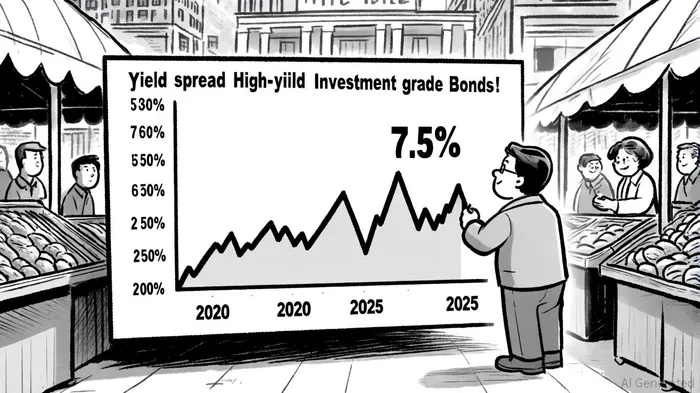
The U.S. economy's projected 2% growth in 2025, supported by robust consumer spending and cooling inflation, provides a stable foundation for high-yield credit[1]. Yields on U.S. high-yield bonds reached 7.5% at the end of 2024, significantly outpacing investment-grade counterparts[2]. This yield premium, coupled with historically low default rates and improved credit fundamentals, positions high-yield bonds as a cornerstone for income resilience. However, dispersion across the sector remains elevated, underscoring the need for active management[2].
Strategic Sector Rotation: Capitalizing on Structural Strengths
Sector rotation has proven effective in navigating rising-rate environments. Energy, technology, and healthcare sectors have outperformed in recent years due to strong fundamentals and growth prospects[3]. Conversely, sectors like retail and commercial real estate face structural challenges, including elevated leverage and exposure to interest rate sensitivity[3].
The HYSA Sector Rotation ETF, launched in 2023, exemplifies this approach by dynamically allocating to resilient sectors such as industrials, telecom/media/tech, and consumer cyclicals[4]. Academic research supports the efficacy of such strategies, showing that sector rotation based on interest rate cycles can outperform traditional buy-and-hold approaches[4]. For instance, services and utilities sectors are highlighted for their limited exposure to tariffs and strong cash flow profiles, aligning with long-term secular trends like the energy transition[2].
Credit Selection: Prioritizing Quality and Active Management
Active credit selection is critical in a rising-rate environment. Investors should focus on "second-tier" issuers in the BB and B rating categories, which offer more attractive risk-adjusted returns compared to overvalued higher-rated names[4]. Over 40% of the high-yield market is now secured by underlying assets, enhancing creditworthiness[2]. Additionally, the proportion of double-B-rated issuers in the index is at an all-time high, reflecting structural improvements in the sector[2].
Sectors with strong cash flow generation, such as utilities and industrials, are particularly well-positioned to withstand rate hikes. Conversely, sectors with weaker balance sheets, like real estate, require cautious exposure due to their vulnerability to tightening financial conditions[3].
Duration Management: Balancing Yield and Rate Risk
Duration management plays a pivotal role in mitigating interest rate risk. Short-duration high-yield bonds offer a compelling yield-to-duration trade-off, with "pull-to-par" effects reducing default risk as maturity approaches[2]. For example, short-duration bonds have historically delivered strong risk-adjusted returns, especially in environments where central banks engineer soft landings through rate cuts[4].
However, the decision to extend or shorten duration depends on macroeconomic outlooks. While short-duration strategies limit exposure to rate volatility, long-duration bonds may offer attractive real yields if rate cuts materialize[5]. Active managers can dynamically adjust duration relative to benchmarks, underweighting duration in rising-rate scenarios to outperform as yields increase[1].
Conclusion: A Holistic Approach to Income Resilience
High-yield credit markets in 2025 present a unique confluence of yield, credit quality, and strategic flexibility. By leveraging sector rotation, active credit selection, and duration management, investors can enhance income resilience while navigating macroeconomic uncertainties. As policy shifts and sector dynamics evolve, a disciplined, active approach will remain essential to unlocking the sector's full potential.







Comentarios
Aún no hay comentarios