
The High-Stakes Game of DEX Bot Security: Navigating Risks and Opportunities in DeFi 2025
In 2025, decentralized finance (DeFi) has reached a critical inflection point. The rise of DEX bots-automated trading agents that execute arbitrage, liquidity provision, and market-making strategies-has transformed the DeFi landscape. However, this innovation comes with a shadow: a surge in security breaches and vulnerabilities that threaten to undermine trust in the ecosystem. For investors, understanding the interplay between emerging risks and nascent solutions is key to navigating this high-stakes arena.
The Risks: A $3.1 Billion Problem
The past year has exposed glaring weaknesses in DEX bot infrastructure. According to a report by Yellow.com, DEX exploits cost $3.1 billion in 2025 alone, driven by flash loan attacks, oracle manipulation, and logic-level smart contract flaws. One of the most illustrative cases is BunniDEX, which lost $8.4 million in a single attack exploiting a vulnerability in its liquidity distribution function-despite having undergone security audits as highlighted in the same report. This underscores a sobering reality: even well-audited protocols are not immune to sophisticated exploits.
Reentrancy attacks, a classic vulnerability in smart contracts, have also resurfaced with devastating consequences. Data from Medium indicates that reentrancy attacks alone accounted for $420 million in losses in 2025. These attacks exploit the sequential execution of blockchain transactions to repeatedly drain funds from vulnerable contracts. Meanwhile, CrediX and Odin.fun suffered $4.5 million and $7 million in losses, respectively, due to weak access management and logical errors in their AMM (Automated Market Maker) code as detailed in a comprehensive review.
A particularly alarming trend is the normalization of private key exposure. As OKX CEO Star Xu warned, many DEX bot platforms require users to upload private keys to centralized servers, creating a honeypot for hackers. The Nova Trading Platform breach in September 2025, where $500,000 was drained via a manual attack, exemplifies how even non-smart contract vulnerabilities can cripple DEX infrastructure according to Cyber Defense Magazine.
The Opportunities: Building a Safer Future
While the risks are daunting, 2025 has also seen a wave of innovations aimed at fortifying DeFi's security foundations.
1. Protocol Upgrades and Zero-Knowledge Proofs
Starknet's 2025 upgrades offer a glimpse into the future of secure DeFi. By transitioning to a Stage 1 Rollup and implementing a Decentralized Sequencer Architecture, StarknetSTRK-- has eliminated single points of failure and reduced MEV (Maximal Extractable Value) extraction as reported in its 2025 review. Additionally, the integration of the S-two prover has accelerated proving times, enabling private DeFi and verifiable AI applications as detailed in the same report. These advancements not only enhance scalability but also mitigate risks like front-running and sandwich attacks.
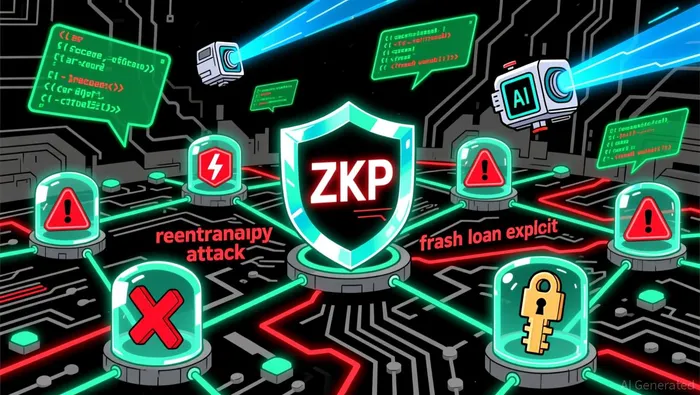
Zero-knowledge proofs (ZKPs) are another game-changer. By enabling privacy-preserving transactions, ZKPs reduce the attack surface for bots while maintaining regulatory compliance. Protocols leveraging ZKPs, such as zkRollups, are also slashing gas fees and increasing transaction throughput, making them attractive for high-frequency DEX bot activity as outlined in a recent analysis.
2. AI-Driven Risk Management
The same AI that powers DEX bots is now being weaponized for defense. AI-driven risk management systems, as outlined in a Medium article, use reinforcement learning and anomaly detection to monitor smart contract activity in real time. These tools can flag suspicious patterns-such as sudden liquidity withdrawals or oracle price manipulations-before they escalate into full-blown exploits.
For example, Quillaudits has developed AI-based auditing tools that simulate attack scenarios to uncover vulnerabilities in smart contracts as described in the same article. Such proactive measures are critical in an ecosystem where even minor logic errors can lead to catastrophic losses.
3. DeFi Insurance and Regulatory Frameworks
As losses mount, DeFi insurance is emerging as a critical risk-mitigation layer. Regulatory developments in 2025 now require crypto firms to carry insurance against cyberattacks and operational failures. Protocols like CrediX and BunniDEX are integrating insurance mechanisms to protect liquidity providers and users from financial shocks as reported by Relmin Insurance.
However, insurance is not a panacea. It remains underdeveloped for niche risks like DEX bot-specific exploits (e.g., front-running). Investors should prioritize protocols that combine insurance with robust security practices, such as multi-sig governance and trusted oracles like ChainlinkLINK-- as detailed in a comprehensive analysis.
The Path Forward: Balancing Innovation and Caution
The DEX bot ecosystem is at a crossroads. On one hand, the proliferation of bots has unlocked unprecedented efficiency and liquidity in DeFi. On the other, the $3.1 billion in losses from 2025 highlights the fragility of current infrastructure. For investors, the key is to identify projects that treat security as a core feature rather than an afterthought.
Protocols that adopt checks-effects-interactions patterns in Solidity, integrate ZKPs for privacy, and leverage AI-driven audits are well-positioned to thrive. Similarly, cross-chain solutions like PolkadotDOT-- and CosmosATOM--, which reduce reliance on single networks, offer a hedge against systemic risks as described in a top solutions analysis.
Yet, caution is warranted. The BunniDEX and Nova Trading Platform incidents remind us that even "well-audited" systems can fail. Investors should diversify their exposure, favoring protocols with transparent governance, active community oversight, and a track record of addressing vulnerabilities swiftly.
Conclusion
The DEX bot arms race is far from over. While 2025 has been a year of reckoning for DeFi security, it has also catalyzed a wave of innovation. For those willing to navigate the risks, the rewards are substantial: a more resilient, efficient, and inclusive financial system. The challenge lies in distinguishing between hype and substance-backing projects that prioritize security as much as scalability.







Comentarios
Aún no hay comentarios