
The High-Risk Trajectory of Chronic Kidney Disease and Its Implications for Biopharma and MedTech Sectors: A Goldmine for Early Detection Innovators
The global healthcare landscape is witnessing a seismic shift in how we approach chronic kidney disease (CKD), a condition that affects over 850 million people worldwide and is a silent killer lurking behind diabetes and hypertension. With the World Health Assembly's 2025 resolution prioritizing kidney health, the stakes have never been higher-and the investment opportunities, equally compelling. Let's break down why early detection and intervention technologies are not just a niche play but a high-conviction bet for biopharma and medtech investors.
The Market Is Booming-And It's Just Getting Started
The CKD early detection market is projected to balloon to $75.09 billion by 2025, growing at a compound annual rate of 6.3% according to market research. This surge is fueled by an aging population, rising diabetes prevalence, and the explosive adoption of telemedicine and AI-driven diagnostics. Blood tests currently dominate the market (49.82% share), but the real fireworks are in the pipeline: AI, multi-omics, and non-invasive tools like retinal imaging are rewriting the rules.
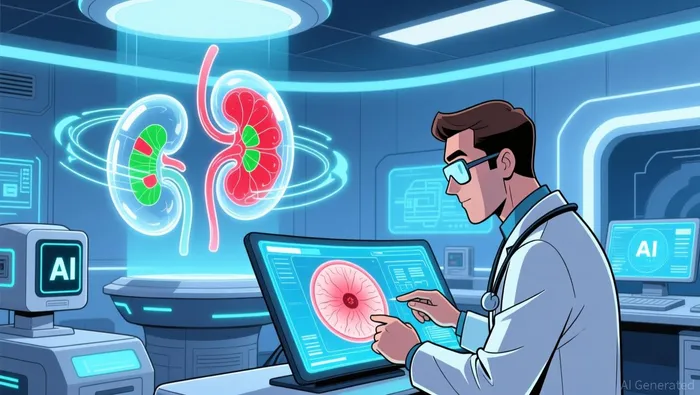
Consider this: AstraZeneca and Aptar Digital Health are teaming up to commercialize AI algorithms that detect CKD via retinal scans during routine eye exams as reported. This isn't just clever-it's a game-changer. By leveraging the microvascular similarities between the retina and kidneys, these tools can flag CKD years before traditional biomarkers like eGFR or creatinine show signs. And with diabetic retinopathy screening already a $1.2 billion market, the cross-pollination of ophthalmology and nephrology is a no-brainer.
The Tech Is Outpacing the Competition
Forget the old playbook. The new frontier in CKD detection is multi-omics and AI. Biomarkers like neutrophil gelatinase-associated lipocalin (NGAL) and kidney injury molecule-1 (KIM-1) are outperforming legacy metrics, while machine learning models like Klinrisk are predicting CKD progression with uncanny accuracy. Meanwhile, smartphone-powered home testing-as seen in a Geisinger-Highlight.io collaboration-has boosted screening rates by 250% in high-risk populations.
But the crown jewel? Retinal imaging. AstraZeneca's Reti-CKD algorithm, which uses AI to analyze retinal scans, has demonstrated superior diagnostic accuracy compared to urine tests according to a 2023 report. This is the kind of innovation that doesn't just disrupt-it redefines.
Who's Winning the Race?
Let's talk numbers. Judo Bio, a biotech unicorn, recently raised $100 million in a Series A round, valuing the company at $1.27 billion. Its STRIKE platform is delivering siRNA directly to kidney cells-a shot across the bow for traditional therapies. Meanwhile, Maze Therapeutics, fresh off a $140 million IPO in January 2025, is banking on its APOL1 inhibitor (MZE829) and SLC6A19 inhibitor (MZE782) to tackle CKD and PKU. With $264.5 million in cash and a runway through 2027, Maze is a poster child for the sector's momentum.
Partnerships are the glue holding this ecosystem together. Siemens Healthineers and Carna Health are integrating AI with point-of-care testing to democratize CKD screening in underserved regions. In Thailand, AstraZeneca's collaboration with the Department of Disease Control aims to screen 7.2 million at-risk individuals by 2027. These aren't just partnerships-they're blueprints for scalable, real-world impact.
The Risks? They're Real, But Manageable
CKD is a high-risk condition, but the same can't be said for the sector. The global push for early detection-bolstered by WHO policies and national initiatives-is a tailwind investors can't ignore. Yes, regulatory hurdles exist, but the payoff is massive: every 1% improvement in early diagnosis could prevent thousands of dialysis-dependent patients and save billions in healthcare costs.
Final Call: This Is the Time to Act
The CKD market is no longer a "maybe." It's a must-have in any investor's portfolio. From Judo Bio's $1.27B valuation to AstraZeneca's AI-driven retinal imaging, the sector is a mosaic of innovation and scalability. The question isn't whether to invest-it's how much.
As the old Wall Street adage goes: "Buy the rumor, sell the news." But in this case, the news is just getting started.







Comentarios
Aún no hay comentarios