
The High-Risk, Long-Term Viability of Re-Entering Venezuela's Oil Sector Post-Maduro
Venezuela's oil sector, once a cornerstone of global energy markets, remains a paradox of potential and peril. With the world's largest proven oil reserves, the country's energy infrastructure has deteriorated under decades of mismanagement, sanctions, and political turmoil. As of December 2025, the post-Maduro landscape is mired in uncertainty, with competing claims to power and a fractured legal framework complicating efforts to revive production. For U.S. oil firms considering re-entry, the calculus is stark: a high-risk, high-reward proposition that hinges on geopolitical stability, infrastructure rehabilitation, and the ability to navigate a volatile operating environment.
Political Instability: A Looming Shadow
The political chaos in Venezuela remains the most immediate barrier to investment. Following the U.S. military's capture of Nicolás Maduro in January 2026, the country is caught in a tug-of-war between rival factions. Delcy Rodríguez, Maduro's vice president, was sworn in as acting president by the Supreme Court, while opposition leader María Corina Machado has pushed for Edmundo González to assume power. Meanwhile, U.S. President Donald Trump has declared the U.S. will temporarily manage Venezuela, creating a surreal overlap of foreign and domestic claims to authority. This lack of a clear, stable government deters investors, as legal contracts and regulatory frameworks remain in flux. As one analyst notes, "Until Venezuela has a legitimate, internationally recognized administration, any investment will be a gamble on who controls the country next."
Legal and Operational Barriers: A Minefield of Uncertainty
Even if political clarity emerges, Venezuela's oil sector faces entrenched legal and operational challenges. The Trump administration has signaled support for U.S. firms to rebuild infrastructure, but sanctions relief remains conditional and politically sensitive. Companies with outstanding arbitration awards from previous disputes now face uncertainty about how these claims will be resolved. For example, ChevronCVX--, the only major U.S. oil company still active in Venezuela, has navigated nationalization threats before, yet its joint ventures with PDVSA remain fragile.
Infrastructure decay compounds these legal risks. 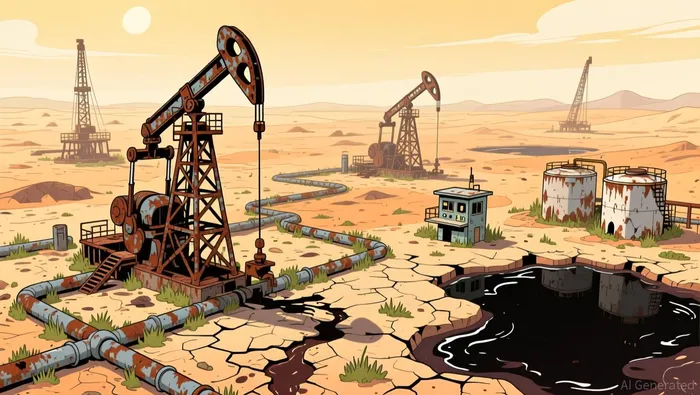 Venezuela's production capacity hovers at 800,000–1.1 million barrels per day, a fraction of its historical peak of 3.5 million barrels in the 1990s. Rehabilitation of existing fields and pipelines could add 500,000 barrels per day within two years with $10–20 billion in investment, but full-scale development would require tens of billions more. The technical challenges of extracting heavy, sour crude-requiring specialized refining capabilities-further limit the appeal of U.S. Gulf Coast refineries, which are uniquely suited to handle this oil.
The Role of Oilfield Services Companies: Enablers or Casualties?
U.S. oilfield services firms like Halliburton and Schlumberger (SLB) are positioned to play a pivotal role in Venezuela's oil revival. These companies specialize in infrastructure rehabilitation, including drilling rigs, well completion, and production optimization-critical for restoring Venezuela's output. However, their involvement is contingent on political stability and assurances against asset nationalization. For instance, Halliburton and SLB could dominate upstream and midstream work if conditions stabilize, but their willingness to invest hinges on guarantees of investment security.
Chevron, which has maintained a presence in Venezuela, is better positioned to scale up quickly than rivals like Exxon MobilXOM-- and ConocoPhillipsCOP--, which exited after nationalization in 2007. Yet even Chevron's operations are not immune to the risks of a volatile environment. As one industry executive explains, "The difference between a $10 billion and $100 billion investment lies in whether Venezuela's government can be trusted to honor contracts."
Market Dynamics: A Question of Timing and Profitability
The global oil market's oversupply and low prices-forecasted at $55 per barrel in 2026-add another layer of complexity. Venezuela's heavy crude, while abundant, is less desirable than lighter, sweeter grades, reducing its competitiveness. For U.S. firms, the incentive to invest in a high-cost, high-risk environment is further eroded by the time lag required to see returns. As a report by the Council on Foreign Relations notes, "Revitalizing Venezuela's oil sector will take years, not months, and requires a level of patience and capital that few companies are willing to commit in today's uncertain climate."
Conclusion: A Gamble on the Long-Term
The question of whether to re-enter Venezuela's oil sector ultimately boils down to risk tolerance. For investors with a long-term horizon and a tolerance for geopolitical volatility, the potential rewards are immense. Venezuela's oil reserves represent a once-in-a-generation opportunity, provided the country can stabilize and implement reforms to attract investment. However, for most firms, the combination of legal uncertainty, infrastructure decay, and political instability makes this a high-risk, low-reward proposition.
Until Venezuela establishes a credible, stable government and demonstrates a commitment to institutional reforms, the oil sector will remain a cautionary tale of potential unmet. As one industry observer concludes, "Venezuela's oil revival is possible-but only if the country's leaders stop fighting over power and start building a future."





Comentarios
Aún no hay comentarios