
The High-Risk, High-Reward Opportunity in Venezuela's Oil Sector
Venezuela's oil sector, once a cornerstone of global energy markets, now stands at a crossroads. With over 300 billion barrels of proven reserves-the world's largest-and proximity to U.S. Gulf Coast refineries, the country's hydrocarbon potential remains tantalizing. Yet, years of U.S. sanctions, political instability, and infrastructure decay have reduced production from a peak of 3.5 million barrels per day in the 1990s to less than 1 million barrels today. For private investors, the question is no longer whether Venezuela's oil sector is viable, but whether the risks of re-entry outweigh the rewards in a post-Maduro landscape.
The Sanctions-Driven Collapse and Its Aftermath
U.S. sanctions, first imposed in 2017 and expanded under the Trump administration, have crippled Venezuela's oil infrastructure. These measures blocked access to international financial systems, froze PDVSA's assets, and restricted transactions with state-owned entities. As a result, Venezuela's oil production plummeted by 1.5 million barrels per day under Maduro's rule, with most exports now flowing to China via shadow fleets at discounted rates. Even after Maduro's removal in January 2026, foundational sanctions remain in place, and companies must still avoid transactions involving PDVSA or its affiliates.
However, the U.S. has signaled a potential shift. Recent statements suggest selective rollbacks of sanctions could occur if Venezuela severs ties with China, Russia, and Iran and aligns with U.S. partners. This creates a conditional opening for private capital, though the path remains fraught with geopolitical uncertainty.
Non-U.S. Investments: Barter, Debt, and Shadow Fleets
In the absence of U.S. subsidies, non-U.S. firms have adopted creative strategies to navigate sanctions. Chinese state-owned companies like CNPC and Sinopec, for instance, have maintained their presence through barter transactions and oil-for-loan agreements. These arrangements, dating back to the Hugo Chávez era, allow Venezuela to repay Beijing with crude oil instead of cash, circumventing U.S. financial restrictions. By 2025, CNPC controlled 1.6 billion barrels of reserves, while Sinopec held 2.8 billion, despite Venezuela's production decline to 1.1 million barrels per day.
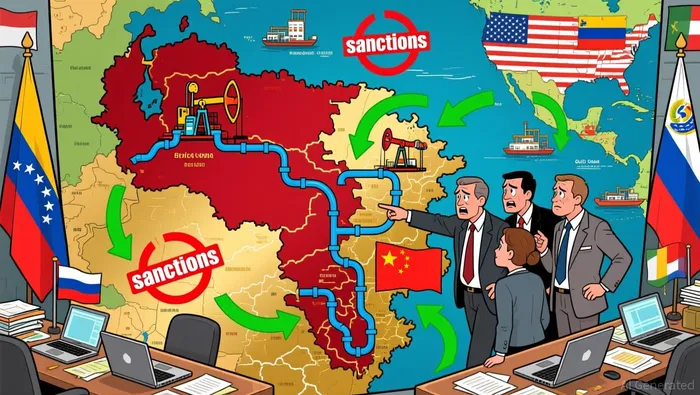
Russian firms, including Rosneft and its subsidiary Roszarubezhneft, have also persisted through loan-backed investments. However, U.S. enforcement actions-such as the 2025 seizure of the M/T Skipper tanker-highlight the risks of operating in this environment. Shadow fleets, often registered in offshore jurisdictions, have become a lifeline for Venezuela's oil exports, though these vessels face heightened scrutiny and interdiction risks.
Strategic Rationale for Private Capital
For international oil companies (IOCs), the strategic appeal of Venezuela lies in its untapped reserves and proximity to U.S. markets. A report by Bloomberg notes that restoring production to 1–1.5 million barrels per day could require $10–20 billion in investment, with a more aggressive 2.5 million-barrel target demanding $40–60 billion. While these figures are daunting, the potential rewards are equally significant. If sanctions ease and governance improves, Venezuela's oil sector could become a critical supplier to U.S. refineries, reducing transportation costs and enhancing energy security.
European and Asian firms, however, remain cautious. Eni and Repsol, for example, continue to operate under joint ventures but face unpaid debts and regulatory hurdles. Meanwhile, Chinese firms are reassessing their exposure as Venezuela's economic crisis deepens. The U.S. strategy of "energy dominance", which prioritizes upstream control over global oil supplies, further complicates the landscape for non-U.S. investors.
Risk Mitigation and the Path Forward
Investors must navigate a web of legal, geopolitical, and operational risks. U.S. sanctions compliance remains a critical concern, with OFAC enforcing strict penalties for transactions involving PDVSA or sanctioned entities. Additionally, the potential for U.S. military intervention-such as strikes on Venezuela's oil infrastructure-adds a layer of volatility.
To mitigate these risks, private capital may adopt Production Sharing Agreements (PSAs) or long-term service contracts that guarantee returns during reconstruction phases. These models allocate 60–80% of initial revenues to operators, declining to 20–40% post-stabilization. Debt restructuring, including debt-for-climate swaps, could also unlock investment by aligning resource development with environmental recovery.
Conclusion: A Calculated Gamble
Venezuela's oil sector remains a high-risk, high-reward proposition. While the U.S. has signaled conditional support for investment, the path to recovery depends on political stability, sanctions relief, and infrastructure modernization. For private capital, the key lies in balancing patience with pragmatism-leveraging alternative financing mechanisms, navigating sanctions compliance, and hedging against geopolitical shifts. As the world grapples with energy security and diversification, Venezuela's oil could once again become a strategic asset-if the right conditions align.







Comentarios
Aún no hay comentarios