
High-Potential Smart Contract Platforms in the Post-Ethereum Era
The Post-Ethereum Landscape: A New Era of Competition
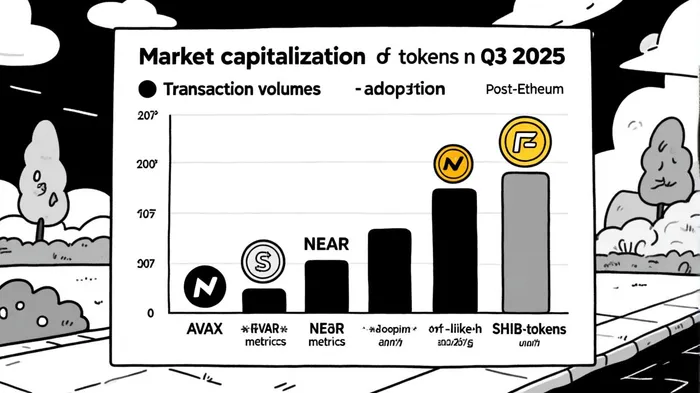
The post-Ethereum era in 2025 is defined by a shift in market dynamics, where scalability, utility, and community-driven innovation are reshaping the smart contract platform landscape. While EthereumETH-- remains a dominant force, platforms like Avalanche (AVAX) and NEAR Protocol are emerging as robust alternatives, while a new wave of SHIB-like tokens is leveraging memeMEME-- culture and speculative appeal to capture retail attention. This analysis evaluates these contenders, focusing on their technical advancements, adoption metrics, and long-term viability.
Avalanche (AVAX): Scalability and Enterprise Adoption
Avalanche has solidified its position as a high-performance Layer-1 blockchain, driven by its subnet architecture and continuous upgrades. According to a report by CoinLaw, AVAX's ecosystem saw a 21.3% increase in daily transactions in Q2 2025, reaching 3.4 million, with applications like Pulsar (an RPG game on Avalanche's subnet) contributing 1.8 million daily transactions alone [1]. The Avalanche9000 upgrade reduced transaction fees by 42.7%, while daily active addresses surged by 57% to 46,397 [1].
Institutional partnerships further bolster AVAX's utility. Collaborations with SwissBorg, Visa, and VanEck have expanded its real-world applications, including tokenized real estate and stablecoin settlements [4]. The Octane upgrade, which slashed gas fees by up to 99%, has attracted DeFi and gaming projects, enhancing throughput and affordability [4]. Retail and whale investor participation has also grown, with a 47.7% rise in addresses holding less than 100 AVAX [3]. Analysts project AVAXAVAX-- could reach $80–$100 by year-end, supported by its subnet model and enterprise integration [2].
NEAR Protocol: User Growth vs. Price Stagnation
NEAR Protocol has demonstrated impressive user adoption, becoming the second-leading Layer-1 blockchain in monthly active users (46 million in Q2 2025) [2]. Its infrastructure upgrades, including 600-millisecond block times and 1.2-second finality, position it as a top chain for AI applications [1]. However, its token price remains stagnant at $2.492, despite a 4% surge following a 12.8% correction [3].
The protocol's strengths lie in its developer-friendly environment and performance metrics, but its tokenomics and market sentiment lag behind AVAX. While NEAR's user base and transaction volume (e.g., $88.85 million in NEAR Intents swaps) are robust, its price struggles highlight the challenge of converting utility into value for investors [2].
SHIB-Like Tokens: Meme Culture Meets Speculation
The post-Ethereum era has seen a surge in SHIB-like tokens, blending meme-driven appeal with speculative utility. Key contenders include:
Wall Street Pepe (WEPE):
WEPE's migration to SolanaSOL-- and a 600% surge since June 2025 underscore its potential. The token's Solana-based migration involves burning Ethereum-based WEPE, preserving a 200B supply cap. A 18% weekly price gain and a 5,000-piece NFT collection launched in August 2025 have driven engagement [1]. However, a 37.91% 30-day drop reflects the volatility inherent in meme coins [3].Catslap (SLAP):
SLAP's slapping game has reached 1.4 billion slaps, with token burns reducing supply. The token surged 185.78% since its ICO and is projected to reach $0.0143 by year-end [4]. Strategic partnerships and Binance listings could further boost adoption [2].Solaxy (SOLX):
As a Solana Layer-2 solution, SOLX aims to reduce network congestion through off-chain bundling. Despite a 46.84% 7-day price drop, its 71% APY staking rewards and planned CEX listings (Binance, Coinbase) offer short-term appeal [5].Flockerz (FLOCK):
FLOCK's Vote-to-Earn model and AI initiatives, such as the FL Alliance and AI Agent Marketplace, highlight its utility-driven approach. The project's Q3 2025 roadmap includes federated learning frameworks and an API platform compatible with OpenAI SDKs [6].Dawgz AI (DAGZ):
Combining AI trading with meme culture, DAGZ raised $3.5 million in its presale and offers 125% growth from its TGE price. However, its long-term viability remains speculative due to a lack of concrete utility [2].
While these tokens benefit from Solana's high-speed infrastructure and viral community appeal, their sustainability depends on overcoming tokenomics challenges and regulatory scrutiny.
Comparative Analysis: Utility vs. Hype
AVAX and NEAR stand out for their structured ecosystems and real-world applications, whereas SHIB-like tokens rely on community-driven momentum. AVAX's subnet model and institutional partnerships provide a scalable foundation, while NEAR's user growth and AI focus position it as a strong contender. In contrast, SHIB-like tokens face volatility and questions about long-term utility, despite leveraging Solana's DeFi surge (e.g., $26.2 billion in meme token trading volume in July 2025) [5].
Conclusion: Strategic Investment Considerations
For investors, the post-Ethereum era presents a dichotomy: utility-driven platforms like AVAX and NEAR offer structured growth and institutional adoption, while SHIB-like tokens provide high-risk, high-reward opportunities. AVAX's ecosystem upgrades and enterprise integration make it a top-tier bet, whereas NEAR must address its price stagnation despite strong user metrics. SHIB-like tokens, while volatile, could benefit from Solana's infrastructure and meme-driven demand but require caution.
As the market evolves, the key differentiator will be sustainable utility—a factor where AVAX and NEAR currently outperform their meme-driven counterparts.






Comentarios
Aún no hay comentarios