
High-Interest Debt vs. Emergency Savings: The High-Stakes Race for Your Wallet
Let's cut to the chase: If you're staring down a mountain of high-interest debt while trying to build an emergency fund, you're not alone. But here's the brutal truth-this isn't a 50-50 toss-up. It's a high-stakes race where the loser could cost you tens of thousands in lost wealth over your lifetime. Let's break it down.
The Case for a Minimal Emergency Fund First
Before you panic, hear me out: You don't need to build a six-figure emergency fund before tackling debt. A $500–$1,000 safety net is enough to avoid the "I'll just put it on my credit card" trap during a flat tire or medical bill, according to Millennial Dollar. Why? Because a Forbes analysis shows the average credit card APR now exceeds 22%, while even the best high-yield savings accounts barely hit 4.5%. That's a 17.5% gap-your personal wealth's equivalent of a wildfire.
Data from the 2024 Federal Reserve report underlines this: 63% of Americans can cover a $400 emergency, but 13% can't cover it at all, a figure highlighted by Millennial Dollar. That's not financial resilience-that's a waiting game for disaster. A small emergency fund stops you from digging a deeper hole.
The High-Cost Trap of High-Interest Debt
Now, let's talk about the real wealth vampire: high-interest debt. Credit card companies aren't in the business of doing you favors. At 22% APR, every dollar you carry over charges you nearly 2 cents a day in interest. Over five years, that $5,000 balance becomes $8,500-assuming you make minimum payments.
Here's where the opportunity cost hits: That same $5,000 invested in a 4.5% savings account would grow to just $6,200 in five years. But if you pay off the debt, you're left with $8,500 in cash-a 70% difference. And if you invest that $8,500 instead? Let's call it a $15,000 windfall in 10 years at 7% returns. That's not financial advice-that's a wealth multiplier, as Forbes outlines.
The Federal Reserve's 2025 analysis of student loan resumptions in 2023 proves this isn't theoretical. In high-debt ZIP codes, consumer spending dropped by $80 billion annually post-payment resumption. People weren't just paying down debt-they were starving their savings, investments, and discretionary spending.
Opportunity Cost: The Long-Term Wealth Equation
Long-term wealth isn't built by saving 4.5%-it's built by eliminating negative returns. Consider this: A 30-year-old with $20,000 in credit card debt at 20% APR would spend $80,000 to pay it off over 15 years. Meanwhile, that same money invested at 7% would grow to $330,000 by age 65. That's not just a math problem-it's a generational wealth gap, as WealthKeel explains.
Academic studies back this up. A 2025 analysis of household financial behavior found that those prioritizing high-interest debt saw 3x higher net worth growth over 10 years compared to those who prioritized low-yield savings, a pattern Millennial Dollar documents. Why? Because compounding works against you when you're paying 22%, but for you when you're earning 7%.
The Strategic Balance: Waterfall, Not Jenga
Here's the playbook:
1. Automate minimum debt payments to avoid penalties, a step WealthKeel recommends.
2. Build a $500–$1,000 emergency fund to avoid new debt, per Millennial Dollar's guidance.
3. Aggressively attack high-interest debt using the "avalanche method" (pay highest-APR debt first), as advised by WealthKeel.
4. Once debt is under control, ramp up emergency savings to 3–6 months of expenses, the standard Millennial Dollar suggests.
5. Then-and only then-allocate to investments.
This isn't rigid-it's a waterfall. If your income drops or rates spike, rebalance. But the core principle holds: Negative returns must die first.
Final Call: Don't Let Debt Rob Your Future
In 2025, 42% of Americans have made "debt reduction" their top financial priority, according to Forbes. They're not wrong. Every dollar you free from high-interest debt is a dollar you can invest, save, or spend on what truly matters.
So ask yourself: Do you want to be the person shackled by 22% interest, or the one watching their investments compound? The choice isn't just about money-it's about who you become financially. 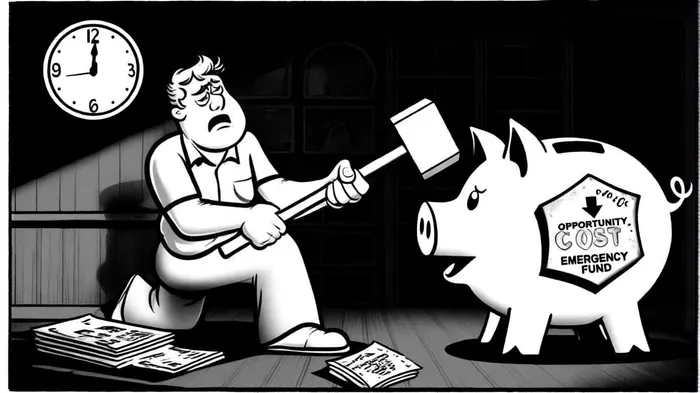







Comentarios
Aún no hay comentarios