
High-Insider-Owned Asian Growth Stocks in 2025: Alignment of Interest and Long-Term Performance Potential
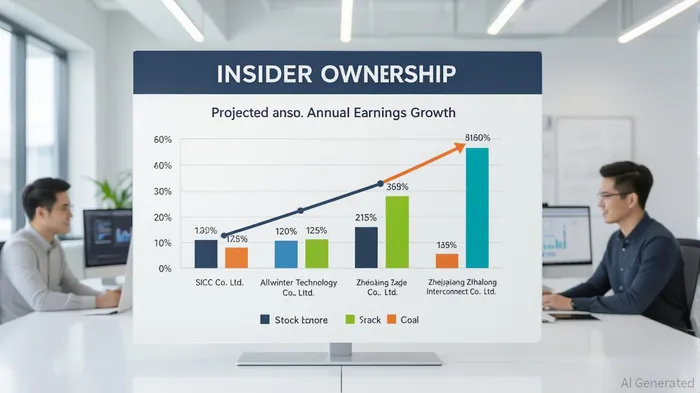
In the dynamic landscape of Asian equities, high-insider-owned growth stocks have emerged as a compelling investment theme in 2025. These companies, spanning sectors like semiconductors, robotics, and interconnect solutions, demonstrate not only robust financial performance but also a unique alignment of management and shareholder interests. This alignment, driven by significant insider ownership, is increasingly viewed as a catalyst for long-term value creation in emerging markets.
The Alignment of Interest: A Governance Advantage
When insiders hold substantial equity stakes, their incentives to prioritize sustainable growth over short-term gains become more pronounced. For instance, SICC Co., Ltd., a leader in silicon carbide semiconductor materials, boasts 26.8% insider ownership and is projected to grow earnings at 38.2% annually, outpacing the Chinese market average [1]. Similarly, Allwinner Technology Co., Ltd., with 37.4% insider ownership, forecasts 40.93% annual earnings growth, despite a lower return on equity [1]. These figures underscore how insider ownership can foster disciplined decision-making, as managers are more likely to invest in long-term projects that enhance firm value.
Academic research corroborates this trend. A global study of 10,460 corporate bonds found that higher insider ownership correlates with increased bond yield spreads, signaling potential agency costs [3]. However, in Asian markets, where governance structures often emphasize long-term orientation, this risk is mitigated. For example, Fulin Precision Co., Ltd., with 11.8% insider ownership, reported half-year revenue of CNY 5.81 billion and net income of CNY 174.46 million, with forecasts of over 50% annual earnings growth [1]. Such performance highlights the role of insider ownership in driving operational efficiency and innovation.
Long-Term Performance Potential: Beyond Short-Term Metrics
The long-term performance of high-insider-owned Asian stocks is further bolstered by strategic governance mechanisms. Zhejiang Zhaolong Interconnect Technology Co., Ltd., for instance, is expected to grow revenue at 29.3% annually and earnings at 44.92%, both exceeding Chinese market averages [1]. This growth is underpinned by insider-driven investments in R&D and market expansion, reflecting a focus on durable competitive advantages.
Moreover, governance frameworks in these firms often include performance-based executive compensation and independent boards, which align insider interests with shareholders. A report by Tikr notes that such structures reduce agency costs and enhance transparency, directly influencing firm valuation and access to capital [1]. For example, Shijiazhuang Shangtai Technology Co., Ltd., with 39.5% insider ownership, is growing revenue at 21.4% annually, demonstrating how governance can translate ownership alignment into consistent performance [2].
Mitigating Risks: Governance as a Safeguard
While high insider ownership can drive growth, it is not without risks. Empirical studies caution that excessive insider control may lead to self-interested decisions, such as over-leveraging or under-investing in innovation [3]. However, Asian firms with strong governance mechanisms—such as SK Oceanplant Ltd., which has 20.2% insider ownership and forecasts 47.3% annual earnings growth [2]—often mitigate these risks. Independent boards and shareholder rights frameworks ensure that insider decisions remain aligned with long-term value creation.
Conclusion: A Strategic Investment Opportunity
For investors seeking exposure to high-growth Asian equities, high-insider-owned stocks offer a compelling blend of alignment and performance. Companies like Vuno, with 15.6% insider ownership and a staggering 113.4% earnings growth forecast [2], exemplify the potential of this strategy. While risks exist, robust governance structures and sector-specific innovation trends position these firms to outperform broader markets. As 2025 unfolds, investors should prioritize companies where insider ownership is complemented by transparent governance and a clear long-term vision.







Comentarios
Aún no hay comentarios